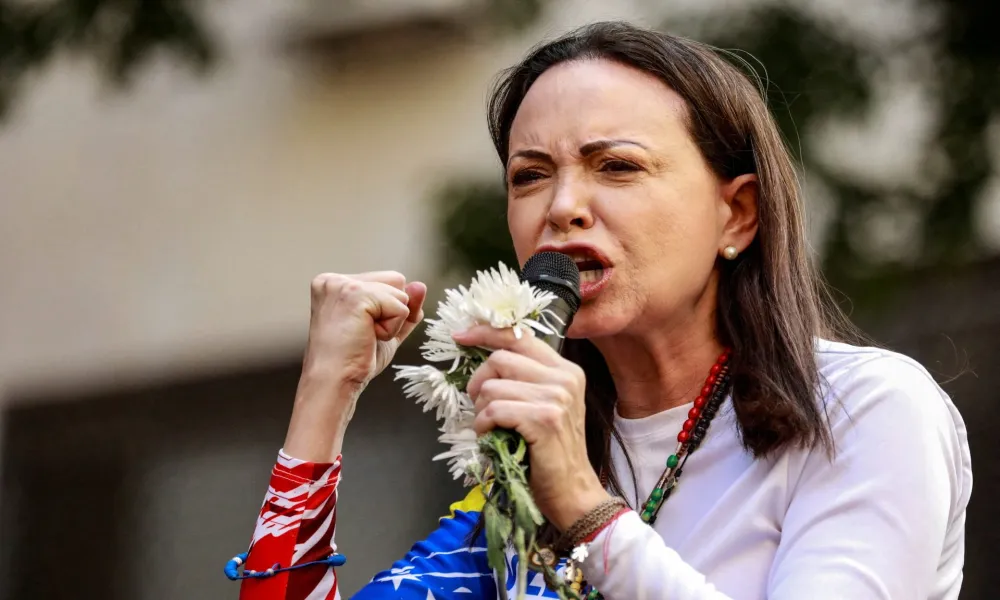
Venezuela’s leading opposition figure, María Corina Machado, has said she intends to return to the country “as soon as possible” and called for fresh elections, following the arrest of Nicolás Maduro by US authorities and the swearing-in of interim president Delcy Rodríguez.
Speaking in her first public interview since Maduro’s detention at the weekend, Machado said the opposition was ready to win a democratic vote, insisting that it had already secured a decisive victory in the disputed 2024 election.
“We won an election by a landslide under fraudulent conditions,” Machado said. “In free and fair elections, we would win more than 90% of the vote.”
Machado, 58, fled Venezuela in October in disguise to attend the Nobel Peace Prize ceremony, where she received the award on behalf of Venezuela’s opposition movement. She has not disclosed her current location and remains wanted for arrest in Venezuela, where institutions remain under the control of ruling Socialist Party loyalists.
A transition without the opposition
While Machado welcomed Maduro’s removal, she acknowledged that the United States has so far shown little inclination to back her leadership. Washington appears instead to be weighing cooperation with Rodríguez and other senior figures from the former Maduro administration, citing concerns over stability.
US President Donald Trump has publicly questioned the feasibility of holding elections in the near term, arguing that Venezuela’s institutional collapse makes a rapid vote unrealistic.
“We have to fix the country first,” Trump told NBC. “There’s no way the people could even vote.”
That position has disappointed opposition supporters and alarmed Venezuela’s large diaspora, an estimated one in five citizens who left the country during years of economic collapse under Maduro and his predecessor Hugo Chávez.
Sharp criticism of interim leadership
Machado has rejected the idea that Rodríguez could oversee a credible transition. In remarks to Fox News, she accused the interim president of being deeply implicated in repression and corruption.
“She is one of the main architects of torture, persecution, corruption and narco-trafficking,” Machado said, describing Rodríguez as closely aligned with Russia, China and Iran and lacking legitimacy among Venezuelans.
Rodríguez, a long-time Maduro ally, has condemned his arrest as a “kidnapping” while also signalling willingness to maintain pragmatic relations with Washington.
Political prisoners and security concerns
Despite official assurances of calm, tensions remain visible in Caracas. Fourteen journalists were briefly detained on Monday while covering developments linked to Maduro’s arrest, and video footage verified by Reuters showed gunfire into the air, which authorities said was intended to deter unauthorised drones.
According to local rights groups, nearly 900 political prisoners remain in detention. Machado’s Vente Venezuela movement has demanded their immediate release as a first step towards democratic restoration.
“There can be no transition without freedom,” the movement said in a statement.
Maduro in court, oil at the centre
Appearing in federal court in New York, Maduro pleaded not guilty to narcotics trafficking charges, insisting he remains Venezuela’s legitimate president. He has long denied US accusations, describing them as a pretext for foreign control over the country’s oil resources.
Venezuela holds the world’s largest proven oil reserves, estimated at more than 300 billion barrels. However, production has steadily declined due to mismanagement, sanctions and underinvestment, averaging around 1.1 million barrels per day last year.
Trump has said the United States will now help revive Venezuela’s energy sector with private investment, declaring that Washington is “in charge” of the country’s future direction.
International concern grows
The US operation, described as the most significant American intervention in Latin America since Panama in 1989, has drawn condemnation from Russia, China and several left-leaning governments in the region. Legal experts and UN officials have raised concerns over its legality and broader implications.
“It sends a signal that the powerful can do whatever they like,” a spokesperson for the UN human rights office said.
Mexican President Claudia Sheinbaum warned against repeating historical patterns. “Intervention has never brought democracy, stability or prosperity to Latin America,” she said.
As Washington weighs stability against political change, Venezuela’s opposition remains sidelined, its future uncertain despite the dramatic removal of its long-time ruler.
Source: Reuters