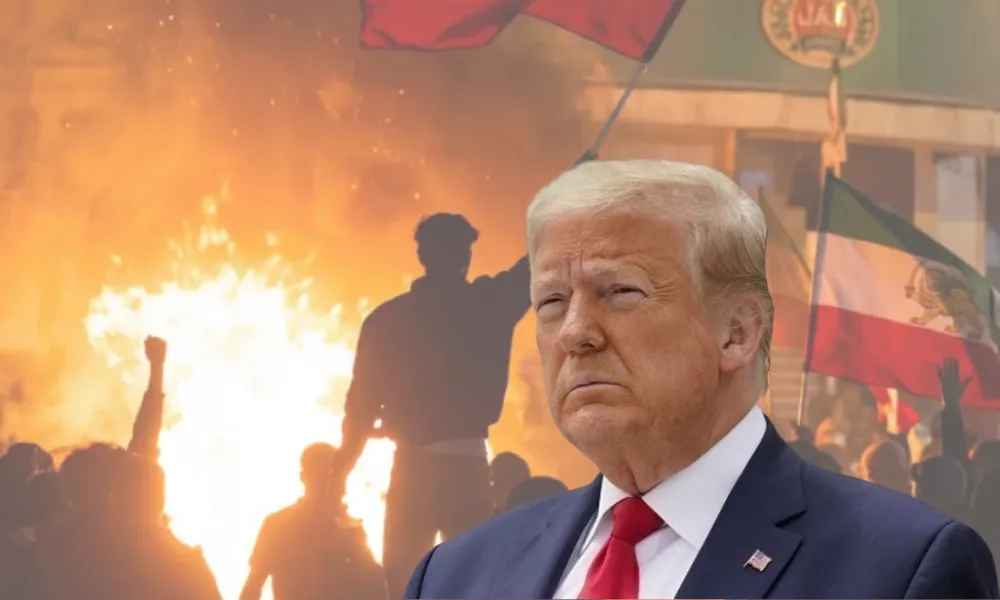
The United States appears poised to strike Iran within days, following a major deployment of American air and naval forces across the Middle East. According to the BBC, including reporting and analysis from its security correspondent Frank Gardner, the potential targets are largely predictable, but the consequences of any attack are far from certain. If no last-minute diplomatic breakthrough is reached and President Donald Trump orders US forces to act, the region could face anything from limited confrontation to prolonged instability.
1. Limited strikes and regime change
In the most optimistic scenario, US forces carry out targeted strikes against Iran’s Islamic Revolutionary Guards Corps, the Basij paramilitary force, ballistic missile sites, and elements of Iran’s nuclear programme. Civilian casualties are minimal and the weakened leadership collapses, eventually giving way to a democratic transition. The BBC notes, however, that similar assumptions made during interventions in Iraq and Libya did not lead to stable democracies, but instead to years of instability.
2. Regime survives but moderates its policies
Another possibility, described by the BBC as unlikely, is that the Islamic Republic survives US strikes but is forced to alter its behaviour. Frank Gardner compares this to a Venezuelan-style outcome, where a show of overwhelming force leaves the regime intact but constrained. In Iran’s case, this could involve curbing support for armed groups across the Middle East, scaling back its missile and nuclear programmes, and easing domestic repression. The BBC cautions that Iran’s leadership has resisted fundamental change for nearly five decades.
3. Regime collapses and military rule follows
Many analysts cited by the BBC believe a collapse of the current leadership could be followed by the emergence of a military government dominated by Revolutionary Guards figures. While the regime is unpopular, Iran’s security apparatus remains powerful and deeply invested in maintaining the status quo. Past protests have failed because of the leadership’s willingness to use extreme force and the lack of defections among elite security figures, according to Gardner.
4. Iranian retaliation against US forces and allies
Iran has repeatedly warned that it would retaliate against any US attack. The BBC reports that although Iran cannot match US military power directly, it could strike bases in Bahrain and Qatar using missiles and drones, many hidden underground. It could also target infrastructure in countries it considers complicit, such as Jordan. Gardner highlights the 2019 attack on Saudi Aramco, attributed to an Iranian-backed militia, as evidence of how vulnerable Gulf states remain.
5. Mining the Strait of Hormuz
The BBC highlights a long-standing concern that Iran could lay mines in the Gulf, particularly in the Strait of Hormuz. This narrow waterway carries around a fifth of the world’s oil and liquefied natural gas exports. During the Iran-Iraq war in the 1980s, Iran mined shipping lanes, prompting international naval operations to clear them. Any renewed mining would disrupt global trade and drive up energy prices.
6. Sinking a US warship
Frank Gardner has reported that US naval officers fear so-called swarm attacks, where large numbers of explosive drones and fast boats overwhelm ship defences. The Revolutionary Guards Navy specialises in this form of asymmetric warfare. While the BBC considers it unlikely, the sinking of a US warship would represent a serious blow to US prestige, as past incidents such as the bombing of the USS Cole in 2000 and the missile strike on the USS Stark in 1987 show.
7. Collapse followed by chaos
The analyst warns that if the Iranian regime collapses without a clear successor, the country could face civil war, ethnic conflict involving Kurds and Baluchis, and widespread disorder. Neighbouring states, including Qatar and Saudi Arabia, fear a humanitarian and refugee crisis in a country of around 93 million people. While many regional powers, including Israel, would welcome the end of the Islamic Republic, the BBC stresses that few would want to see the Middle East’s most populous nation descend into chaos.
The central risk, according to BBC's Frank Gardner, is that military action could begin without a clear end-state. Once started, a war with Iran could be unpredictable, prolonged, and have far-reaching consequences for the region and the wider world.