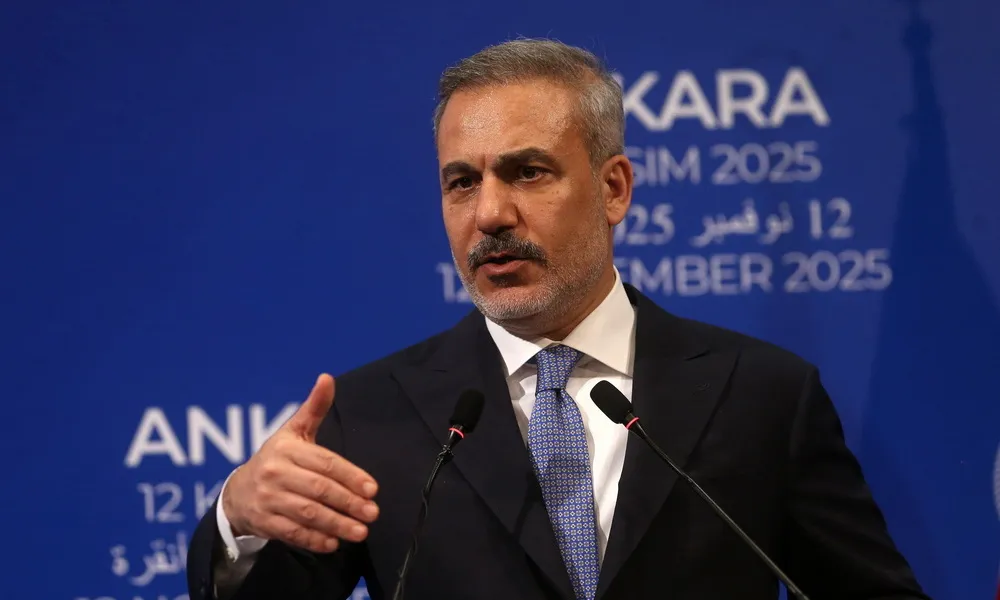
Türkiye warned on Wednesday that the escalating war between Iran and U.S.-Israeli forces could trigger a wider regional crisis affecting energy security, migration, and militant activity, as Foreign Minister Hakan Fidan said Ankara had previously attempted to delay the outbreak of the conflict through diplomatic efforts.
Speaking to Ankara bureau chiefs of media organizations during an iftar meeting, Fidan said Türkiye had worked intensively in recent weeks to prevent hostilities between Iran and its adversaries, even proposing what he described as “creative solutions.”
“We tried to prevent the war. We made serious efforts for that. We even delayed its outbreak for some time,” Fidan said. “The developments we are witnessing now carry risks not only for our region but also for global stability.”
The fighting, which has entered its sixth day with continued air and missile strikes, has heightened concerns in Ankara that the confrontation could expand beyond Iran and Israel and draw in Gulf energy infrastructure or U.S. bases across the region.
Energy and economic shock scenarios
Fidan warned that the most destabilizing scenario would involve a prolonged escalation that spreads across the region, particularly if critical energy routes are disrupted.
“The closure of the Strait of Hormuz could create serious fluctuations in global financial and energy markets,” he said, referring to the narrow waterway through which roughly a fifth of the world’s oil supply passes.
Such a development, he suggested, could place pressure on Washington to seek a rapid outcome to the conflict due to the global economic repercussions.
Another concern for Ankara is the possible interruption of Iranian natural gas supplies. Iran is one of Türkiye’s key external gas suppliers, and any disruption could complicate the country’s energy security calculations.
“If natural gas flows from Iran are cut or energy imports from Gulf countries face serious disruptions, this would create significant risks for global supply security,” Fidan said.
Turkish officials say multiple institutions are now working on contingency planning covering military, political, economic, and energy dimensions of the crisis.
“Our fundamental expectation is clear: mutual attacks must stop as soon as possible and diplomacy must resume,” Fidan said.
Iranian domestic stability and military balance
Despite the intensity of the strikes, Fidan said there were currently no signs of internal upheaval inside Iran that could threaten the survival of the government.
“At this stage we do not see a wave inside Iranian society that would produce regime change,” he said.
At the same time, he suggested that both sides appear to be pursuing strategies aimed at increasing the costs of continued fighting.
According to Fidan, Israel and the United States are seeking to weaken Iran to the point where it no longer represents a strategic threat in the future. Iran, in turn, is attempting to impose costs by targeting energy-related assets in the Gulf region and maintaining pressure on Israel through missile and drone attacks.
“Iran can seriously harass Israel if it continues to employ its missiles and drones intensively,” he said, though he added that it remained unclear how long Iran could sustain such operations.
Kurdish militant movements monitored
Turkish officials are also closely watching possible political and military movements among Kurdish groups inside Iran.
Fidan said Ankara had observed signs of coordination among different Kurdish factions, including joint statements and political contacts, though it remains unclear how far such cooperation could evolve.
“We are monitoring whether different Kurdish groups will form alliances and how they might act against the regime or against other ethnic groups in the region,” he said.
Türkiye considers the activities of the Kurdistan Workers Party (PKK) and affiliated organizations in neighboring countries a major national security concern. Officials fear that instability inside Iran could create opportunities for militant groups to expand their operations.
Fidan linked the issue to Türkiye’s own internal political debate over what officials describe as a “terror-free Türkiye,” referring to ongoing parliamentary discussions about possible steps to reduce domestic militant activity.
“For a terror-free Türkiye, there must also be a terror-free region,” he said, noting that developments in Syria, Iraq, and Iran are closely interconnected.
Military alert and border monitoring
Meanwhile, the Turkish Defense Ministry said regional developments were being closely monitored and confirmed that NATO air defense systems had intercepted a ballistic projectile fired from Iran that briefly entered Turkish airspace.
According to Rear Admiral Zeki Aktürk, NATO air and missile defense units deployed in the eastern Mediterranean engaged the projectile before it could pose a direct threat. Debris from the interception fell in Hatay province in southern Türkiye, with no casualties reported.
The ministry emphasized that Turkish airspace security remains fully operational and that Ankara continues to coordinate with NATO allies.
“Türkiye maintains the determination and capability to protect its airspace and citizens at the highest level,” Aktürk said.
Migration fears and border stability
Turkish authorities also moved to dispel reports circulating on social media that large numbers of Iranian civilians were attempting to cross into Türkiye.
Officials said there has been no unusual movement along the Türkiye–Iran border. According to the defense ministry, Iran is currently restricting its own citizens from leaving the country.
“Claims of mass migration from Iran toward our borders do not reflect reality,” the ministry said, adding that all borders are under continuous surveillance with advanced technological systems.
Government agencies including the Interior Ministry, disaster authorities, and intelligence services have nonetheless been coordinating contingency planning for possible humanitarian scenarios.
Cyprus and regional security implications
Asked about potential risks to Cyprus if the conflict expands, Fidan said the likelihood of Iranian attacks against the island currently appeared limited.
“I do not see a major risk for Northern Cyprus at the moment,” he said, adding that risks for civilian facilities on the island appear “very limited.”
However, Ankara remains attentive to the broader strategic implications of the war, particularly given the presence of British sovereign base areas in Cyprus that host Western military assets.
The Turkish Defense Ministry reiterated that Türkiye would continue to support the security of the Turkish Republic of Northern Cyprus and would act within its rights as a guarantor power if necessary.
Diplomatic push continues
Despite the growing military confrontation, Turkish officials say diplomatic channels remain active and that Ankara continues to advocate a return to negotiations.
Fidan said one of the most sensitive issues surrounding the outbreak of hostilities was that the war began while diplomatic talks were still underway.
According to the minister, Iranian officials view the timing of the strikes as a betrayal of diplomacy.
“The war started in the middle of negotiations,” he said. “From their perspective, diplomacy was undermined.”
For Türkiye, the conflict represents not only a regional security crisis but also a test of whether diplomatic frameworks can still function in an increasingly volatile Middle East.
“The attacks must stop,” Fidan said. “All disputes must return to the path of dialogue and diplomacy.”