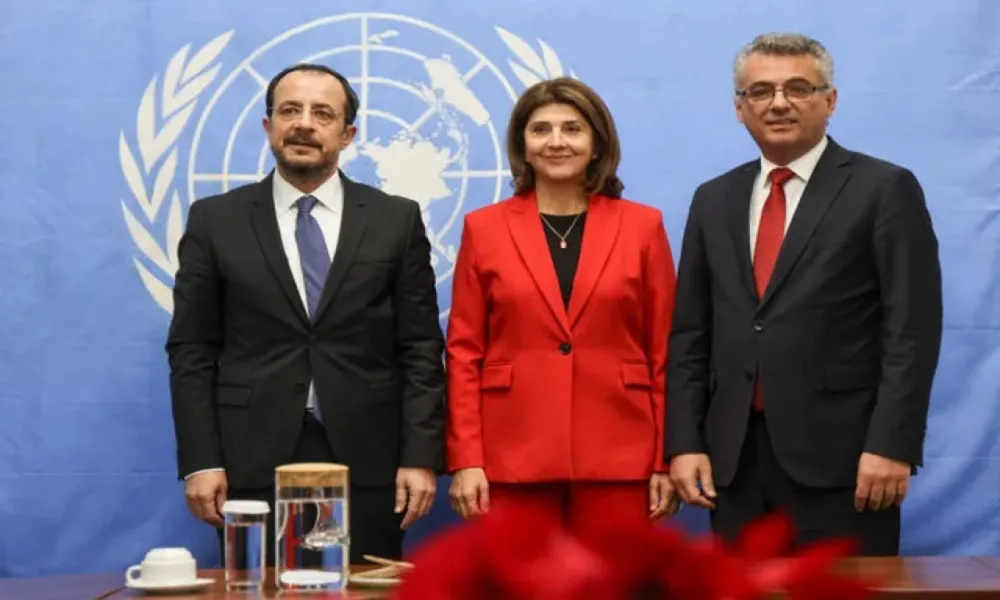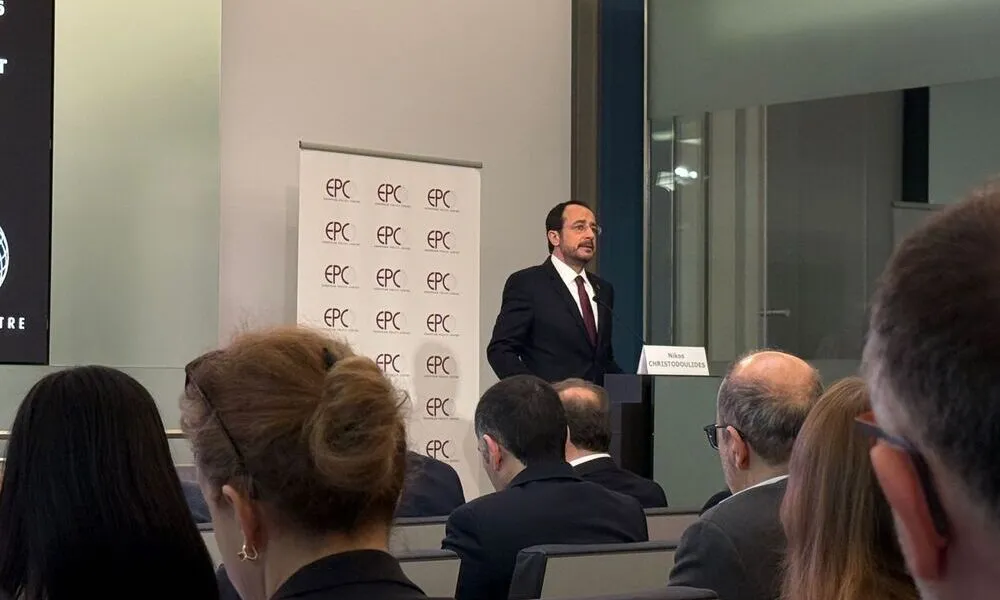



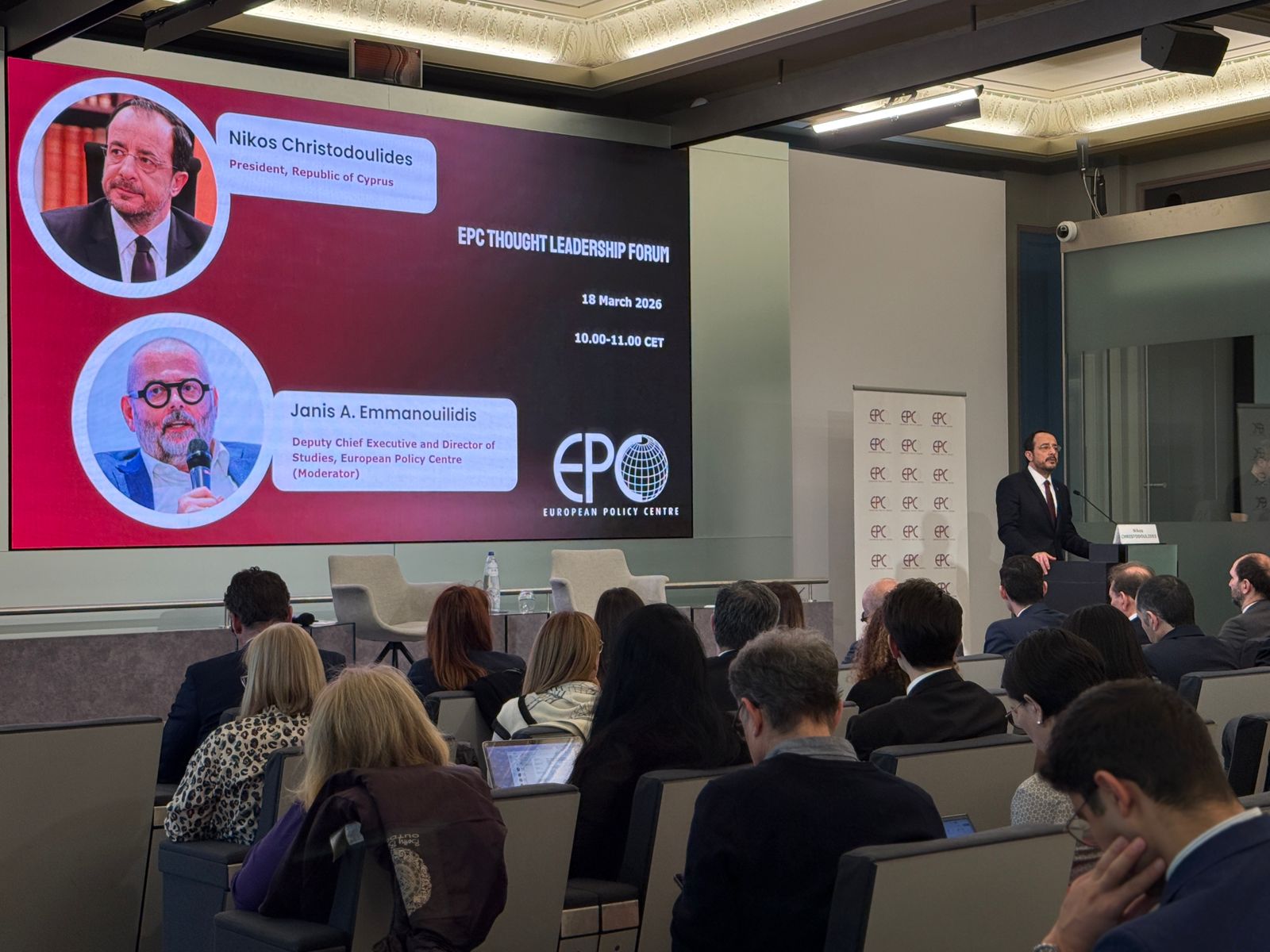
Nikos Christodoulides used his address at the EPC Thought Leadership Forum in Brussels to set out an assertive vision for the Cyprus Presidency of the Council of the European Union, centred on strategic autonomy, security and external engagement.
Speaking at what he described as a moment of “remarkable uncertainty, heightened tension and volatility,” Christodoulides argued that crises should act as a catalyst for deeper European integration.
“Autonomy is no longer a theoretical aspiration, but the driving force for action,” he said, framing it as “the next necessary step of European integration.”
Strategic autonomy at the core
The president positioned “An Autonomous Union, Open to the World” as the guiding principle of the Cyprus Presidency, stressing that Europe must be able to act independently while maintaining strong international partnerships.
“A Union strong from within… able to cooperate with external partners whenever possible, while also acting independently whenever necessary,” he said.
He rejected claims that European autonomy is unrealistic, stating: “I do not agree with those who say European autonomy is untenable.”
Security, defence and Ukraine
Christodoulides linked the urgency of this agenda to Russia’s war in Ukraine, noting that it had “shattered any illusion… that peace and stability in Europe was a constant.”
He highlighted Cyprus’ role in advancing EU decisions, including work on financial support for Ukraine and sanctions packages, while placing defence readiness at the forefront of the Presidency’s priorities.
Referring to a recent drone incident near British bases in Cyprus, he pointed to what he described as a practical test of the EU’s mutual assistance clause.
“We may not have triggered Article 42(7)… but Cyprus essentially tested it. Successfully so,” he said, adding that the response from countries including Greece, France, Italy, Spain and the Netherlands demonstrated “valiant solidarity.”
Regional role and Middle East
The president underscored Cyprus’ geopolitical position, describing it as “an integral part of the Middle East” with direct exposure to regional developments.
“For Cyprus, the situation is not abstract. Our geography directly links us to the region. And it links the region to Europe,” he said.
He reiterated Cyprus’ role as a humanitarian and diplomatic actor, describing the country as “a safe haven… always part of the solution, never part of the problem” and “a lighthouse in the Eastern Mediterranean.”
Energy and competitiveness
Christodoulides also focused on the economic dimension of strategic autonomy, particularly energy.
“The volatility of energy prices remains a major concern for citizens, businesses and industry,” he said, calling for a “true Energy Union” and greater investment in infrastructure and interconnections.
He linked competitiveness to simplification of EU rules and diversification of trade partnerships, referencing progress on agreements such as Mercosur and India, while calling for further deals, including with the UAE.
Enlargement and EU influence
On enlargement, he described it as “the Union’s most successful foreign policy tool,” pointing to ongoing progress with countries such as Montenegro, Albania, Ukraine and Moldova.
He stressed that the process must remain “credible, merit-based and anchored in the Union’s fundamental values.”
Cyprus issue and EU role
Christodoulides also addressed efforts to resolve the Cyprus problem, reaffirming commitment to a comprehensive settlement based on UN Security Council resolutions and EU law.
Concluding, the president argued that the EU must lead precisely in times of instability.
“Europe cannot choose the moment in which it must lead… the time for the Union to lead is now,” he said.
He also sought to reassure international partners, emphasising that “there is normalcy, safety and security in Cyprus,” highlighting strong economic performance and the country’s role as “a reliable hub of stability and connectivity in the Eastern Mediterranean.”