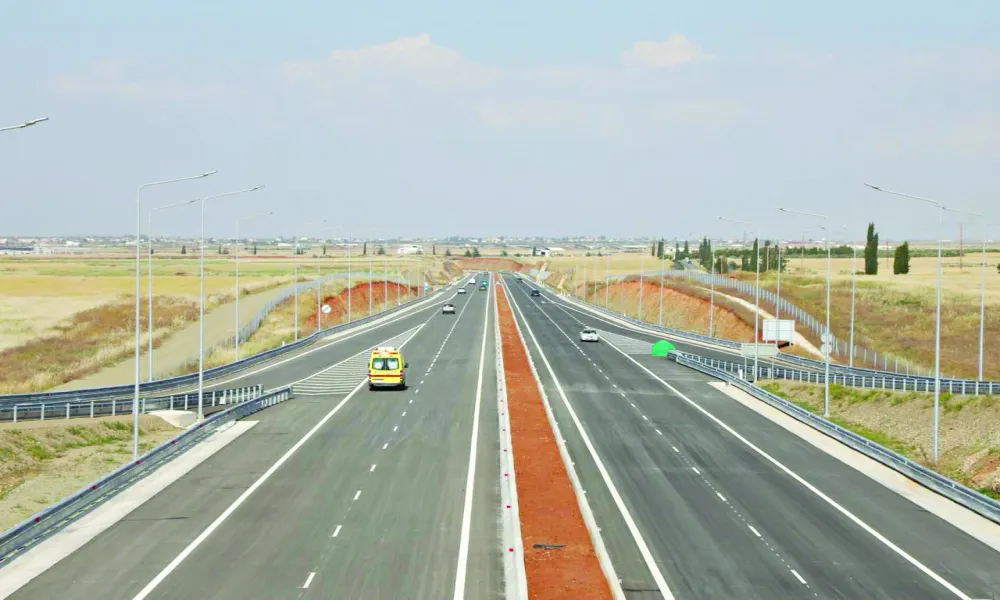

With a delay of 50 years, another section of the Nicosia–Evrychou highway was finally delivered on Thursday. Not the entire road. If back in 2001—now a quarter century ago—we were writing in a series of reports that the villages of Solea and Marathasa had grown old waiting for the road artery that would stop the outflow of young mountain residents to the cities, today they have effectively been emptied. Those residents who remained simply clenched their teeth to endure decline and abandonment.
Planned before 1960
For the record, the road was designed—and indeed considered an urgent priority—well before 1974. The plan was for construction to begin in 1973. The invasion changed priorities. From the 1980s onwards, successive governments invested in developing a road network aimed at rebuilding the economy, linking coastal tourist areas with the capital and with each other. The countryside was always the poor relative, one that did not “fit” either the “sun and sea” slogan or state budgets. It was left with an interurban road that, despite improvements, remained outdated, dangerous for road safety, and a major reason for permanent relocation to the cities.
For decades, residents insisted that the road would help curb urban migration, encourage young couples to remain in their communities, and possibly even lead to a gradual return of residents—initially for weekends and later permanently. This, in turn, would support agritourism, maintenance of orchards, production of local goods, job creation, and overall development. Their voices fell on deaf ears.
So, if the Cypriot countryside was for decades already “with one foot in the grave,” today the newly delivered section of the highway leads straight into a vast cemetery.
This is not an exaggeration. According to data cited in the National Strategy for Mountain Communities, in 2001 nearly 17% of the population in Troodos communities belonged to the 0–14 age group. This dropped to 12% in 2011. Meanwhile, those aged 65 and over increased from 25.6% in 2001 to 27% in 2011, and projections show continued ageing through 2030. Specifically, the 65+ population is expected to rise to 35% by 2030.
“Immediate and decisive measures to retain and attract population are now essential to prevent demographic collapse—at least in certain areas,” the Strategy states.
Fragmented construction
The first phase of the project, from Lakatamia to Kokkinotrimithia, was completed in the late 1990s under President Clerides. Years later, in January 2003, just before the end of Averof Neophytou’s term as Minister of Communications, contracts were signed for the next phase, from Kokkinotrimithia to Denia, 8.3 km long and costing £20 million.
At the time, efforts were underway—via UNFICYP—to secure consent from the occupied north for the road to pass through the buffer zone (specifically via Avlona) for the Akaki–Astromeritis section. This agreement never materialised.
Promises without substance
It is almost absurd that even then—23 years ago—the government planned to proceed first with the Astromeritis–Evrychou section (the one delivered this week), a longstanding demand of Solea communities. At the same time, pre-election promises were made for an alternative route outside the buffer zone, but governments hesitated, fearing it would be politically wrong to abandon the original plan.
Back in 2001, assurances were given that the Akaki–Astromeritis section would begin in early 2002 and be completed by the end of 2004.
From then on, community leaders from Solea and Marathasa repeatedly visited Parliament, ministries, and the Public Works Department. Meetings were held—results were zero. Under Minister Kikis Kazamias (2003–2004), it was stated that abandoning the buffer zone route would be politically wrong.
By 2005, the narrative shifted. The problematic buffer zone section would be bypassed for the time being—some hoped a Cyprus settlement might eventually resolve it—and focus moved to the Astromeritis–Evrychou segment (12 km long).
In 2007, promises suggested tenders would be issued by 2009, with completion by 2011. Environmental studies were underway.
Delayed by the financial crisis
Planning for Astromeritis–Evrychou was completed around 2012, but construction did not proceed due to fiscal constraints. During President Anastasiades’ second term, the project resurfaced. Transport Minister Vasiliki Anastasiadou (2018–2019) announced plans were being updated to reduce costs, estimated at €60 million, with completion targeted for 2026. The government also decided to abandon the buffer zone route and explore an alternative south of the communities.
How and why it “unlocked”
The project’s revival was not random. In 2017, President Anastasiades appointed Yiannakis Papadouris as adviser on mountain development. A comprehensive policy study followed, leading to the 2019 National Strategy, involving over 90 scientists. The Office of the Commissioner for Mountain Communities was also established.
Under these conditions—and pressure from Parliament, particularly Transport Committee chair Marinos Mousiouttas—the government announced in 2019 that construction would start earlier, in December 2020, aiming for completion by 2023 instead of 2026. Costs rose to €100 million.
Local communities cautiously welcomed the timeline but insisted they would no longer accept delays due to external factors.
The latest milestone
In reality, construction did not begin early as promised. It started on 21 October 2022 and was completed with a six-month delay, on 30 April 2026, costing €74.4 million.
The final milestone remains the central section from Akaki to Astromeritis. Despite strong opposition from nearby communities, current Transport Minister Alexis Vafeades has insisted the project will proceed without delay, warning that without it, the mountainous region of Nicosia is doomed to depopulation.
According to timelines, tenders for the 18 km stretch were expected in the first half of 2026, with costs estimated at €109 million. However, reports indicate the tender process has not yet begun due to incomplete land expropriations.
This article was originally published on the Greek-language Politis website.