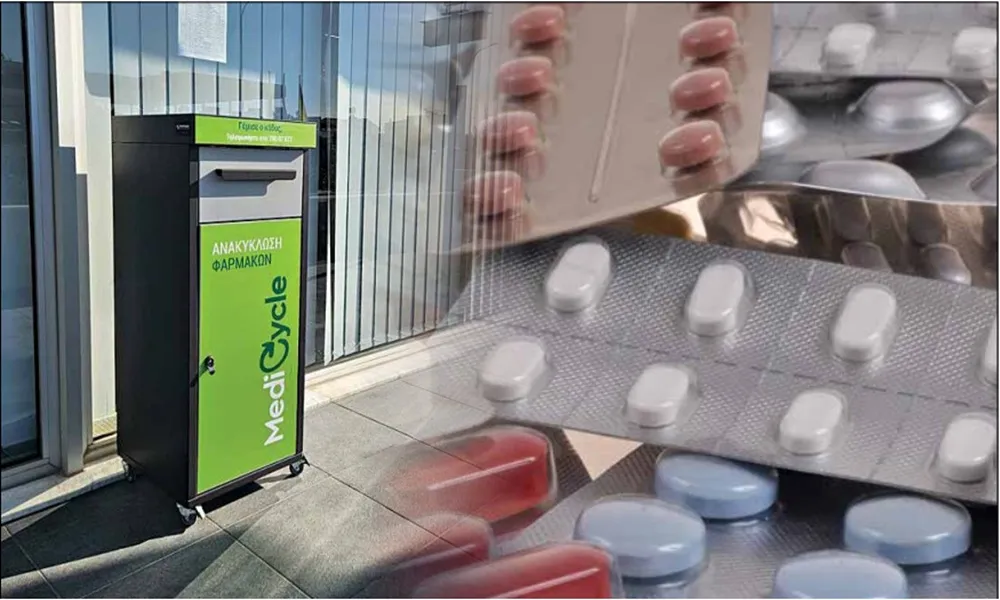
Proper management of household pharmaceutical waste has now become an important pillar of environmental policy in Cyprus. Through an organised collection and recycling system, the protection of public health and the ecosystem is being strengthened, while also promoting responsible behaviour among citizens and stakeholders regarding sustainable waste management.
From 2024 until 16 April 2026, 583 pharmaceutical waste recycling bins were installed in 87% of pharmacies across all districts of Cyprus, ensuring geographical coverage even in remote areas such as Pyrgos Tillyrias. In 2025 alone, approximately 4,000 kilograms of household medicines were collected island-wide.
The collective system MediCycle, operated by Green Dot and funded by companies placing pharmaceutical products on the market, collects household medicines that have expired or are unsuitable for use. These exclude specialised medicines supplied exclusively through hospital pharmacies for serious conditions, as well as controlled drugs under the Narcotic Drugs and Psychotropic Substances Law. The system accepts medicines in their primary packaging, including blister packs, syrup containers, ointment tubes, inhalers, ampoules and eye drops. However, syringes with needles must be disposed of as hazardous household waste, while cardboard outer packaging is directed to recycling streams.
According to MediCycle data, the 53 member companies of the system place around 31 million household pharmaceutical product units on the market annually. “The need for this waste management system lies in the fact that medicines ending up in landfills, sewage systems or other water recipients pose serious risks to human health and the wider ecosystem, as these substances can enter the food chain through contaminated water and affect species’ normal biological functions,” said Ioanna Constantinidou, Senior Officer at the Department of Circular Economy, Department of Environment.
Collection
“Waste is collected every three months, unless a bin fills up earlier, in which case the pharmacy notifies the system and it is emptied within 48 hours,” said Marios Vrahimis, Director General of Green Dot.
A QR code system is also being introduced on bins, allowing pharmacists to scan and instantly notify the system for collection. This reduces response time and improves mapping of bin locations across pharmacies.
Transport is carried out using licensed Green Dot vehicles, which deliver the waste to an authorised facility in Limassol for incineration. The remaining ash is then used by the Vasilikos Cement Works for energy recovery. As explained, due to the complex composition of medicines, incineration is considered the most appropriate final treatment method.
Collected items include blister packs, syrup containers, ointment tubes, inhalers, ampoules and eye drops.
Producer responsibility
Implementation of the system began in 2023 through actions by the Ministry of Agriculture, Rural Development and Environment and the House of Representatives.
Under the Waste (Management of Household Pharmaceutical Products) Regulations of 2023 (C.D.P. 80/2023), producers—those holding manufacturing or wholesale pharmaceutical licences in Cyprus—are obliged to establish individual or collective systems for managing household pharmaceutical waste placed on the market.
In December 2023, Green Dot Cyprus submitted an application for a collective system under the trade name “Medicycle”. Following a positive opinion from the Advisory Waste Management Committee, its operating licence was issued on 14 June 2024.
System effectiveness
According to MediCycle’s 2025 annual report, around 10% of pharmacies do not host a bin due to space constraints or preference, which partially affects system performance. The system’s effectiveness will be assessed over its six-year licence period.
In 2024, 145 kilograms of waste were collected through 32 collections. In 2025, this rose significantly to 4,021 kilograms through 264 collections across 538 bins, reflecting improved participation and efficiency.
Risks and compliance issues
Regulations require bins to be placed inside pharmacies to prevent damage and theft. However, some are currently placed outside premises, a point raised in Parliament.
Pharmacists have reported risks of theft by individuals with substance dependencies, as bins—although secure—can still be physically removed due to their weight. Practices vary: some pharmacies bring bins inside overnight, while others fix them externally or move them at different times of day.
Environmental awareness
Since the system began operating, MediCycle has conducted educational presentations in schools, businesses and organisations. Its website, medicycle.com.cy, provides information on the programme, the types of medicines collected, and participating pharmacies, aiming to raise public awareness and participation.