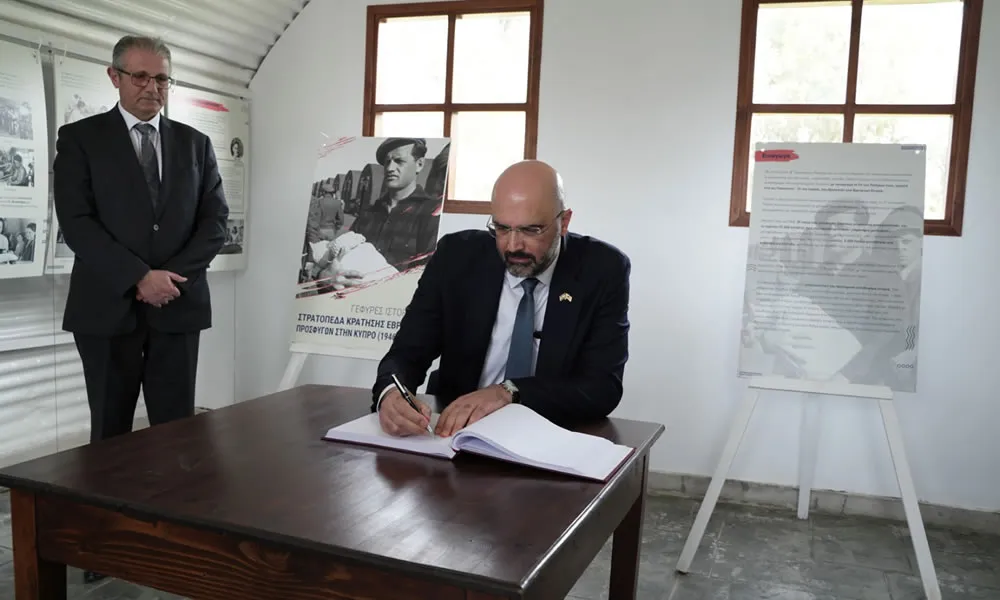

Speaking at an event to mark the 77th anniversary since the camps detaining Jewish Holocaust survivors in Cyprus were closed, Defence Ministry acting permanent secretary Stelios Kountouris spoke of the duty to preserve the memory associated with the Jewish migratory presence in Cyprus during the period 1946-1949.
"The mass extermination of millions of Jews during the Holocaust, combined with the entrenched antisemitism that had for decades shaped the policies of several states, demonstrates in the most tragic manner the failure of the international community to protect the Jewish people," Kountouris said.
He noted that "the idea of establishing a distinct Jewish homeland had already emerged in the late nineteenth century, within a European context that favoured the crystallization of nation-states."
"Along the journey of Jewish refugees toward their new homeland, Cyprus became a place of temporary refuge," he said, adding that "within this framework, the operation of the British detention camps during the period 1946-1949 marked one of the final major chapters of the Jewish migratory presence in Cyprus."
Over 50,000 survivors passed through Cyprus
"More than fifty thousand persecuted individuals, who preserved their dignity while seeking the hope that had been painfully absent from their lives, passed through the gates of these camps in an effort to chart a new course toward a better future," said the ministry official.
He added: "At this critical historical juncture, the response of the Cypriot people was immediate and tangible, demonstrating the enduring solidarity and profound humanitarian ethos that have consistently characterized them in moments of need."
Kountouris noted that during the three years of operation of the camps in Cyprus, until their closure in February 1949, 2,200 children were born in the camps.
"This site of remembrance, part of the shared history of Cyprus and Israel, reminds us of the resilience of the human spirit and of our duty to preserve the memory associated with this chapter of history," he said.
"We are obliged to teach future generations that memory constitutes a form of resistance against oblivion, racism, and every form of intolerance. We are obliged to teach future generations that humanity is not a given, but something that must be cultivated, safeguarded, and consciously upheld," Kountouris said.
"As we pay tribute to all those who, under conditions of extreme persecution, dehumanization, and constant existential threat, preserved their human dignity and kept hope alive for a better future, let us all work toward a world in which peace, solidarity, and mutual respect form the foundations of our societies," he concluded.