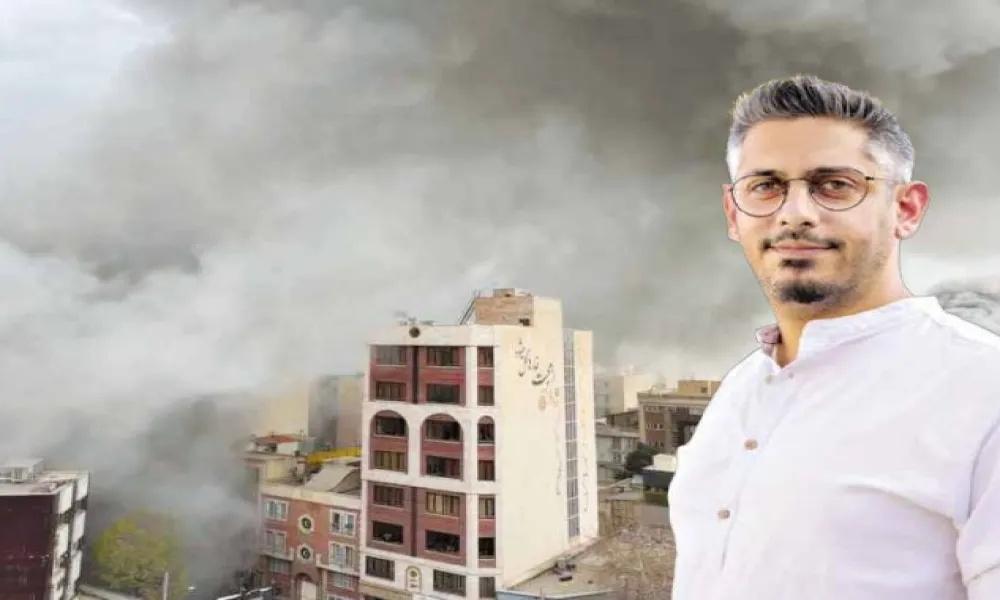
The conflict involving Iran is unfolding through what can be understood as a five-phase war with two strategic objectives, according to Zenonas Tziarras, lecturer in Turkish and Middle Eastern Studies at the University of Cyprus.
Speaking to Politis, Tziarras argued that the neutralisation of Iran’s ballistic programme alone does not sufficiently explain the scale of the military operation launched by the United States and Israel against Tehran. Instead, he said the campaign must also be viewed through the lens of Israel’s strategic vision for the region and Washington’s broader competition with China.
Two strategic objectives
According to Tziarras, the goals of the United States and Israel can be understood on two levels.
The most ambitious objective is regime change in Iran. A second objective is the weakening of Iran as a regional power, a development that would also carry global strategic implications.
On the first objective, Tziarras said Israeli Prime Minister Benjamin Netanyahu had made the goal explicit. “The same objective was mentioned by US President Donald Trump,” he noted. “However, US Defence Secretary Pete Hegseth later clarified that Washington does not officially seek regime change.”
The second objective concerns the destruction of Iran’s strategic capabilities and the weakening of Tehran’s influence across the region. This includes limiting Iran’s ability to support allied groups such as Hezbollah, the Houthis and Shia militias in Iraq.
Tziarras noted that while Israel appears committed to both objectives, the United States may not fully share that approach.
“Washington does not want to become bogged down in a prolonged war and lacks the domestic political legitimacy for long-term military involvement,” he said. “This could eventually lead to divergence between the United States and Netanyahu’s determination to replace the Iranian regime.”
He also pointed out that the United States has from the beginning left open the possibility of a diplomatic solution. According to statements attributed to Donald Trump, the new Iranian leadership that emerged following the death of Supreme Leader Ali Khamenei has indicated willingness to negotiate, although this claim has been disputed by Tehran.
Tziarras suggested that Washington may believe that sustained military pressure could force Iran’s new leadership into negotiations and ultimately into concessions, particularly regarding Tehran’s nuclear programme.
He added that Israel’s focus on Iran’s ballistic missile programme reflects primarily its own security concerns, noting that the ballistic issue was not included in the 2015 nuclear agreement reached during the presidency of Barack Obama.
The broader geopolitical context
Tziarras stressed that Iran should not be viewed solely through a regional lens. Tehran, he said, represents a key pillar in the strategic architecture of both China and Russia.
He pointed out that this geopolitical dynamic predates Donald Trump’s presidency but that current conditions have created a moment in which such a confrontation has become more likely.
Following developments in Venezuela, the continuing fallout from the Russia–Ukraine war and the ongoing Middle East crisis, Iran now forms another piece in what he described as a strategic effort to deprive Russia and particularly China of key allies.
He also recalled that in 2021 China and Iran signed a 25-year strategic cooperation agreement worth approximately 400 billion dollars. The deal extends beyond China’s Belt and Road Initiative and includes cooperation in energy, security and trade.
For that reason, he said, the confrontation with Iran should also be understood as part of a wider global power rivalry.
Five phases of the conflict
Tziarras believes Israel’s strategy is unfolding through several phases.
The first phase involved targeting and neutralising the Iranian leadership.
The second phase, currently under way, focuses on the destruction of Iran’s air defence systems and ballistic missile capabilities.
The third phase, he said, is likely to involve strikes against Iran’s internal security institutions. Such attacks could weaken the regime’s ability to control protests, dissent and potential armed opposition groups.
A fourth phase could involve the mobilisation and support of political or armed opposition groups that might emerge in the context of internal instability, potentially aiming to seize power.
Netanyahu’s strategic vision
Tziarras also highlighted what he described as problematic aspects of Netanyahu’s regional strategy.
For example, Israel’s decision to enter southern Syrian territory and occupy a Druze-populated zone may have undermined the possibility of improved relations with Syria’s new leadership.
He suggested that Israel could have pursued a diplomatic path with Iran, applying pressure to reach an agreement similar to the one achieved in 2015, which included safeguards and United Nations monitoring mechanisms.
Instead, Netanyahu has chosen a more decisive military approach aimed at weakening Iranian power through strikes on strategic and politically important infrastructure.
According to Tziarras, Israel’s objective appears to go beyond weakening Tehran and includes the possibility of regime change, with the aim of installing a leadership that would adopt a more pro-Western orientation and abandon the goal of confronting Israel.
When asked whether Netanyahu’s objectives are rational from Israel’s perspective, Tziarras said they are logical within Israel’s own strategic framework.
“Rationality in this context is subjective,” he said. “Different actors calculate costs and benefits differently.”
He added that Netanyahu and his allies appear to view Israel’s security through the elimination of Iranian power, regime change in Tehran and the broader vision often described as “Greater Israel”.
Implications for Cyprus
Tziarras warned that the conflict has direct implications for Cyprus because of its proximity to the region.
The recent attack targeting the British bases in Akrotiri demonstrated how instability in the Middle East can spill over into the Eastern Mediterranean.
He also suggested that the post-war landscape could produce new power shifts that might not lead to stability but instead trigger further geopolitical competition.
One possible development could be heightened rivalry between Turkey and Israel, particularly if US efforts to normalise relations between the two countries fail.
He also warned that destabilisation in Iran could revive the Kurdish question, as well as encourage other ethnic groups such as the Baloch and Azeris to exploit potential security vacuums.
In such a scenario, the region could enter a prolonged period of instability.
Cyprus, he said, would be unlikely to remain unaffected, facing potential pressures ranging from refugee flows to economic and energy disruptions, as well as new geopolitical rivalries involving countries that are also partners of the island.