

Citizens in Europe and North America express concern that the world may be moving towards a new global conflict within the next five years, according to a Politico poll conducted in five Western countries. The findings indicate a sharp rise in perceptions of insecurity compared with last year, alongside hesitation over how increased defence spending should be financed.
The survey was carried out by Public First between 6 and 9 February, with a sample of 2,000 respondents in each country.
Rising perception of global risk
Across the United States, Canada, the United Kingdom, France and Germany, respondents reported that they believe the world is becoming increasingly dangerous.
Seb Ride, head of polling at Public First, stated that the shift in Western public opinion in less than a year reflects “a dramatic movement towards a more insecure world, where war is considered likely and alliances unstable”, adding that the figures have increased significantly over the past year.
In the United Kingdom, 43 per cent of respondents consider it “likely” or “very likely” that a new world war will break out by 2031, compared with 30 per cent in March 2025. In the United States, 46 per cent hold the same view, up from 38 per cent last year.
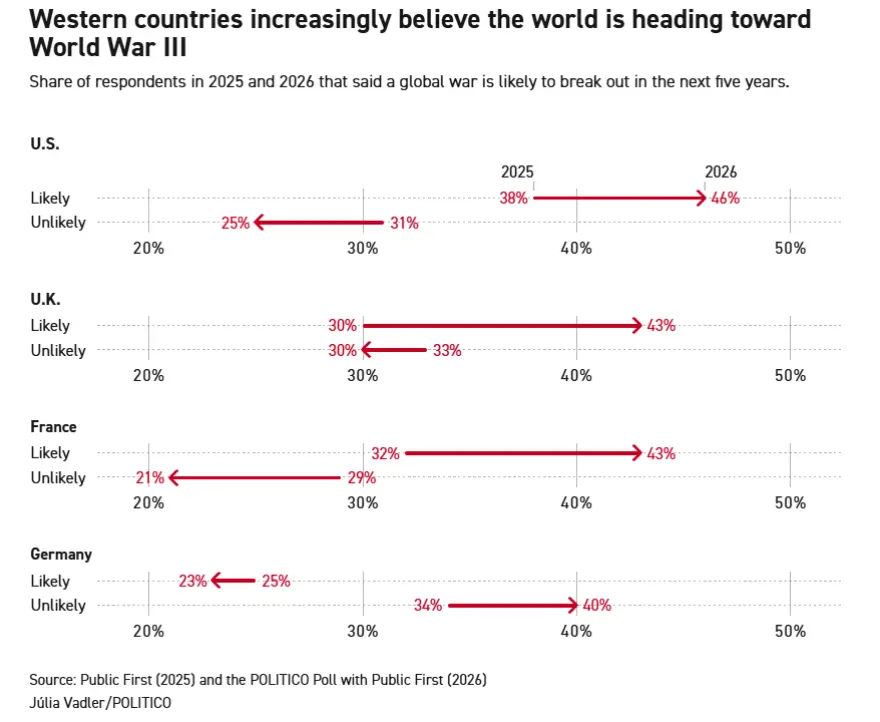
Among the five countries, only German respondents overall believe that a third world war is unlikely within the next five years.
National military involvement and nuclear concerns
When asked about the likelihood of their own country becoming involved in military action within the next five years, American respondents were the most likely to consider this probable, followed by respondents in the United Kingdom and France.
At least one in three people in the United States, the United Kingdom, France and Canada believe it is likely or very likely that a nuclear weapon will be used in a war within the next five years.
The continued war in Ukraine and developments involving the United States under President Donald Trump in Iran, Syria, Venezuela and Africa were cited in the broader context of rising concerns.
Perceived threats to peace
Russia is viewed as the greatest threat to peace in Europe. Canadian respondents consider the United States under President Donald Trump to be the greatest security risk.
In France, Germany and the United Kingdom, the United States is identified as the second greatest threat, mentioned more frequently than China.
Defence spending and economic trade-offs
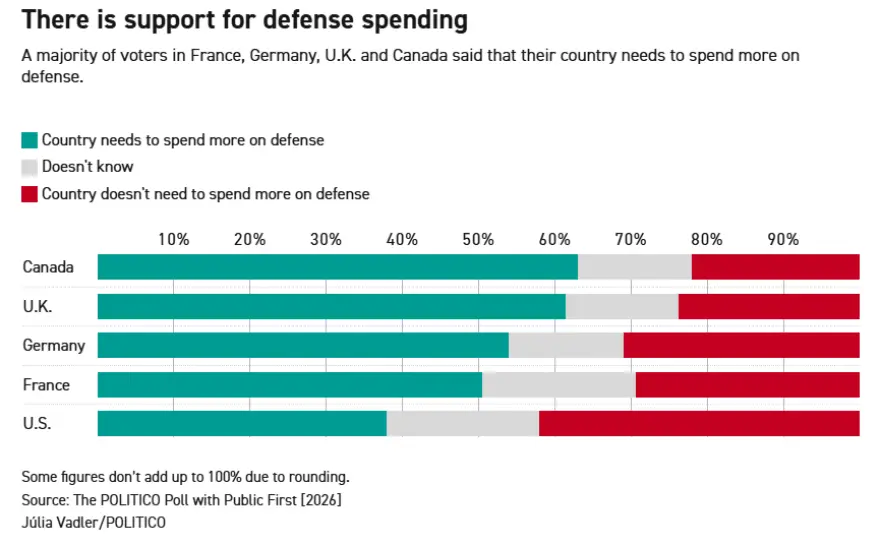
A majority of respondents in France, Germany, the United Kingdom and Canada stated that their country should spend more on defence, with support strongest in the United Kingdom and Canada.
However, the survey found that support declines when respondents are asked whether such funding should come from cuts to other sectors, increased public borrowing or higher taxes.
In 2025, 40 per cent of the French public and 37 per cent of the German public said they would support higher defence spending when trade-offs were specified. This year, support has fallen to 28 per cent in France and 24 per cent in Germany.
In Germany, defence spending ranks among the least popular options for public expenditure, ahead only of foreign aid.
According to Politico, France and Germany are now more likely to oppose increased defence spending when questions arise over who will bear the financial cost.
Attitudes towards European defence structures
The survey also indicates strong scepticism regarding the creation of a common European army under a central command, an idea that has been expressed by the European Commission. The proposal is supported by 22 per cent of German respondents and 17 per cent of French respondents.
By contrast, compulsory military service receives significantly higher acceptance in both countries, with support at approximately 50 per cent.
Source: Politico