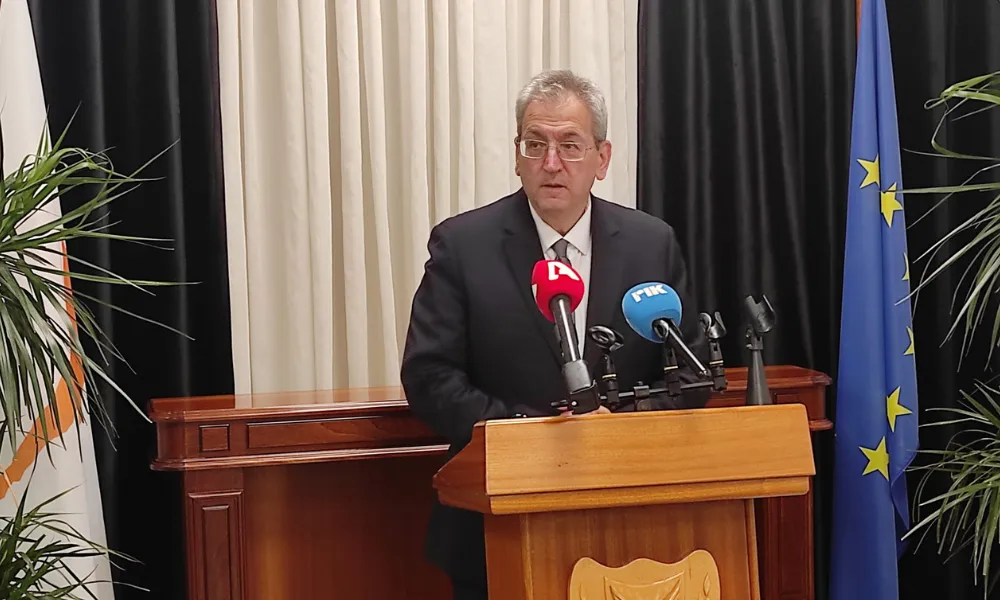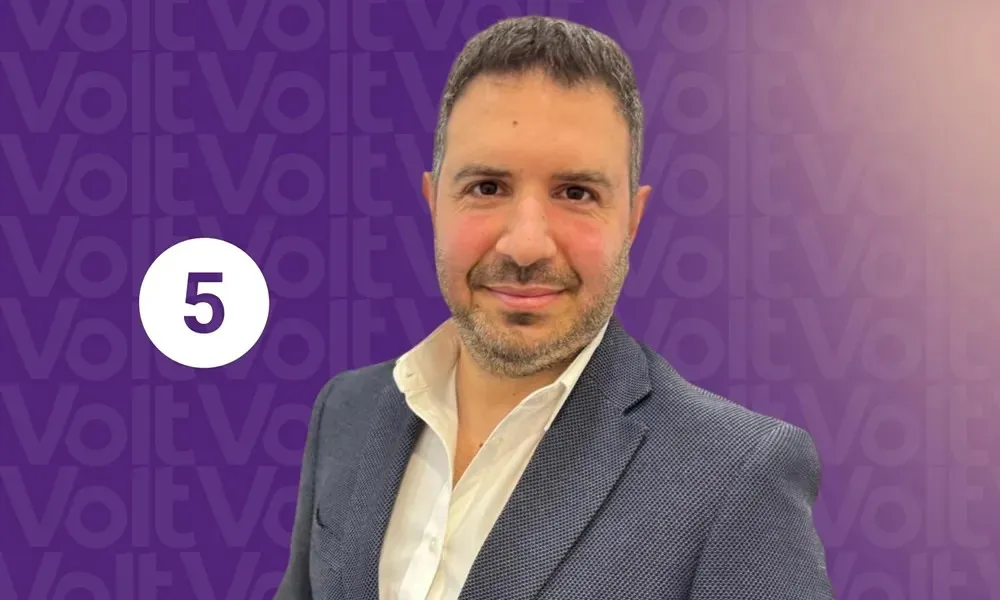

Volt co-chair Panos Parras, in an interview with "P," makes clear that he will not seek re-election to the party's leadership in the upcoming internal elections. He also explains what he considers the most important challenges facing the party's new leadership. At the same time, he criticises the relevant authorities over their stance towards journalist and investigator Makarios Drousiotis. Parras also addresses the presidential election, setting out the criteria Volt will take into account when called upon to make decisions. He goes on to call on both leaders to rise to the occasion, stressing that another roadblock is not enough. "Given where things now stand," he emphasises, "far bolder steps are required — steps that will not merely prevent partition, but will make a solution irreversible."
On the prosecution of Makarios Drousiotis
Do you consider the criminal prosecution of Makarios Drousiotis to be an act of retaliation?
That is something the authorities should be pressed to answer. In a state of lawlessness, where interpretations of the law become elastic depending on who is being prosecuted, where public-interest criminal prosecutions are suspended by the Law Office without accountability, what other character could it possibly have? But let's look at it the other way round too. We often discuss the lack of trust in institutions. When for four years no proceedings were brought against the journalist and author of "Mafia State," and it comes immediately after it became known that former President of the Republic Nikos Anastasiades may be implicated in corruption cases, what message is being sent to citizens? Not to mention the absurdities said about an allegedly illegal fundraising campaign for his legal defence. The cross-party wave of support for Makarios Drousiotis was, I think, telling in itself.
Internal party elections
Internal elections will be held at Volt on 10 October. Will you seek re-election as co-chair?
The regular electoral congress in December was effectively moved to 10 October to speed up the process of turning a new page for the party. In a party that relies exclusively on volunteerism, you know, you cannot keep running at high speed for a long period. That is precisely why the term of the political council, and of the leadership more generally, has been set at two years. Personally, I believe that when someone genuinely wishes to contribute, they don't necessarily need to always be on the front line. I ran on the front line as vice-chair and then as co-chair for three years. At this stage, I will not seek re-election, but I will of course remain active.
What will be the main challenges for the party's new leadership?
The main challenge for the new political council is to give the party's reason for existing a meaning that is more widely understood by society — a substantive answer to the political question "why Volt." Because while 11,500 citizens found meaning and answered that question, many more are needed to "finally change the current." Beyond that, the policy-production teams need to be reactivated, the district committees need to become active, and a great deal of organisational work needs to be done at the local community level.
The parliamentary elections
Has a final assessment been made of the defeat in the parliamentary elections?
Many steps were taken to gather data and opinions around the causes of the election result. Online submission of feedback, an in-person review with our parliamentary candidates, and a large gathering with members and friends where views were exchanged. We are now at the final stage of collecting and categorising the data towards drawing final conclusions. More broadly, I have been following the political and party scene for decades. I believe the result itself is a good guide for assessment. We were measured again, and we were few. The progressive world, the average liberal European next door whom we meet every day, with whom we sometimes discussed politics and agreed on most things, ultimately turned towards choices they had previously rejected, or didn't even get up to vote at all. That alone says a great deal about voters' selection criteria and how we interpret the need for change.
Does a party that failed to enter parliament have a future?
Certainly this is not the end of the road. Especially for a party that carries policies and ideals that are today under-represented in political affairs. European progressivism and liberalism, pragmatism, the bi-communal form of organisation — these are some of the characteristics that make up Volt and that are not expressed by other formations. Consequently, even our failure to enter parliament cannot eliminate the need for representation of these principles for the citizens who embrace them.
Presidential elections
Was the joint protest by Volt and AKEL outside the Law Office, following the Anti-Corruption Authority's findings on "Mafia State," a sign of cooperation ahead of the presidential election?
Although fighting corruption is always a good reason for forming alliances, it is not a sign of anything in particular. The country is in the red zone when it comes to issues of corruption, entanglement of interests, and the rule of law. That is precisely why the protest, and the general demand for measures to be taken, is an obligation on all of us. To go one step further, though, the absence of other parties from a protest of this kind says a great deal more about how the political system views the issue of corruption.
Which party do you rule out cooperating with in the 2028 presidential election?
Certainly excluded are those parties and/or candidates who do not see that there is a problem of corruption in the country and damage to the rule of law, who see no problem in the intensifying income and social inequality, who do not consider a solution to the Cyprus problem necessary, and who do not favour the country's European perspective. Needless to say, there is also no room for cooperation with ELAM or other extreme voices.
Cyprus problem
The new initiative by the UN Secretary-General represents an opportunity for the Cyprus problem. Do you believe President Christodoulides is handling developments correctly?
Personally, I would not even dare call it an opportunity. We have disappointed society many times in the sense of "cultivating" uncertain hope that ultimately never bears fruit. For this new effort to constitute hope, I believe that both President of the Republic Nikos Christodoulides and Turkish Cypriot leader Tufan Erhürman will need to rise to the occasion. The circumstances do not call for yet another Confidence-Building Measure that fails to touch the majority of citizens on either side of the roadblock. Another roadblock will not, above all, send the message to our own people that there is still room to find a definitive solution. Given where things now stand, far bolder steps are required — steps that will not merely prevent partition, but will make a solution irreversible. Let us not forget, however, that for now they haven't even managed to agree on a single roadblock, which keeps expectations low.
Ultimately, which side bears greater responsibility for the lack of prospects on the Cyprus problem — Turkey, or political timidity in Nicosia?
It would be risky to try to weigh the long-standing lack of prospects on the Cyprus problem on a scale. Nor do I believe it is the role of a political party to apportion blame on such a critical issue. Ankara's responsibilities are there, and the continuing occupation alone says a great deal about them. But what concerns us, affects us, and disappoints us more, is certainly our own side's stance. Because it is precisely from our own side that we have the most demands, and where we demand evidence of good faith. Timidity, lack of will, petty political expediencies, and the absence of political stature have, with certainty, at times deprived us of the prospect of a resolution. And the story continues…