After ten years in parliament, the new Commissioner for the Environment and Animal Welfare reviews his career, criticising Marinos Sizopoulos.
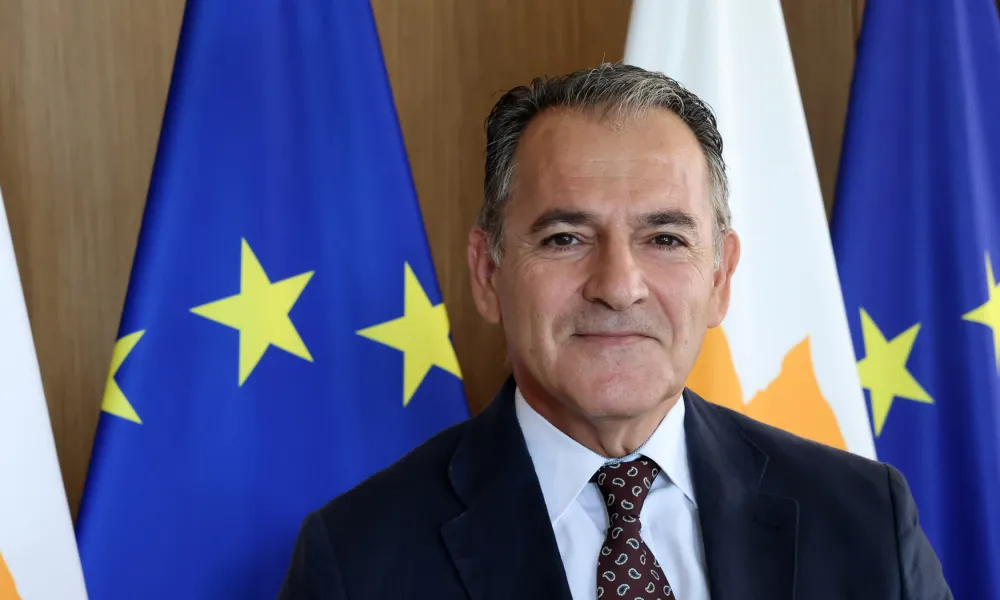
Former Paphos MP for EDEK and newly appointed Commissioner for the Environment and Animal Welfare, Ilias Myrianthous, opens up to "P," giving an extensive review of his decade-long parliamentary presence, discussing the political battles he fought, the challenges he faced, and his next steps in public life. At the same time, he makes clear that his decision not to stand as a candidate in the last parliamentary elections does not constitute a departure from politics, but a different form of service to society.
Looking back on his ten years in parliament, Myrianthous describes it as particularly productive. As he notes, he participated in tabling or co-signing more than one hundred legislative proposals, covering a wide range of issues, from economic and social policy matters to agriculture, energy, tourism and transport. He places particular emphasis on his work through the parliamentary committees, where significant legislative interventions were promoted to support citizens, workers and farmers.
Beyond his legislative work, he notes that he was particularly active in raising problems through self-initiated motionsand parliamentary questions. During his term, hundreds of issues were registered for discussion in parliamentary committees, while he submitted more than three hundred parliamentary questions to the relevant ministries, pursuing solutions to issues affecting both the Paphos district and Cypriot society as a whole.
Primary residence
Asked which he considers the most significant political battle he fought, Ilias Myrianthous does not hesitate to answer that it was the effort to protect primary residences and borrowers from foreclosure procedures.
As he explains, from the early years of the foreclosure framework's implementation, he had argued that there needed to be stronger safeguards for households at risk of losing their primary home. In his view, the problem of non-performing loans was handled in a way that did not adequately take into account its social dimensions, resulting in many citizens finding themselves in an extremely difficult position.
He argues that the State should have, from the outset, shaped a more balanced framework, one that would allow for the restructuring of the banking system without leaving the most vulnerable borrowers exposed. He believes that several of the proposals tabled did not receive the attention they deserved at the time, and that the corrective measures that followed came considerably later than they should have.
He also describes as one of the most difficult moments of his political career the consultations that preceded the passing of the 2021 state budget. As he notes, EDEK had set specific social conditions and proposals for supporting citizens, including arrangements concerning foreclosures. Today he acknowledges that, in hindsight, additional guarantees should perhaps have been secured before the party gave its positive vote.
Political activity
Despite not seeking re-election, Myrianthous stresses that he is not withdrawing from political life.
"Involvement in public affairs is not limited to the capacity of MP," he says, noting that public service can continue through many different institutions and roles. For him, politics is a lifelong choice, not a temporary professional occupation.
He leaves open the possibility of becoming active in the future in other decision-making positions, whether in local government or other institutions, depending on how circumstances develop. He makes clear, however, that such decisions will be made at the appropriate time and guided by the public interest.
His criticism of EDEK
He is particularly sharp when asked to comment on EDEK's course and the result of the last parliamentary elections, which left the party outside parliament for the first time in decades of parliamentary presence.
He believes this development does not concern EDEK alone, but the country's political system as a whole, given the historic role the party played in Cyprus's social and national struggles.
He argues that the primary responsibility for the electoral collapse lies with those who led EDEK from 2015 to 2025, and in particular the party's former president, Marinos Sizopoulos.
As he notes, a political leader is obliged to operate in a consensual manner, to pursue collective decision-making, to strengthen transparency and to foster unity within the party.
In his view, the past ten years were marked by introversion, internal party conflicts and personal clashes, a fact that alienated both EDEK's traditional voters and many citizens who were seeking a credible political proposal.
At the same time, he expresses broader concern about the direction political life is currently taking, noting that in several cases formations with strongly personality-driven characteristics and limited ideological cohesion are gaining ground — a fact that, he says, makes it harder to produce substantive proposals for major social problems.
Closing the interview, Ilias Myrianthous expresses his thanks to the citizens who supported him throughout his political career. A particular place in the interview is reserved for a reference to his wife, Angela, whom he describes as the "calm and sheltered harbour" of his life.