
Greece’s agreement with Israel to acquire a modern, integrated air defence shield worth around $3.5bn is expected to create new dynamics in the wider region, with Cyprus also likely to be affected by the development.
The agreement, signed last Monday, provides for the acquisition of the multi-layered system known as the “Achilles Shield”. Its capabilities, combined with the significant strengthening of the Greek armed forces in recent years, are expected to further alter the regional balance of military power.
Military sources estimate that, within around three years, once the system has been installed and become fully operational, Greece could have comprehensive airspace coverage against a wide range of threats.
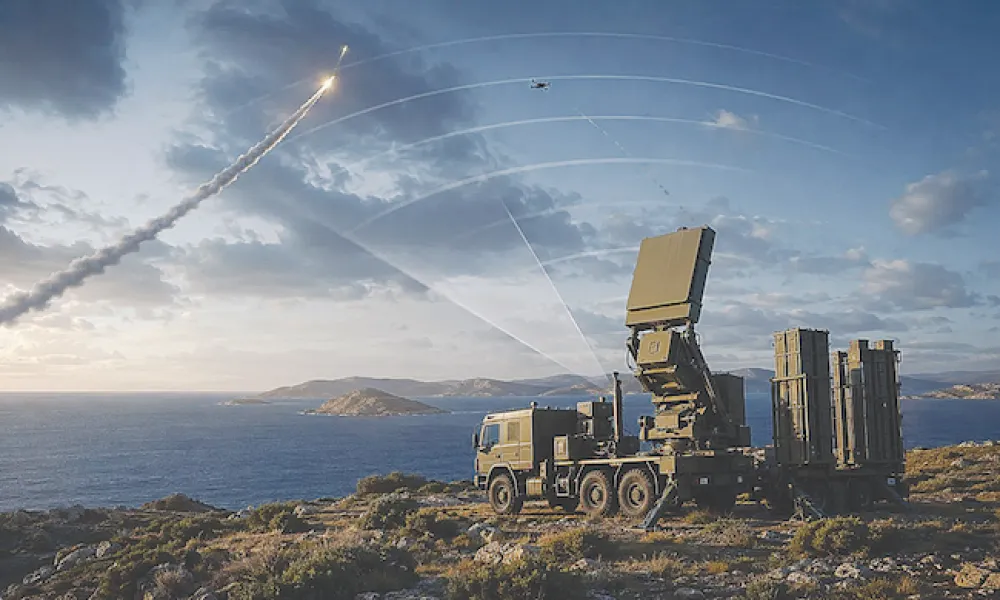
The Israeli system will provide information on objects entering Greek airspace and, depending on the nature of the threat, activate the appropriate interception capability.
The new architecture will complement Greece’s acquisition of French Belharra frigates and Rafale fighter jets, its planned introduction of F-35 aircraft, with the first deliveries expected in 2028, and the upgrade of its F-16 fleet to the Viper configuration.
A system designed for multiple threats
A military source told “Politis” that Greece’s new integrated air defence system should not be regarded as identical to Israel’s Iron Dome, nor should it be directly compared with the system recently acquired by Cyprus’ National Guard.
There are similarities in terms of the overall philosophy, including the detection and identification of potential threats and the rapid activation of an appropriate air defence response.
However, Greece’s air defence architecture has been designed specifically around the country’s geographical size and operational requirements. It is intended to address threats ranging from unmanned aerial vehicles and fighter aircraft to various types of missile attacks.
One of the system’s key features is its ability to incorporate additional capabilities without disrupting its overall operation.
According to information that has emerged, Greece’s domestically developed Centaur anti-drone system could also be integrated into the Achilles Shield. The system has already been installed on Greek frigates, including the frigate Elli, which was recently deployed in waters around Cyprus as part of measures taken to protect the island against potential Iranian attacks following a Shahed drone strike on the British Bases at Akrotiri.
Other compatible systems could also be incorporated into the wider architecture.
Potential for Cyprus-Greece information sharing
Although the Greek and Cypriot systems will remain fully autonomous, there is potential for closer cooperation between the two countries’ armed forces, particularly through the exchange of critical information relating to airspace threats.
Military sources said that while descriptions of a single “common air defence umbrella” may be premature, practical cooperation could nevertheless develop through the sharing of information between the two systems.
For example, the Greek Air Force could provide information about potential aerial threats approaching areas that are not covered by Cyprus’ air defence capabilities, while information could also flow in the opposite direction.
Given the increasingly close military cooperation between Cyprus, Greece and Israel in recent years, military sources said Israel could also become part of such an information-sharing framework.
This could be particularly significant because potential threats to the three countries can originate from similar directions.
The importance of an integrated network
According to an extensive analysis published by To Vima, the real strength of the new architecture lies not simply in the range of its missiles, but in the ability to connect different systems within a common digital command-and-control environment.
The new Israeli radars are expected to be linked with Greek sensors, existing Patriot systems, military surveillance capabilities and non-kinetic anti-drone systems already deployed on islands and at key military installations.
When a radar detects a target, the information will be transmitted to the unified command system, where factors including speed, altitude, direction and likely impact point will be assessed.
The system can then determine the most appropriate interception method.
This approach means that a small drone would not necessarily need to be engaged with an expensive long-range missile. Depending on the circumstances, it could instead be countered through electronic warfare, an anti-drone system or a lower-cost interceptor.
A ballistic missile, by contrast, would require a faster and more powerful system operating at a higher tier.
Three layers of protection
Once fully deployed, the Achilles Shield is expected to consist of three layers covering short, medium and long ranges, as well as the upper tier of ballistic missile defence.
The first layer will be provided by Rafael’s SPYDER All-in-One system. The mobile system combines radar, a command centre and up to eight missiles on a single vehicle.
It is designed to protect military facilities, airports, ports and energy infrastructure from aircraft, helicopters, drones and guided munitions. Depending on the interceptor used, its engagement range extends from up to 15km with Python-5 to 20km with I-Derby and up to 40km with I-Derby ER.
The second layer will be provided by Israel Aerospace Industries’ BARAK MX system, a network-centric platform capable of launching different types of missiles from the same launchers.
Its interceptors have ranges of 15km, 35km, 70km and 150km and are designed to counter fighter aircraft, drones, subsonic and supersonic cruise missiles and tactical ballistic missiles. The system can also engage multiple targets approaching from different directions.
At the highest level will be David’s Sling, jointly developed by Rafael, Raytheon, Israel Aerospace Industries and Elbit.
The system is designed to intercept short- and medium-range ballistic missiles, large rockets, cruise missiles and UAVs. It uses a two-stage interceptor designed to destroy targets through direct impact, or “hit-to-kill”.
Priority areas across Greece
The initial focus is expected to be on Thrace, the eastern Aegean, air and naval bases, command centres, ports and critical energy infrastructure.
The network would then gradually expand across mainland Greece, with the objective of creating a common operational picture for responding to different types of threats.
However, military analysts stress that no air defence system can provide absolute protection, particularly in the event of a large-scale saturation attack.
For Cyprus, the development is significant not because the Greek and Cypriot systems will become a single defence network, but because the increasingly close military relationship between Cyprus, Greece and Israel could provide opportunities for greater coordination and the exchange of information about potential aerial threats.
The emergence of the Achilles Shield therefore adds another dimension to the evolving defence cooperation between the three countries and could further strengthen their ability to coordinate responses to regional security challenges.