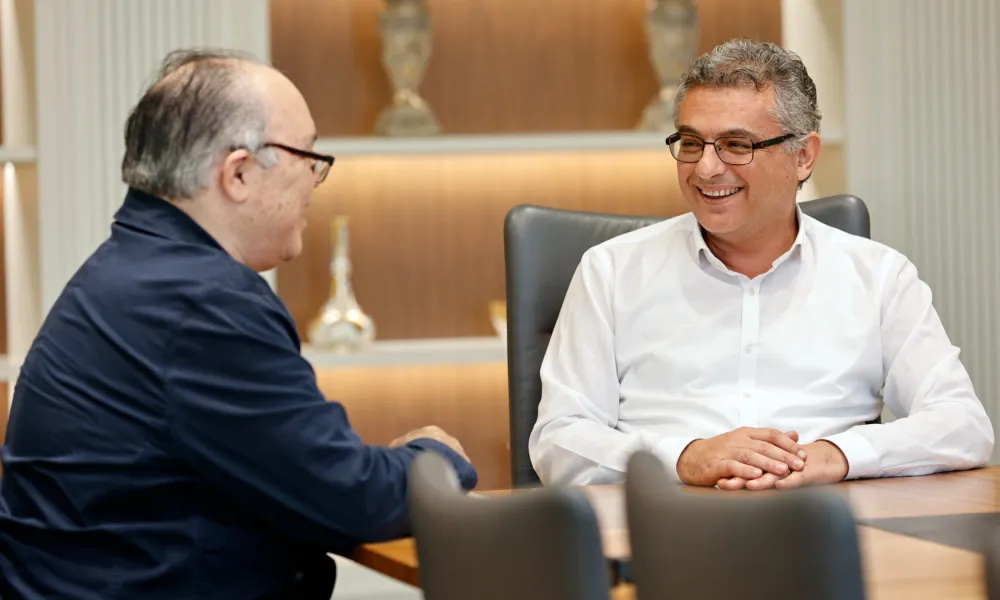
Turkish Cypriot leader Tufan Erhürman describes a relationship in which trust remains elusive, despite repeated meetings and declarations of a shared wish for a solution, in the second part of his exclusive interview with Politis.
Asked directly whether he trusts President Nikos Christodoulides as a negotiating partner, he avoids answering in the affirmative. Instead, he stresses that “actions speak louder than words” and denounces actions by the Greek Cypriot leadership that, he says, undermine trust.
A pointed revelation
He also makes a pointed revelation. According to Erhürman, when he asked the President to explain these actions, Christodoulides told him they were a duty of the Republic of Cyprus and that they would continue. “This is an even greater insult!” he remarks.
The Ledra Street proposal
His answer to why he has not visited the Greek Cypriot community, a year after his election, is equally revealing. He says he had proposed to Christodoulides that they walk together along Ledra Street or make joint visits to both sides. The President, however, preferred to postpone such moves until full negotiations begin.
Property and energy
On the sensitive property issue, Erhürman defends the ‘Immovable Property Commission’, citing case law of the European Court of Human Rights. He disputes that the Guardian of Turkish Cypriot Properties offers equivalent remedies. He also describes the prosecutions and arrests over Greek Cypriot properties in the north as actions that undermine trust.
His position on energy is of particular interest. He believes the Great Sea Interconnector could become an opportunity for cooperation, provided an inclusive approach is adopted that does not exclude the Turkish Cypriot side.
Despite his criticism, he says he is determined to continue working with Christodoulides, stressing that a solution is in both sides’ interest: “Either we both win or we both lose.”
The interview reveals a fundamental contradiction. While the two leaders say they are seeking a resumption of talks, they still disagree even on the moves that could build the necessary trust.
The interview
After a year of contacts, there appears to be considerable mistrust between you and Nikos Christodoulides. Do you trust Nikos Christodoulides as a negotiating partner or not?
My wish is to be able to trust my interlocutor, as trust lies at the very foundation of every relationship. Building and maintaining trust require continuous effort and cooperation towards achieving a common goal. In this respect, actions speak louder than words. The intensification of actions that undermine trust naturally weighs on the relationship between the two sides.
When I asked my interlocutor why the Greek Cypriot leadership is taking these actions, he told me that it is their duty as a state and that these actions will continue. This is an even greater insult! Trust cannot be built in a vacuum! It cannot prevail in a hostile environment.
We will not increase trust or create this rapprochement between Turkish Cypriots and Greek Cypriots by further isolating Turkish Cypriots, by preventing children from fulfilling their dreams related to sport or young people from meeting at a music event, or by calling on diplomatic missions not to listen to what Turkish Cypriot officials have to say. Such actions will only deepen existing fears, entrench prejudices and alienate people even further. Both leaks to the press and engaging in blame games are also counterproductive.
Nevertheless, I am determined to continue working with my interlocutor in a positive and sincere manner, as we have a shared obligation to achieve a settlement in Cyprus. Such a settlement will contribute not only to the security and prosperity of Turkish Cypriots and Greek Cypriots, but of the entire region.
I would like to point out that, in my view, a solution is in the interest of both Turkish Cypriots and Greek Cypriots, especially our children. Either we both win or we both lose. Trust is also essential for a solution. I am ready to do my part in building that trust.
Do you trust AKEL? Why do you not meet Stefanos Stefanou? Is there some coolness or distance in your relationship?
I believe in dialogue. Also, I am not aware of any request having been made by Mr Stefanou for such a meeting. If there is a communication problem, I will resolve it immediately.
You are proceeding with construction and development on land that remains the subject of negotiation. This provokes people who believe the Turkish Cypriot side genuinely wants a settlement and, precisely for this reason, should avoid actions that could be seen as provocative or harmful to a future agreement. What is your response?
Had we managed to achieve a settlement in 2004 or 2017, it would have been possible to resolve, among other things, the property issue in a comprehensive manner. In the absence of such a comprehensive settlement of the property issue, we, as the Turkish Cypriot side, have ensured that there is a mechanism in the north to which Greek Cypriots can apply in relation to property claims.
This instrument, namely the Immovable Property Commission (IPC), which has also been recognised by the European Court of Human Rights, is an effective mechanism that provides different remedies for such claims. I would also like to stress, in this context, that there is no equivalent mechanism in the south for such claims by Turkish Cypriots. The absence of such a mechanism in the south results in Turkish Cypriot properties being exploited or used without any remedy being provided to their Turkish Cypriot owners.
Indeed, we are not the ones instrumentalising the property issue for political purposes. The continued initiation of court proceedings and the arrests in relation to properties in the north are among the main trust-undermining actions carried out by the Greek Cypriot administration. Likewise, it also continues to politicise the property issue during the discussions of the Committee of Ministers of the Council of Europe.
Our sole goal as the Turkish Cypriot side is to resolve the Cyprus problem through a results-oriented process with a specific timeframe, without further delay, and to address the property issue, as well as the other outstanding issues, in a comprehensive manner. We therefore do not support an open-ended process and negotiations for the sake of negotiations. We expect this approach to be reciprocated by the Greek Cypriot leadership.
What you say about the property issue needs clarification. The Compensation Commission was not created by the Turkish Cypriots but by the European Court of Human Rights (ECHR). In the free areas there is the Guardian of Turkish Cypriot Properties, and no one can proceed with building development without scrutiny and approval. Hundreds of Turkish Cypriots have been compensated for cases where their properties were exploited...
First of all, I would like to clarify that it would be factually incorrect to describe the Immovable Property Commission as a “Compensation Commission”, as it does not only provide compensation but also provides for the exchange and restitution of properties.
Secondly, the Commission was not created by the European Court of Human Rights (ECHR) but by the Turkish Cypriot side, following the ECHR’s judgment in the Xenides-Arestis case. This mechanism was subsequently recognised by the ECHR, in its judgment in the Demopoulos case, as an effective domestic remedy.
In the south there is no equivalent mechanism able to offer similar remedies for Turkish Cypriots’ claims to their properties before a solution to the Cyprus problem. The Guardian of Turkish Cypriot Properties system to which you refer does not serve this purpose and does not compensate Turkish Cypriot owners. The sums supposedly accumulated through the Guardian system are not available to Turkish Cypriot owners before a solution to the Cyprus problem.
What could ultimately be the catalyst for a solution to the Cyprus problem: natural gas, water, electricity or something else?
There are many areas in which we can cooperate, which would not only help build trust and interdependence between the two sides in Cyprus but would also strengthen regional prosperity and security.
For example, on energy, we have submitted several proposals to the Greek Cypriot side for joint action on the exploration and exploitation of the island’s natural resources and the export of these resources in the most economically viable way. Indeed, Turkey has also proposed holding a regional conference that would bring together all stakeholders and address these issues with a mutually beneficial approach.
Similarly, on electricity interconnectivity, an inclusive approach would create the necessary conditions for cooperation and interdependence and would prevent the rise in tension that a zero-sum approach would entail. In this respect, the Great Sea Interconnector project could be a good opportunity through which such an inclusive approach could be adopted. Such joint efforts would be the most important confidence-building measures not only for our island but for our entire region.
A year has passed since you assumed the Turkish Cypriot leadership. Why have you not crossed to the other side to walk along Ledra Street or visit Limassol or Paphos? What is stopping you? What are you afraid of?
I had proposed to Nikos some time ago that we cross to the other side to walk along Lokmacı/Ledra Street, or visit one site in the north and one in the south, alternately or simultaneously. I believed it would be more meaningful if we did this together. It would send a strong message to both Turkish Cypriots and Greek Cypriots. His answer was that he would prefer such visits to take place after the start of full negotiations.