
President Nikos Christodoulides said on Sunday that Simon Aykut, had he been in Cyprus, could have been released from August 2026 because of his state of health. He defended the decision to transfer the Israeli national, who was convicted of usurping Greek Cypriot properties in the north, to Israel, saying it was made in line with the Republic of Cyprus's international obligations. His comments came as DISY and the Movement of Ecologists sharply criticised the government over Aykut's early release by the Israeli authorities.
Almost half of a five-year sentence
Aykut served a total of about 29 months in custody, 22 in Cyprus and seven in Israel, almost half of his five-year sentence.
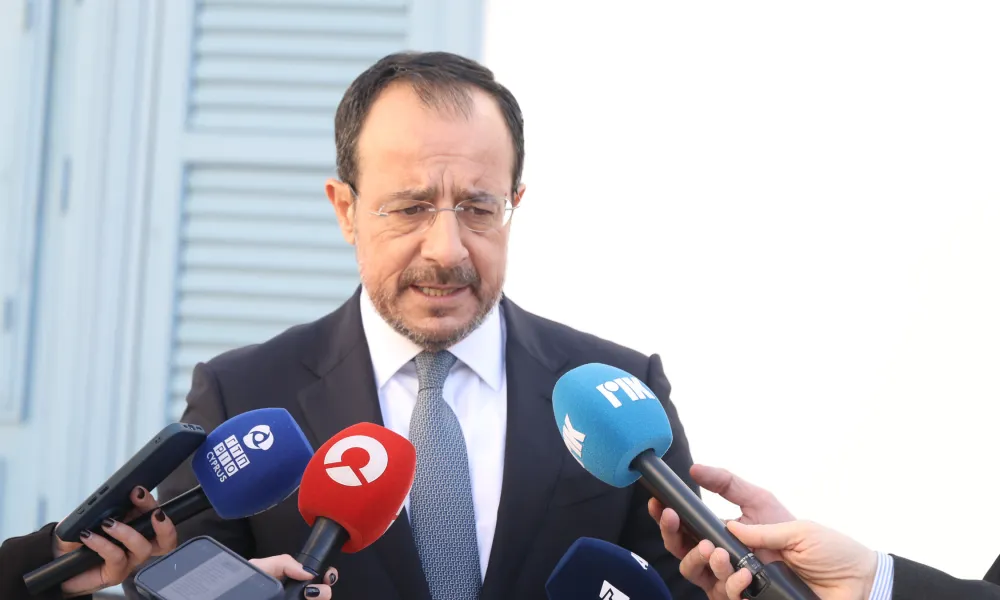
Speaking at Mammari, after the national memorial service for EOKA hero Savvas Rotsides, and asked about Aykut's release, President Christodoulides said that "Mr Aykut, if he were in Cyprus, given the state of health he is in, could have been released from August 2026".
He added that "it is very important that Israel recognised the reasons for which Mr Aykut was punished, for the illegal acts he committed".
"Third, it is very important that after his conviction by the Republic of Cyprus, we have a dramatic reduction in the illegal purchase of properties in the occupied areas by Israeli nationals," he noted.
Referring to Aykut's transfer to Israel, the President said that "the Republic of Cyprus, because it is an internationally recognised state, a member state of the United Nations, has contractual and international obligations as a state governed by the rule of law".
"We are not a pseudo-state, we are an internationally recognised state," he stressed, adding that the Republic of Cyprus "responded to the request for Mr Aykut to be sent to Israel".
President Christodoulides recalled that legislation on the consequences of the illegal usurpation of properties in the north has existed for many years.
"I am glad, I am proud that only our government dared to take such cases before the courts, and we will continue to do so," he concluded.
DISY: "We warned. The government did not listen"
DISY Famagusta MP Nikos Georgiou said in a written statement titled "We warned" that the government had failed to secure the necessary guarantees and safeguards for what would follow Aykut's transfer to Israel.
"Do you remember the case of the Israeli usurper of Greek Cypriot properties, Simon Aykut? We warned. The government did not listen. And today, unfortunately, we have been proved right. From the very first moment of the decision to transfer Simon Aykut to Israel, I publicly warned of the risks. I asked the obvious question: what will happen when Aykut is outside Cypriot jurisdiction? Will he at some point appear free? We also warned about the resumption of work on Greek Cypriot properties in the occupied areas, and about the risk that interests linked to the usurpation of refugees' properties would continue their activity undisturbed. Today all of this is being confirmed," Mr Georgiou said.
"Citing a deterioration in his health, Aykut was released in Israel, while the Republic of Cyprus, according to what has been made public, was not informed in advance. And this is the crux of the matter. The issue does not concern Israel. Israel protected one of its nationals. The question is: did the Cypriot government protect the interests of the Republic of Cyprus? Because the government knew the case. It knew the risks. It knew the importance of Aykut's conviction for the issue of the usurpation of refugees' properties. And yet it does not appear to have secured the necessary guarantees and safeguards for what would follow his transfer to Israel. The Republic of Cyprus cannot follow developments after the fact and learn that someone convicted in a case concerning the usurpation of Greek Cypriot properties has been released," he added.
"The government should have foreseen this. Just as we had foreseen it. Refugees and owners of properties in the occupied areas are entitled to much more than after-the-fact statements. They are entitled to determination, a plan and the effective defence of their rights. And today, if anyone must apologise, it is not Israel. It is the Cypriot government that owes refugees an apology. For the lack of determination. For the inadequate assessment of the risks. For the absence of the necessary safeguards. And for the wrong messages it sent," he noted.
Ecologists: "Government and Legal Service remain exposed"
The Movement of Ecologists described Aykut's transfer to prison in Israel as a fiasco, which it said ended with his release. The movement expressed anger at the development and at what preceded it, and asked whether anyone would answer for it, even now.
In a statement, the movement said the development "in no way surprises" it, and that it had formally warned the Christodoulides government.
It said that the government and the Legal Service remain exposed because, before the case was tried, key charges were withdrawn: 200 of the 240. These included significant charges of money laundering and corruption which, it noted, should also have been of interest to the European Union.