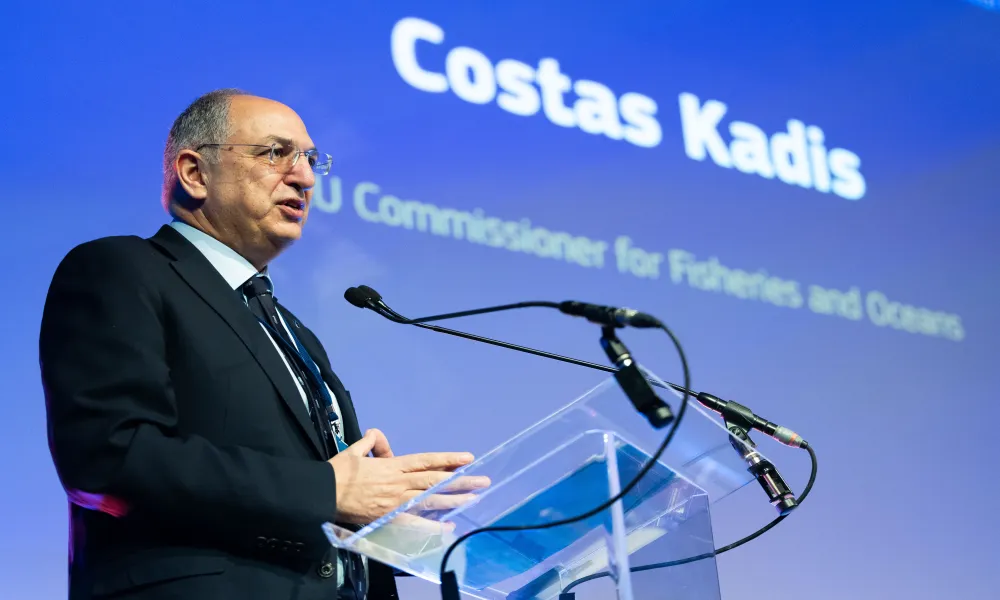

His wife Marina's social media posts on the mass killings of children in Gaza, and on other current issues, through which she at times criticises the government and parliamentary parties, are prompting debate and reactions. Some are even trying to link these public positions both to him and to his role as European Commissioner. Costas Kadis makes clear that his wife, Marina Michaelidou Kadi, an award-winning children's author and a champion of animal and environmental protection, is an independent person with every right to express her views freely, without needing his permission. He also reveals that he received no intervention or complaint from President Christodoulides about his wife's posts.
The European Commissioner for Fisheries and Oceans talks about research into using the silver-cheeked toadfish's toxin to develop cosmetic products as a possible alternative to Botox, the problems facing Cypriot fishers, and Cyprus's prospects in marine research.
In a joint interview with Politis and Phileleftheros, the European Commissioner for Fisheries and Oceans also talks about the challenges facing the European fisheries sector and the problems of Cypriot professional fishers. He refers to the loss of fishing grounds, rising fuel costs and the spread of the silver-cheeked toadfish, revealing that research is under way into using its toxin even in cosmetics, as an alternative to Botox. Mr Kadis also discusses the prospects of Cyprus becoming a regional centre for marine research, European initiatives to protect the seas, and his plans after his term ends.
Recently, your wife's social media posts have caused debate and reactions, mainly over her positions on Gaza, but also on other issues concerning Cypriot society. Some even link her public positions to your own role as European Commissioner. Were there any interventions on the matter from the Presidential Palace? And what do you say to those who link your wife's views to your institutional role?
Marina is an independent person, and I am not going to dictate to her what she can and cannot express. And I am truly puzzled by posts that link Marina to my own role. Are we living under a regime where a woman must get her husband's permission before expressing an opinion? But I also want to share something more personal with you. What brought Marina and me together, when we met, was our love of and work on the environment. I was more of a technocrat, Marina had a more activist voice. I believe both are needed in the world we live in. From then until today, Marina has expressed her views in various ways, particularly through her children's books, which touch on sensitive environmental and social issues and have won recognition both in Cyprus and internationally. In substance, I do not believe there is anyone who is not saddened when children are killed or targeted, wherever they may be.
I received no intervention on this matter from the President, with whom I have excellent relations. He himself, after all, is in favour of freedom of expression and pluralism in our society.
The European Commission's recent report on Turkey sets out clear criticism of Ankara's stance on issues concerning Cyprus. According to our information, you also contributed to shaping the relevant references. What was your role?
What I can say is that, during the preparation of the report, there were coordinated efforts to set out Turkey's obligations clearly. The report expresses the collective position of the Commission.
Reports are emerging of behind-the-scenes consultations on the next Cypriot Commissioner. Would you be interested in continuing in this post in the next European Commission?
At this time, my team and I are focused on carrying out our mission in the best possible way. And I will do this with all my strength until the last day of my term, so that I serve European citizens as well as possible and honour my country and those who entrusted me with this post. After my term ends, my intention is to return to Cyprus.
According to Mr Kadis, fluctuations in energy prices have repeatedly threatened the viability of European fisheries. That is why, he points out, the Commission recently approved the Roadmap for the sector's energy transition.
Fisheries and Cyprus
On 20 October 2026, the European Commission presented Vision 2040 for fisheries and aquaculture, aimed at the sector's sustainability and competitiveness and the protection of marine resources. What tangible changes can European fishers, and Cypriot fishers in particular, expect in the coming years?
Vision 2040 concerns two critical sectors. Two sectors that bring affordable and healthy food to our tables, support coastal and island economies, and shape the identity of hundreds of local communities in the EU. With Vision 2040, we want to give these sectors stability and prospects. Through dialogue with all stakeholders, we arrived at the characteristics fisheries and aquaculture should have by 2040. To reach the level we want in 2040, our action must start today. And Vision 2040 includes actions that will make the sectors more competitive, resilient, sustainable and attractive to the new generation. Among the actions in Vision 2040, those that stand out concern support for small-scale fishers, modernising the fishing fleet to reduce greenhouse gas emissions and improve working conditions, managing unwanted catches, and protecting the European fisheries products chain from unfair international competition. For aquaculture specifically, a new, clearer, simpler and more coherent legislative framework is being put in place.
Cyprus is located in a particularly sensitive region, the Eastern Mediterranean. Does European fisheries policy take sufficient account of the particularities of island states, or does it apply horizontal measures that do not always meet local needs?
Europe has more than 4,000 islands, which, together with coastal communities, are an integral part of its identity, economy and maritime heritage. These regions face particular challenges, but they also have significant development potential. To respond to their needs and particularities and make use of their potential, last June we adopted two strategies, one for the EU's coastal regions and one for its island regions. These strategies were in fact presented in Cyprus, in the context of the Cyprus Presidency. They include measures covering economic development, connectivity, the blue economy, climate resilience and quality of life, with solutions adapted to local realities. This approach also applies to Cyprus.
On your recent visit to the Zygi fishing shelter, you heard directly from professional fishers. What are the main challenges they face, and what next steps did you discuss with them?
Yes, it was a very useful discussion. My visits to member states and direct contact with fishers help us shape policies that meet their real needs. At Zygi, the loss of fishing grounds was highlighted in particular, because of coexistence with the infrastructure of the energy centre and with aquaculture. I must tell you that the sector faces similar challenges in several other member states. Proper maritime spatial planning is the answer to the increased competition over where various beneficial activities are located in the marine environment. We are currently promoting the "Ocean Act", which improves maritime spatial planning so that it better meets the needs of coastal fishing. Other challenges the fishers at Zygi raised were the high cost of fuel and the problems caused by invasive species in our seas, such as the silver-cheeked toadfish and the lionfish.
For all the challenges the fishers presented to us, the EU gives member states tools that can support the sector. And it is with particular satisfaction that I found the Cypriot government is making use of these tools. Minister Mr Senekis has shown particular sensitivity to fishers' problems.
Which support tools for the sector are you referring to?
The European Maritime, Fisheries and Aquaculture Fund (EMFAF) can support fishers for loss of income due to the loss of fishing grounds. It also supports the energy transition and makes it easier for small coastal fishing businesses to access aid. After the blockade of the Strait of Hormuz, we activated the Fund's crisis mechanism to provide financial support to the sector, which Cyprus also used. We are examining extending it into 2027, as the current provision covers 2026.
Through the "Horizon Europe" programme, we support research into the impact of climate change on fisheries, species and ecosystems, while we work with the General Fisheries Commission for the Mediterranean on invasive species. At the same time, the EMFAF funds targeted actions, such as support for professional fishers to catch silver-cheeked toadfish in Cyprus.
The toadfish and... Botox
Is subsidising the catch of silver-cheeked toadfish enough, or is a wider strategy needed for invasive species and the protection of Mediterranean biodiversity?
Tackling the impact of the spread of invasive species is an exceptional priority for the EU, and our action on the issue is not limited to simple subsidies. For some species, such as the lionfish, we are promoting their commercial use. For others, such as the silver-cheeked toadfish, which do not lend themselves to such use, we encourage member states to use the available EMFAF resources. For longer-term and holistic solutions, we fund research through which we hope this species could also acquire economic value. For example, researchers are working on neutralising the toxic substance in this fish so that it can become edible. Other researchers are working on using the fish's toxin for cosmetic purposes, as an alternative to the substances used for Botox.
The EU is promoting the energy transition of the fishing fleet. How can this happen without additional financial burden on small professional fishers, who are already struggling to cover their operating costs?
Fluctuations in energy prices have repeatedly threatened the viability of European fisheries. That is why the European Commission recently approved the Roadmap for the sector's energy transition. The Roadmap combines immediate energy-efficiency measures with research, innovation and pilot projects for wider use of low- and zero-emission technologies. Public funding remains essential, particularly when limited investment capacity makes it difficult for small professionals to make the necessary changes. Supporting innovation and infrastructure is part of this effort.
Illegal, unreported and unregulated fishing remains a problem. What tools does the EU have to tackle it in the Mediterranean, and how effective are the checks?
The EU shows zero tolerance towards illegal and unregulated fishing. The key tool is the relevant European regulation, in force since 2010.
The regulation provides for dialogue with third countries on meeting their international obligations. If these countries' response is judged insufficient, a "yellow card" can be issued, followed by a "red card", with a possible ban on imports of marine fisheries products into the European market. The system has contributed to significant progress on fair competition and the improvement of stocks.
This year, we launched CATCH, the first EU-wide digital certification system for catches to be imported into the EU. It digitally supports the checks and verification of imported consignments, preventing products of illegal fishing from entering the European market. We have already seen the tool's effectiveness, through the blocking of catch consignments that came from illegal fishing.
"Are we living under a regime where a woman must get her husband's permission to express an opinion?" There was no intervention from President Christodoulides over his wife's posts, says Costas Kadis.
The TEPAK school
Cyprus is investing in marine research, among other things through the creation of the Cyprus University of Technology (TEPAK) School of Marine Sciences in Larnaca. How can the European Commission support Cyprus in becoming a regional centre for research and innovation in the Mediterranean?
The creation of the TEPAK School of Marine Sciences in Larnaca is an important step in strengthening Cyprus as a regional centre for marine research and innovation. The Commission can support this prospect through the "Horizon Europe" programme and its successor programmes, cohesion policy, and the initiatives for Centres of Excellence. Cyprus already benefits significantly and ranks among the strong innovators in the European Innovation Scoreboard. It hosts EU-supported Centres of Excellence and has a National Research and Innovation Strategy and a Smart Specialisation Strategy, aligned with European priorities, mainly the green and digital transition.
You are the first Cypriot Commissioner to hold the Fisheries and Oceans portfolio. How easy is it to serve the interests of the Union as a whole while also highlighting the particularities of a small island country such as Cyprus?
Coming from a small island state is both a responsibility and an advantage when you serve the whole Union. I work for the European interest, listening to and understanding all coastal and island communities, from the Mediterranean to the Baltic, the Black Sea and the Atlantic. I fully understand the importance of the sea for livelihoods, connectivity, security and sustainability. We promote balanced European solutions that reflect the Union's diversity and serve common goals.
What do you consider your most important achievement so far as European Commissioner, and what is the biggest outstanding issue you want to settle by the end of your term?
Although it is difficult to pick just one initiative, I would single out the European Ocean Pact, the EU's first comprehensive strategy for the protection and sustainable management of our seas. For the first time, we brought all ocean policies together in a single, coherent framework. We are now focusing on the practical implementation of the actions the Pact includes. And we have already made very significant progress. By the end of my term, I want us to have turned the Pact's commitments into tangible results for the state of the marine environment and for supporting the people who depend on it.
"The creation of the Cyprus University of Technology's School of Marine Sciences in Larnaca is an important step in strengthening Cyprus as a regional centre for marine research and innovation," the Commissioner notes, leaving open the possibility of the EU supporting this prospect through funding instruments.