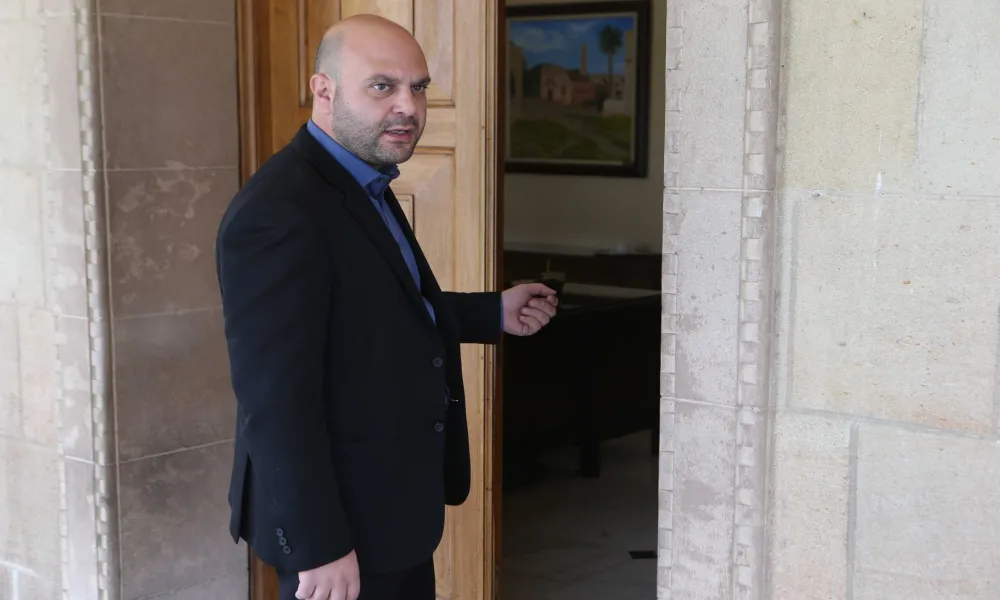

After yesterday's electoral congress of the National Popular Front (ELAM), at which Christos Christou remains leader, as he has been since the party was founded in 2008, preparations are beginning for the party's political congress in January. At the same time, contacts will take place ahead of the 2028 presidential elections.
The final decision on the elections is expected in spring 2027, after the current President of the Republic, Nikos Christodoulides… admits what everyone expects: that he will seek re-election.
It has been clear for some time that ELAM and Nikos Christodoulides are preparing the ground for a political alliancein the 2028 presidential elections, from the first round. It is known that the two sides are in frequent contact. Some (limited) appointments of ELAM members to posts have been made, the government machinery meets requests coming from ELAM, and the party's officials do not (harshly) criticise the government. If anything, they defend it, the latest example being Mr Christodoulides' 12 measures to tackle the high cost of living.
Visible cooperation
ELAM's support for Nikos Christodoulides in the 2028 presidential elections from the first round is no longer a hypothetical scenario. It is a prospect that appears to be gaining political ground within the far-right party.
"The discussion is not only about whom ELAM will back in 2028, but also what it will receive in return for its support."
Although there is no official decision so far, and the issue has not been put before ELAM's collective bodies, the signs point to a relationship of political understanding that appears to be developing into visible electoral cooperation.
Seeking a role
ELAM appears to see the 2028 presidential elections as an opportunity to turn whatever political influence it has gained, and its share of the vote in the parliamentary elections, into institutional participation in power, by claiming ministries and a specific role in the next government.
In other words, the discussion is not only about whom ELAM will back in 2028, but also what it will receive in returnfor its support. The message from within ELAM is clear: Mr Christodoulides is the preferred choice. However, the door to DISY's official candidate has not been firmly closed. The possibility of cooperation with DISY is being used more as leverage (a bargaining chip) than as a realistic scenario.
Ready for some time
ELAM has decided to move from the current informal understanding with the President of the Republic to a formal political alliance. Nikos Christodoulides appears to have been ready for this step for some time, as he needs ELAM's votes to reach the second round of the presidential elections.
"ELAM has decided to seek a share of executive power, and that means visibility and an equal share of posts."
ELAM officials speak of "good understanding and a positive attitude towards Christodoulides". The ELAM members who came from DISY (Pelekanos, Papacharalambous, Chamboullas) are the most openly in favour of closer ties with the President, and they are strengthening this prospect. Even so, Mr Christou sets the pace, and the mood is moving in the same direction.
A new reality
ELAM's confidence is linked to the result of the May 2026 parliamentary elections. It won 10.9% of the vote and eight seats in the House of Representatives, a significant rise. It is now the third-largest parliamentary force. DIKO was limited to 10%, while DISY remained the largest party with 27.1%.
The results of the parliamentary elections create a different political reality. ELAM no longer wants to act simply as a parliamentary force that selectively supports government initiatives, or as the tail of the Presidential Palace without enjoying the benefits, or spoils, of power. It has decided to seek a share of executive power, and that means a normal, equal share of posts.
Sharing out the posts
ELAM's aim for 2028, therefore, is to change this relationship. ELAM wants to back Mr Christodoulides openly, from the first round, to take part in his election campaign and, if he is elected, to receive ministries with people it nominates. It will also ask for equal treatment with DIKO in the allocation of ministries, as their shares of the vote are roughly the same.
According to information obtained by Politis, President Christodoulides, Nikolas Papadopoulos (DIKO leader) and Christos Christou (ELAM leader) appear to be finding common ground on how they will cooperate. The pre-election agreement will even include provision for DISY to take part in the government, through an agreement between the first and second rounds of the presidential elections, should DISY's candidate fail to reach the second round.
"Talks have begun between Christou and Christodoulides on possible cooperation in 2028 and ELAM's participation in government alongside DIKO… and DISY."
"This means we will not accept fewer ministers than DIKO. In other words, the ministerial posts should be divided by three, plus a little more for DISY as the largest party. Mr Christodoulides must not forget that without ELAM and DIKO he does not reach the second round," an ELAM official told Politis, speaking on condition of anonymity.
The same official added that ELAM sees the possible cooperation not as simple political support, but as a negotiation on forming the next government. "ELAM will be on the platform next to the President, together with the other parties supporting him. The days of hide-and-seek are over," he said.
Papadopoulos's role
One of the most important factors in whether this scenario happens is the stance of Nikolas Papadopoulos. Cooperation between ELAM and Mr Christodoulides cannot be considered separately from the position of DIKO, the President's main government partner, which will have to decide whether to stay with him in the next presidential race.
According to information obtained by Politis, the DIKO leader is taking a realistic view. A large part of his partysupports continuing cooperation with Nikos Christodoulides and taking part in the new government, and DIKO's two vice-presidents have already said so publicly.
After the DISY leader withdrew from the race for her party's 2028 nomination, cooperation between DISY and DIKO appears to be receding. Besides, Nikolas Papadopoulos no longer has anything to wait for personally (the Presidency of the House). On the contrary, a second Christodoulides term could keep DIKO in government as part of a new coalition, with the 2033 prospect still open, since the current President will not be eligible to seek a third consecutive term.
With an eye on 2033
This last point, the political horizon of 2033, also appears to be in the minds of DISY's leadership. It appears willing to back Mr Christodoulides in the second round and to take part in government if DISY's candidate fails to reach the second round.
"ELAM will be on the platform next to the President, together with the other parties supporting him. The days of hide-and-seek are over."
Since the Christodoulides presidency would end in 2033, the next five years (2028 to 2033) could serve as a period of preparation for the political ambitions of other parties and figures. Nikolas Papadopoulos and Annita Demetrioucould plan their next moves under different conditions, without facing a sitting President seeking re-election.
Nothing is given
It should be noted that DIKO's acceptance of ELAM is not a given. In any case, it is not a bed of roses. Reactions within the party, as well as the political and ideological distance between the two sides, are real obstacles.
DIKO officials (Koulias, Solomou) have already publicly expressed their disagreement with the possibility of ELAM joining the Democratic Party in a Christodoulides government. On the other hand, other DIKO officials (Papadopoulos, Leonidou) have shown the way and the method for such an unorthodox alliance. Cooperation would be based on the President's programme, and agreements would be made with Mr Christodoulides, not between parties.
This is the EDEK model. EDEK opposes a bizonal federation on the Cyprus problem, yet a formula was found for it to take part in the current Christodoulides government alongside parties that support a bizonal, bicommunal federation(albeit "with the right content").
The Cyprus problem equation
The biggest ideological obstacle to such cooperation is, without doubt, the Cyprus problem. Nikos Christodoulides supports (not fervently, rather lukewarmly) a solution based on a bizonal, bicommunal federation, while ELAM categorically rejects this model.
How can there be cooperation between two sides that "disagree" on one of the most important issues in Cypriot politics? In Cyprus, the logic of political compromise usually prevails on such matters: disagreement on a major issue, even a national one, does not rule out cooperation in other policy areas. In short, the common interest wins.
President Christodoulides already rarely refers to a bizonal, bicommunal federation, doing so only when he has to, such as in official statements and meetings. ELAM, without changing its position, can shift the focus of its political attention to the serious socio-economic problems citizens face today: the high cost of living, energy and electricity prices, housing and traffic.
In any case, there will be no developments or movement on the Cyprus problem. The current UN Secretary-General leaves at the end of the year, and it will take time for the new one to be briefed and to take new initiatives, if and when the circumstances allow.
ELAM and DISY
On possible cooperation between ELAM and DISY's official candidate for 2028, the question arises: "If it is difficult for the far-right party to secure the conditions for cooperation with Christodoulides, why would it be easier with the DISY candidate?"
An alternative scenario could be for ELAM to run its own candidate in the first round, keeping its political and electoral independence. If DISY's candidate reaches the second round, it could then agree to support him. The agreement could also include future participation in government.
The political cost
There is, however, an important factor that cannot be ignored. ELAM knows that a formal alliance with Mr Christodoulides and taking part in government would carry a political cost.
It would have to take responsibility for government decisions, compromise on policy, manage reactions from its base, and go from an anti-system political force to part of the system. ELAM knows it cannot "soften" too much, and does not want to unintentionally leave room for a new movement to emerge on its right.
If ELAM becomes fully identified with Mr Christodoulides' government policy, it risks losing part of the anti-system momentum that helped its electoral rise. On the other hand, staying outside government may limit its ability to make the most of its 2026 election result.
The dilemma, therefore, is whether to choose political influence through government participation or to keep its independence, aiming to grow its electoral base further. Everything suggests it will choose the first.