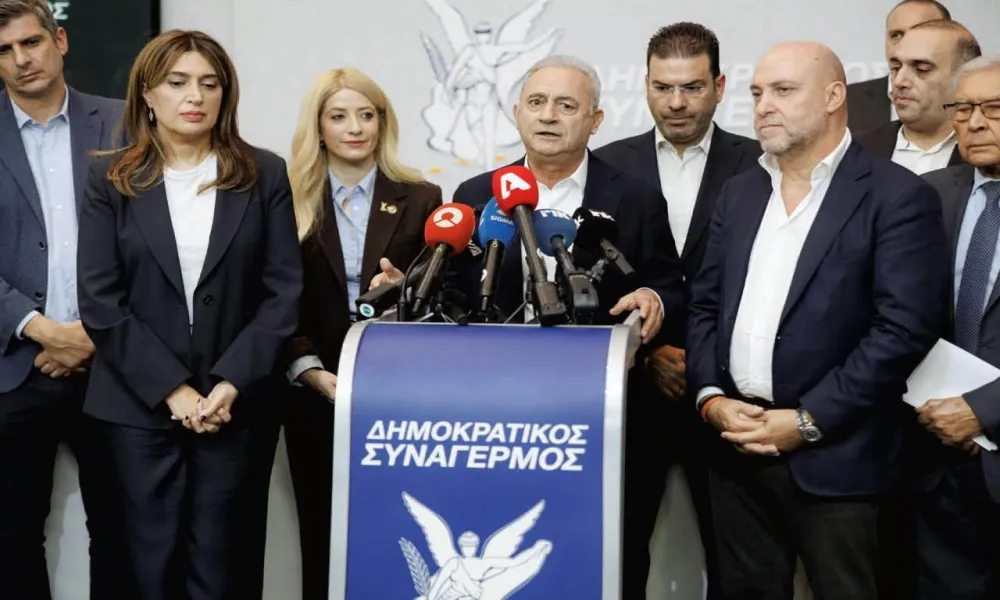



Averof Neophytou emerged as the clear winner of Saturday's internal Disy vote for the party's nomination in the 2028 presidential elections, defeating George Pamborides by a wide margin. The former Disy leader won 10,363 votes (70.47%), while Pamborides received 4,341 votes (29.53%). Turnout stood at 30.86%, with 15,089 of the party's 48,899 registered members casting a ballot. There were 14,704 valid ballots, 234 spoiled and 151 blank.
Turnout and party expectations
Media coverage on Saturday focused on what was described as weak interest in the contest and an abstention rate of 69.14%. A party source told Politis, however, that turnout should not be seen as low, given that the number of active members who pay regular subscriptions ranges between 20,000 and 25,000. The source added that the race was never considered close, and that the widespread belief Neophytou would win had reduced members' incentive to vote.
The same source recalled that in the 2023 internal election for a new party leader, 20,734 of 50,679 registered members voted, a record turnout. In the elections that followed for deputy leader and the party's three vice presidents, 16,790 of 50,750 members went to the polls, a turnout of 33.1%. That contest, the source stressed, was far more competitive, with 10 candidates running for those posts and at least 65 people competing for the 25 elected seats on the Political Bureau.
The unity challenge
The result was announced on Saturday at Disy's headquarters on Pindarou Street by Panayiotis Demetriou, head of the party's electoral committee, in the presence of both candidates and several senior party figures, in an effort to signal that Disy is moving into the next phase united. Securing that unity, however, remains the central challenge on the road to the presidential elections.
Polls show around 25% of Disy supporters backing President Nikos Christodoulides, while a considerable number of members and officials have voiced strong discontent with Neophytou's candidacy. Harris Georgiades, now president of the Glafcos Clerides Institute, has said he will not support Neophytou in the 2028 presidential elections, even if he secures the Disy nomination. Former Disy parliamentary spokesman Nicos Tornaritis has meanwhile accepted an appointment from Christodoulides as Special Political Envoy on the Cyprus problem to countries in Asia and Africa.
Party unity is therefore among the most pressing issues facing Disy, as no one can guarantee there will be no further "Tornaritis cases" in the coming period. The question now is how the party intends to handle such moves and what consequences those who choose to publicly back Christodoulides will face.
Political messages
After the official results were announced, Disy leader Annita Demetriou said at the party's headquarters that "the proud people of Disy have spoken and the verdict is respected". She sent a message of unity and announced she would meet Neophytou the following day.
Neophytou said that "the responsibility is mine to win the trust of society". He said that beyond Disy voters he wants to reach out to people on the left and in the centre, socialists and the unaligned, sending the message that "we live in a divided country with social injustices". He added that "it is these two great national issues that we want to overcome", stressing that "for us there are no political opponents, neither inside nor outside the party". He went on to say that "our great opponent is the open wound of the Cyprus problem and the problems of ordinary people".
Pamborides' defeat
Pamborides emerged from the internal vote politically weakened. His 29.53% share does not allow the Nicosia MP to make a credible bid for the Disy leadership in the future, an ambition that appeared to be at the back of his mind given the criticism he has periodically directed at the party leadership. He may have seen the nomination contest as an opportunity both to build support in the other districts and to gauge his standing among the party's grassroots. The vote showed, however, that he has strong momentum only in Nicosia district, which makes winning the leadership, something that requires strong results in every district, an unrealistic goal.
Seen in this light, the result does not upset the internal balance of power or the calculations over succession in the right-wing party. Instead, it comes as a relief to those senior figures with leadership ambitions who feared they might find themselves alongside yet another strong heir apparent. Figures such as Efthymios Diplaros and Demetris Demetriou remain in the frame for when the post-Annita era arrives.
The day after
A round of contacts between the party leadership and Neophytou opens on Sunday, focused on their cooperation ahead of the presidential elections and the joint drafting of a governance programme. The question of how much autonomy the candidate will have is expected to be raised at Sunday's meeting between Demetriou and Neophytou, with the aim of defining the political limits within which he can operate during the campaign.
Disy wants to avoid any rift between the leadership and its official candidate over the positions expected to be set out on a range of issues during the campaign. That is precisely what happened last October, when Neophytou came out in favour of a partial lifting of energy sanctions against Russia to tackle the rising cost of living, provoking a reaction from some party officials and from the party itself.
The leadership believes that certain sensitive issues touching on Disy's ideological core and long-standing positions leave little room for its candidate to diverge. It also recognises, however, that Neophytou is running in a presidential election and is therefore not addressing Disy's electorate alone.
The right to disagree
It remains unclear whether Neophytou is willing to cede a more decisive role to the party in shaping campaign positions. He may consider bold policy proposals essential, even where they do not have the party's backing. In that case, the two sides could agree that each retains the right to disagree publicly on certain issues. The candidate may also judge it better to first open talks with other political forces on possible alliances, and only then sit down with Disy to draft a campaign programme, so that the positions of others can be included.
New spokesman
Finding a common stride is one of the biggest challenges of the campaign. It is no coincidence that Disy spokesman Onoufrios Koullas raised the issue of appointing a new party spokesman who would deal exclusively with communications, as Koullas currently also serves as the party's executive director. Demetriou accepted his proposal and it was decided that a new person would be appointed to the post after the internal elections. Demetriou has approached several people in recent weeks about taking on the role, and announcements are expected in the coming days.
Turnout by district
At district level, the highest turnout was recorded in Pafos, where 2,141 of 5,975 registered members voted (35.83%). Free Famagusta district followed with 33.59% and 1,479 voters. In Nicosia, which has the largest number of registered Disy members, 5,497 members voted for a turnout of 31.32%, while in Larnaca 2,699 members went to the polls, a turnout of 30.72%. The lowest turnout among the districts was in Limassol, where 3,142 of 11,480 registered members voted (27.37%). At polling stations abroad, 131 members voted, a turnout of just 18.58%.