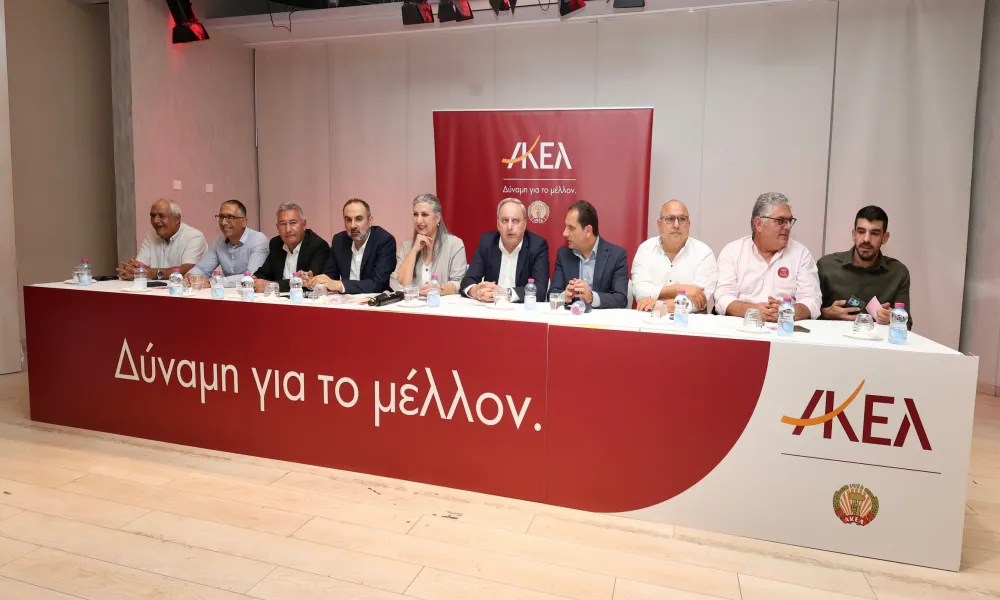



As Akel's round of district conferences draws to a close, with Limassol on Sunday and Pafos on 5 December the last stops, the leadership of the left faces an equation it has yet to solve. The party is looking for more than a way out of its search for a presidential candidate within the timetable set by its Central Committee; it wants a solution that is productive and capable of generating real momentum towards power. The Central Committee's goal of a "progressive change" in 2028, set against what the left describes as the "dystopia" of the Anastasiades and Christodoulides administrations, runs up against a political reality shaped by numbers, ideological limits and personal choices.
Realism and momentum
Whether Akel can emerge unscathed from the search for a candidate is now a question that goes beyond its internal capabilities. It turns on whether the leadership is measuring correctly and realistically what so far appears to be a given, namely the party's inability to make a serious bid for power, which it has not held for 15 years. That concern dominates the current phase, yet circumstances are once again pushing the party strongly towards a repeat of its recent practice, unless a failure to reach agreement with other political forces leads Akel to run a candidate entirely of its own.
For now, and under some pressure of time, Akel is searching for a candidacy that can carry a strategic message and win social appeal beyond the walls of one of the two largest parties. The leadership continues to court the idea of a broader opposition front, even though the rise in the party's share at the last parliamentary elections has given some the sense that a solo run may not be entirely out of the question. That lingering possibility has less to do with the party's poll numbers than with strengthening its voice and political influence among those the leadership is trying to reach. The question is whether the geometry of any alliance can be stabilised, given the constant instability surrounding it so far.
The clash with Diko
Akel's public clash with Diko and its accusations of a planned co-government with the far-right Elam under Nikos Christodoulides are no coincidence, and they amount to far more than an ideological dispute. The sudden suggestion by some in Diko that the party should not return to its partnership with Christodoulides was in essence an attempt by Diko to negotiate with the current president over the spoils of power. Akel was unwilling to play along with Diko's games by keeping itself on hold for a supposed dialogue with Nicolas Papadopoulos, at the same time as he was using negotiating leverage on Christodoulides for a greater share of power.
In these circumstances, Akel hopes to act as a pole of attraction for forces such as Edek, Odysseas Michaelides' Alma, Volt and the Cyprus Greens. Party officials acknowledge that a front of smaller parties is anything but straightforward. The meetings under way until Christmas are running up against internal procedures within Edek and the Cyprus Greens, as well as deep political differences. Akel may find common ground on fighting corruption with Edek, which already views favourably the name of economist Tasos Yiasemides, informally floated by Akel, and with Alma. Bridging the gap on the Cyprus problem is another matter entirely. An alliance may involve compromise, but it also needs a shared programme on the major issues.
Michaelides sets his own terms
The stance of Odysseas Michaelides makes the picture even more complicated. Operating outside traditional party codes, the Alma leader openly publicises his contacts and sets the terms of the game himself. After two meetings with Akel general secretary Stefanos Stefanou, and with a third expected in mid-December, Michaelides has spelled out a "Plan A" and a "Plan B" for how his party will proceed.
He is demanding a purely independent candidate with no party stamp, ruling out both Stefanou and Andreas Mavroyiannis from the outset. At the same time, he has left the door open to technocrats or institutional figures such as Yiasemides, whose name is being discussed on the left, or Transparency Commissioner Harris Poyiadjis, whom Michaelides himself put forward. He has made clear that if no candidate with a genuine chance of winning is found, Alma will run on its own. Akel is listening to and sounding out Michaelides' terms, or rather his ideas, but that does not mean it is handing over the initiative or accepting a framework that would take the larger party outside its own parameters.
The 48% trap
Faced with the risk of ideological concessions and endless bargaining, the question arises whether a party candidacy, with Stefanou himself running, could return as a clean and dignified solution. Such a choice would secure maximum party mobilisation and spare the leadership painful compromises with Alma or Edek. Under current conditions, however, a candidacy by the general secretary looks more like a choice of "honourable defeat" in the second round than a winning strategy. It addresses the question of party identity but leaves unanswered the crucial question of broadening the party's social reach.
At the same time, Akel must avoid the illusion that Mavroyiannis' 48% in the 2023 runoff is a given that can be mechanically repeated. That result was forged in the unprecedented conditions of a split in Disy and the movement of a large share of Disy voters against Christodoulides. Conditions in 2028 will be entirely different, and appealing to a "cross-party" candidate who fails to register in the polls risks leaving the party electorally trapped.
Mavroyiannis returns to the fray
Amid this murky landscape of party manoeuvring and a number of mostly internal polls, Andreas Mavroyiannis has chosen to upset the plans of those who saw him as ready to lay down his arms or even as a spent force. Sensing that a waiting game with alternative scenarios is being played at Akel's Ezekia Papaioannou headquarters, one that could erode his candidacy if he were used as a fallback option, the former candidate of the left has stepped forward with an interesting tactical move that, under certain conditions, could change the picture. Akel, however, has no wish to become captive to Mavroyiannis' calculations, and party sources stress privately that it will not take decisions in the heat of the moment or under pressure.
His statement on ANT1 on Friday can only be read as an attempt to influence the party's internal dynamics. Mavroyiannis said the chances of him running again in 2028 are now greater than not, repeating that he will make his decision by the end of the year, and added that Akel's support is not a necessary condition for him to stand. In short, he is telling Akel that he will not wait passively for decisions by the party's bodies in early 2027, nor serve as a "reserve" should talks with other parties such as Edek and Alma fail. To the Alma leader, and to Irene Charalambides, to whom he responded pointedly, his message is that no one can use tactical manoeuvres to erase potential key players from the map.
Beyond the names
Akel is effectively facing a threefold challenge. It can opt for a solo party run with Stefanou, which is a very slim possibility; it can seek a common path with Alma, Edek and other forces of the political centre, which appears the most feasible option under the circumstances; or it can find itself faced with a fait accompli in the form of a solo run by Mavroyiannis. As long as the debate is confined to names and electoral arithmetic, the left will struggle to win over a social majority. The way out of this impasse lies in answering what exactly Akel would do differently on the economy, institutions and the Cyprus problem, rather than in finding a "saviour" candidate, and this is clearly where Akel is focusing its search for alliances. Without a convincing, modern proposal for government, any electoral tactic, however clever it may look today, will keep hitting the same glass ceiling.