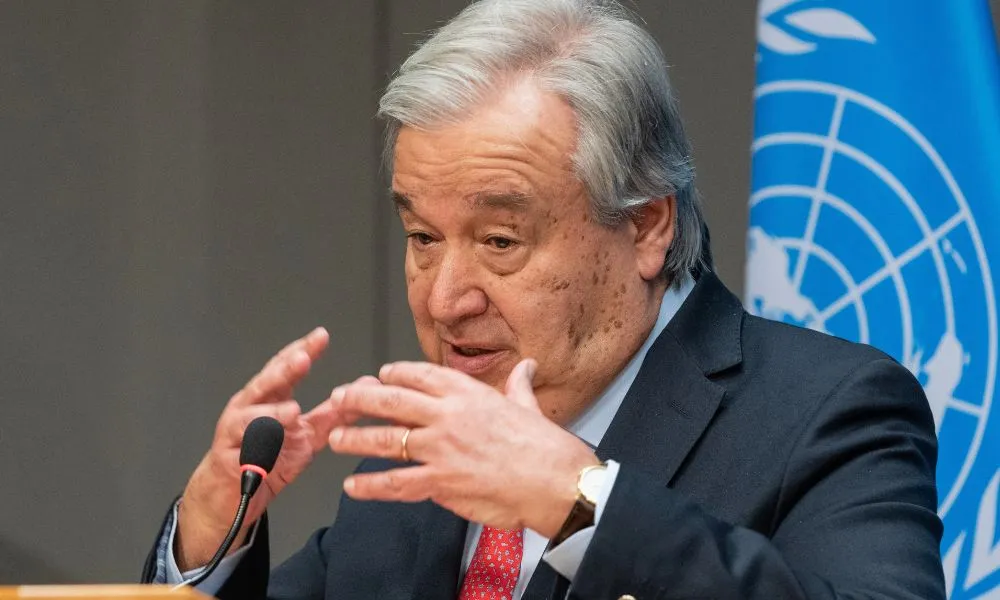

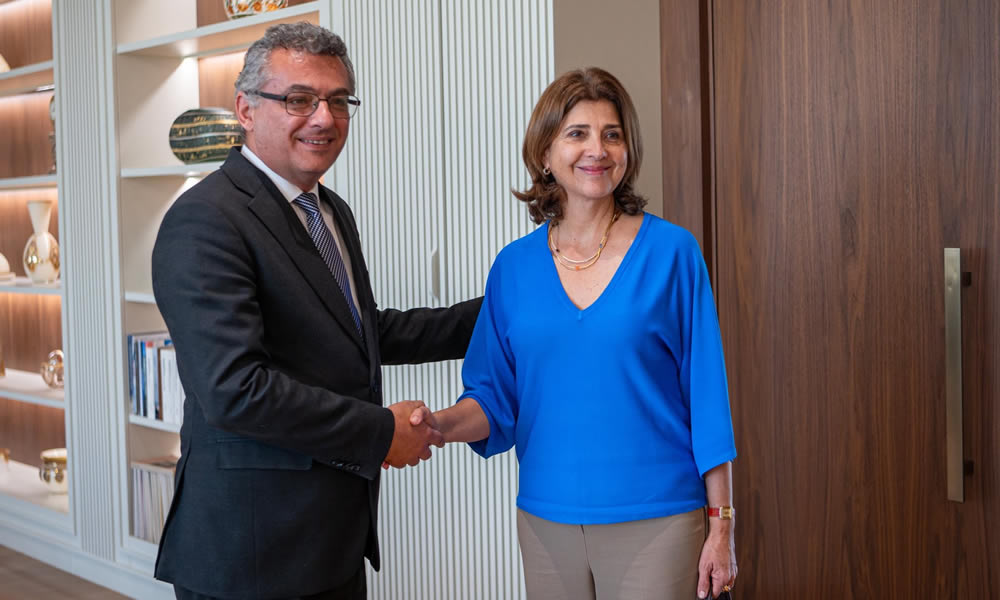
UN Personal Envoy María Ángela Holguín was expected to meet with UN Secretary-General António Guterres yesterday to brief him on her contacts in Cyprus, Greece and Turkey, and receive instructions on next steps towards convening an informal 5+1 meeting in late July or early August.
Following meetings at UN headquarters, Holguín will travel to Brussels to meet with European Council President António Costa and possibly European Commission President Ursula von der Leyen before returning to the island.
EU-Turkey focal point
A lot of focus has been put on the EU-Turkey dimension of the effort to convene a 5+1 that could finally launch peace talks to resolve the Cyprus issue – in the best-case scenario, before Guterres leaves office in December. Guterres has been in constant contact with Costa, while sources close to the effort say both Costa and von der Leyen have requested a meeting with Turkish President Recep Tayyip Erdogan on the sidelines of the upcoming NATO summit in Ankara on 7-8 July.
Turkey is reportedly interested in opening talks with the EU on a customs union upgrade, visa liberalisation for its nationals and participation in the EU’s SAFE mechanism.
However, a customs union upgrade requires EU-wide agreement while progress on visas necessitates rule-of-law reforms on Turkey’s anti-terror laws – benchmarks that have so far proved impossible for the EU to ignore and tough for Turkey to fulfil.
Rapid developments – situation in flux
According to different sources close to the peace effort, rapid developments are taking place, and not only in Nicosia, with multiple actors involved. But the situation remains very much in flux with different ideas and approaches circulating from one day to the next, making it very difficult to predict with certainty what will happen at the next 5+1. Sources from both sides in Cyprus said most discussions taking place are not reflected in press reports.
Things are moving so fast and changing in different directions, said a Turkish Cypriot source. Every meeting brings up something different, sometimes a step forward, sometimes a step back, they added.
The UNSG is trying to come up with a road map to see if it’s possible to reach a settlement, said the source. Discussions are being held in different cities to see if the sides can come together but it is too early to tell. There is no clear road map on procedure or substance, they noted. On potential ‘new’ ideas being floated, the Turkish Cypriot source said it was difficult to have a full assessment without seeing the whole picture. It was too soon to see if they are in the right direction.
The source said the Turkish Cypriot position remains in favour of a three-phase process: 1) Advance confidence-building measures, proving the leaders can deliver. 2) Agree on a clear methodology which ensures this time will be different. Many things still need clarification, such as the UN’s approach to a ‘transitional period’. 3) Start fully-fledged negotiations.
A Greek Cypriot source said a lot now rests on Holguín’s meeting in Brussels and what that produces in terms of advancing EU-Turkish relations. They expressed concern that the effort to get Turkey on board via the EU might hit a stumbling block – not at the level of institutions but member states. Turkey will want something tangible from Brussels, not goodwill alone.
It remains to be seen whether all member states will let the EU institutions provide some form of incentive to Turkey to advance relations in parallel with progress on the Cyprus peace effort.
Recent reports have suggested past convergences in the talks might be revised to create a new situation on governance and power sharing that reflects a ‘looser’ federation. The source said since both sides agree on the need to preserve past convergences, it would be ill-advised to start exploring fundamental changes to previous agreements. If they are raised at the 5+1, this could increase the chances of another failure, they added.
Analyst and PRIO researcher Mete Hatay warned that to maintain ownership of the process, the two leaders should try and do as much as possible together here on the island. “If they don’t do anything here, they will have to do it in the presence of the others at the 5+1, and they won’t be happy about it as the other guys will determine the outcome.”
Ruffling feathers
Last Sunday’s report by Politis created a whirlwind of reactions among prominent figures and the media, mostly in the north and Turkey. Beyond the Turkish Defence Ministry, former negotiators Özdil Nami and Kudret Özersay also waded in. Nami issued a stark warning against opening up past convergences while questioning the wisdom of territorial concessions in advance of power sharing. Veteran Turkish Cypriot journalist Yusuf Kanlı questioned, without concluding, whether a journalist should publish everything they know or whether it is better to sometimes remain silent for the greater good.
Turkish Cypriot leader Tufan Erhürman rejected the premature public debate that had been sparked. Claiming some reports were “entirely unfounded”, he said whatever ideas being discussed at present were “not mature” enough to warrant public discussion.
Foreign Minister Constantinos Kombos dismissed the reports as unimportant, saying what matters is not the various ideas floated but the common ground achieved.
The spark
According to the Politis report, Holguín is discussing ideas with multiple stakeholders around next steps on Cyprus that could finally get the ball rolling, some of which deviate from past convergences.
She is reportedly contemplating a solution model that sits somewhere between the previously negotiated federal model and a ‘looser’ one.
Based on reported discussions with interlocutors, the territorial map will look similar to that tabled at Crans-Montana. The federal state will be smaller in size and power, with a handful of shared competences (five or six ministries), as opposed to around 20. There would be no directly elected federal parliament but a common institution comprising parliamentarians from each constituent state. A presidential council, led on a rotating basis, would make up the executive. Guarantees could be replaced by NATO membership, creating a new basis for a smaller number of Turkish troops to remain on the island, along with troops from other countries.
Thoughts are also being given to a two-to-three-year transitional period, during which the sides could implement partial territorial returns (Varosha being the most obvious as it is uninhabited and costly to maintain if one considers Greek Cypriot claims for loss of use), and direct trade, direct contacts and direct flights for Turkish Cypriots. The Ankara Protocol could also be implemented, allowing Cypriot ships and aircraft to access Turkish ports and airports.