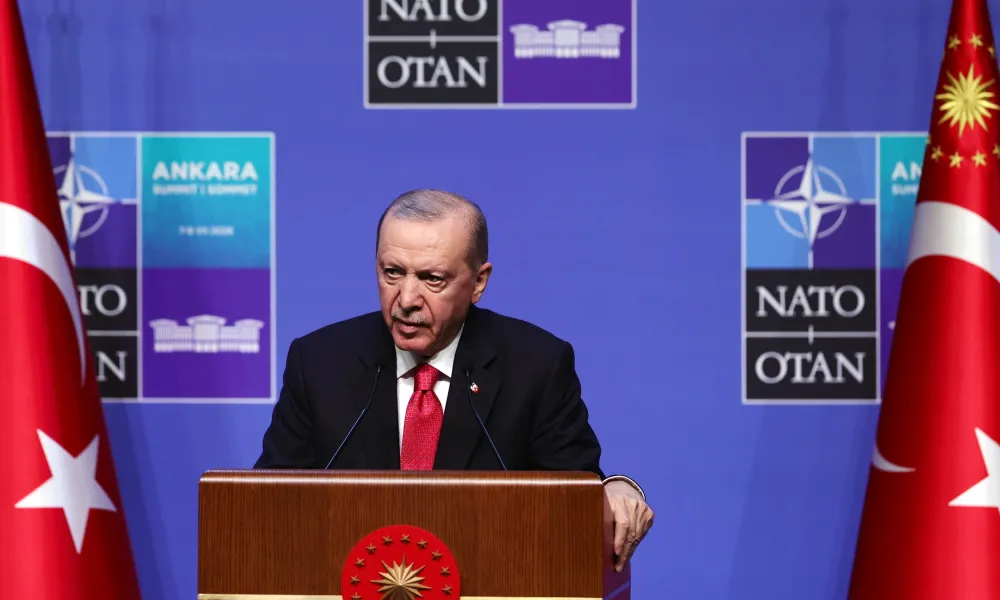

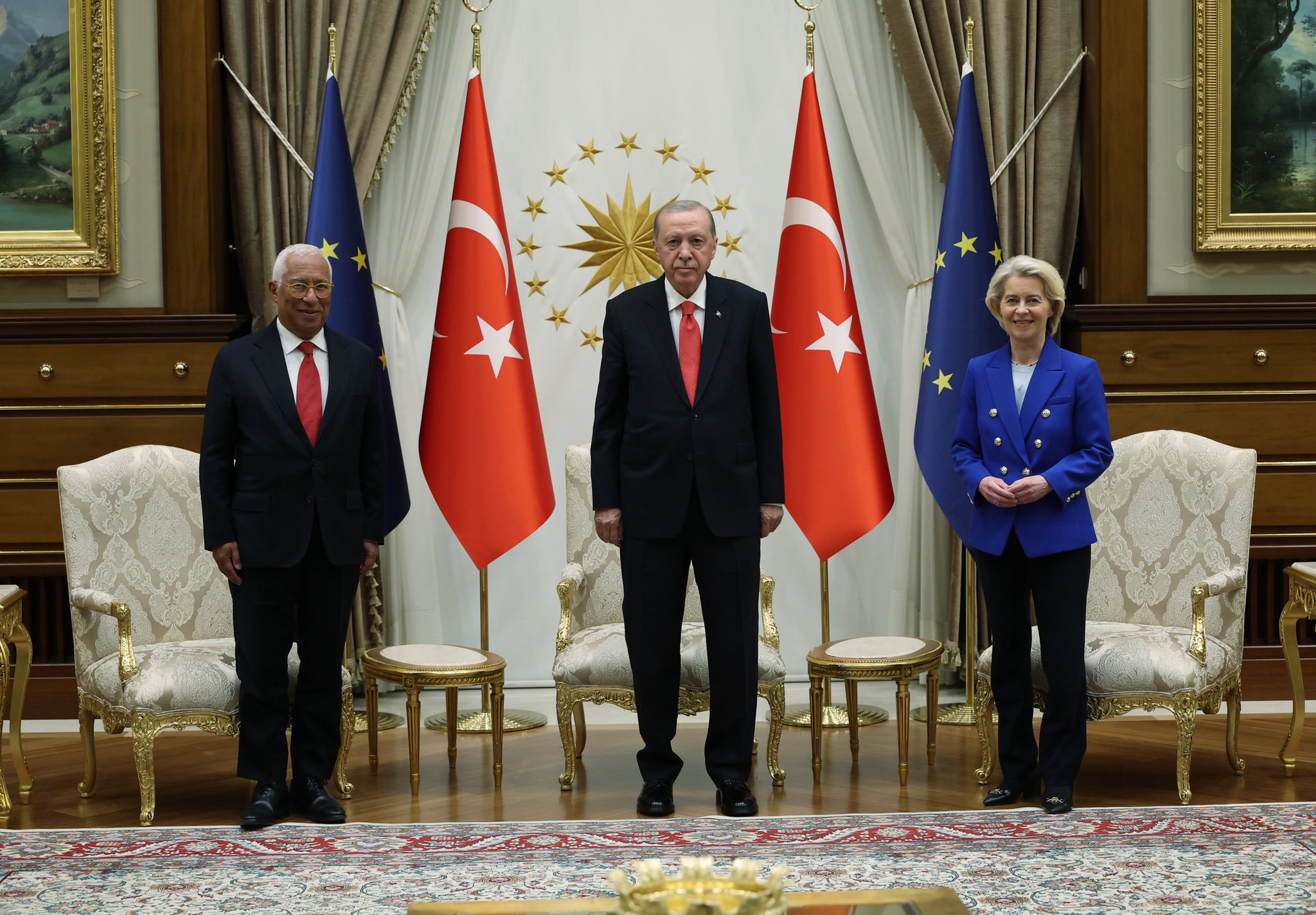
As NATO leaders departed Ankara after one of the Alliance’s most consequential summits in decades, one of the meeting’s most politically significant conversations took place away from the formal plenary sessions. Turkish President Recep Tayyip Erdoğan’s working dinner on Wednesday evening with European Council President António Costa and European Commission President Ursula von der Leyen was intended to inject fresh momentum into relations between Türkiye and the European Union. Instead, it illustrated both the remarkable improvement in the overall political atmosphere and the enduring obstacle which continues to define the relationship. While Europe increasingly sees Türkiye as an indispensable geopolitical partner in an era of war, strategic competition and energy insecurity, Brussels made unmistakably clear that Cyprus remains the central political test of any broader normalization.
The dinner represented far more than another diplomatic courtesy call. It came after months of carefully coordinated European engagement with Ankara, including visits by senior European commissioners, renewed discussions on defense cooperation, growing interest in modernizing the Customs Union, and increasing recognition that Europe’s security architecture cannot realistically be designed without Türkiye. Yet the discussions also demonstrated that while strategic realities have changed dramatically since Russia’s invasion of Ukraine and the subsequent regional crises in the Middle East, the European Union’s institutional position on Cyprus has remained remarkably consistent.
A strategic partnership seeking a political reset
The broader context of the meeting explains why both sides invested considerable political capital in making the dinner successful.
Only a few years ago, EU-Türkiye relations appeared trapped in an almost permanent cycle of confrontation. Disputes over Eastern Mediterranean maritime boundaries, tensions surrounding Cyprus, disagreements over migration, democratic backsliding inside Türkiye, sanctions debates and stalled accession negotiations had reduced political dialogue to crisis management. Contacts never disappeared entirely, but strategic confidence steadily eroded and mutual expectations fell to their lowest point in decades.
Today, however, the geopolitical environment has transformed European calculations. The war in Ukraine has elevated Türkiye’s role in Black Sea security. Continued instability in Syria and Iraq, the expanding confrontation between the United States and Iran, disruptions to global energy routes, and Europe’s ambitious effort to strengthen its own defense industrial base have all increased Ankara’s strategic value. European leaders increasingly acknowledge that isolating Türkiye no longer serves European interests and that selective engagement has become a strategic necessity rather than a political choice.
That strategic reassessment has gradually produced a more pragmatic agenda. Brussels is once again discussing modernization of the Customs Union, deeper economic integration, high-level political dialogue, expanded defense industrial cooperation, migration management and visa facilitation. None of these issues appeared politically realistic only a few years ago, highlighting how profoundly Europe’s strategic priorities have evolved.
Brussels draws a firm line on Cyprus
Despite this renewed pragmatism, Costa and von der Leyen arrived in Ankara carrying an institutional message which had been carefully coordinated in Brussels before the summit. The European Union’s growing willingness to deepen cooperation with Türkiye would not come at the expense of its long-established position on Cyprus.
Both leaders reiterated the Union’s full support for the diplomatic initiative launched by United Nations Secretary-General António Guterres and being conducted by his Personal Envoy María Ángela Holguín. They encouraged Ankara to engage constructively in preparations for the planned enlarged meeting bringing together the island’s two communities, the three guarantor powers and the United Nations, arguing that the present diplomatic climate offers a genuine opportunity to restart a process which has remained effectively frozen since the collapse of the Crans-Montana negotiations in 2017.
The public messaging following the dinner left little room for ambiguity. In identical statements published after the meeting, Costa and von der Leyen described Türkiye as a strategic partner whose cooperation has become increasingly important in an unstable international environment. They highlighted Ankara’s contributions to regional stability, its role in responding to crises across the Middle East, and its support for efforts to secure a lasting peace in Ukraine.
However, they immediately connected that broader strategic partnership with Cyprus. Both leaders argued that the present diplomatic momentum surrounding the United Nations initiative should be seized to advance a settlement under UN leadership. The sequencing was deliberate. Europe was effectively telling Ankara that improved bilateral relations and renewed movement on Cyprus are not separate diplomatic tracks but mutually reinforcing processes.
Erdoğan maintains Ankara’s new doctrine
President Erdoğan entered the discussions from a position of considerable diplomatic confidence.
Hosting NATO leaders at a moment when Europe’s security architecture is undergoing profound transformation has reinforced Türkiye’s image as an indispensable regional power. Ankara’s growing defense industrial capabilities, expanding influence across the Black Sea, Caucasus and Middle East, and increasingly central role in European energy and transport corridors have significantly strengthened Erdoğan’s negotiating position compared with previous years.
That confidence was reflected in Türkiye’s approach to Cyprus.
Rather than returning to the long-established framework of a bi-zonal, bi-communal federation, Erdoğan reportedly reiterated Ankara’s insistence that any future negotiating process must begin by acknowledging the sovereign equality and equal international status of the Turkish Cypriot side. From Ankara’s perspective, decades of negotiations have repeatedly failed because they attempted to negotiate constitutional arrangements without first addressing what Türkiye considers the fundamental imbalance between the island’s two communities.
This position does not necessarily reject negotiations themselves. Instead, Ankara argues that negotiations require an entirely different starting point from the one traditionally endorsed by both the European Union and the United Nations. That conceptual divergence continues to define the diplomatic gap separating the two sides.
Erdoğan also reiterated Türkiye’s desire to revive its long-frozen European accession process, modernize the legal framework governing economic relations and expand political dialogue. At the same time, he argued that the European Union must demonstrate greater objectivity rather than approaching Cyprus primarily through the interests of its member states, particularly the Republic of Cyprus and Greece.
The UN sees opportunity but warns against complacency
The Ankara dinner coincided almost exactly with the publication of Secretary-General Guterres’ latest Good Offices report to the Security Council, which provides perhaps the most balanced assessment of current diplomacy.
The report notes that political dialogue has intensified significantly during the past several months. Following the election of Turkish Cypriot leader Tufan Erhürman, contacts between the two leaders have increased noticeably, while their representatives have held dozens of meetings under United Nations auspices. Holguín has conducted extensive consultations not only on the island but also in Ankara, Athens, Brussels, London and Washington in an effort to identify sufficient common ground for a new enlarged conference.
Yet the report simultaneously delivers a cautionary message. Despite unprecedented diplomatic activity, practical progress remains limited. Of the confidence-building measures previously agreed by both communities, only a small number have advanced meaningfully. Negotiations over new crossing points, renewable energy cooperation, demining activities, environmental projects and several other practical initiatives remain stalled.
Guterres therefore argues that confidence-building measures cannot become substitutes for political negotiations. While practical cooperation can improve daily life and rebuild trust between the communities, only substantive negotiations can produce a comprehensive settlement. Unless greater flexibility emerges, today’s diplomatic momentum risks becoming another missed opportunity.
Europe increasingly offers incentives rather than pressure
One of the most notable changes in European diplomacy has been a shift away from a predominantly punitive approach toward one built increasingly around incentives.
Rather than presenting Cyprus simply as a precondition, Brussels increasingly argues that positive movement on the island would unlock a much broader transformation in EU-Türkiye relations. Modernization of the Customs Union, expanded visa facilitation, closer participation in European defense initiatives, higher levels of political dialogue and renewed economic integration are all increasingly presented as potential dividends of successful diplomacy.
This represents an important evolution in European thinking. For much of the previous decade, discussions focused overwhelmingly on sanctions, disputes and political conditionality. Today’s diplomacy instead seeks to create positive momentum without abandoning the Union’s long-standing political principles.
Whether that balance can ultimately succeed remains uncertain. European officials appear increasingly convinced that geopolitical realities require closer cooperation with Ankara. Nevertheless, they also remain equally convinced that abandoning established positions on Cyprus would undermine the credibility of the European Union itself.
The guarantor powers return to the diplomatic center
The broader diplomatic choreography unfolding around the NATO Summit also demonstrated that Cyprus has once again become a genuinely multilateral strategic issue.
Erdoğan’s separate meeting with British Prime Minister Sir Keir Starmer resulted in the signing of a new security and defense partnership agreement, reaffirming the close cooperation between two of Cyprus’ guarantor powers. Greek Prime Minister Kyriakos Mitsotakis also met Erdoğan during the summit. Although Athens continued to express concerns regarding unresolved disputes in the Aegean, both leaders emphasized their intention to preserve constructive dialogue and continue diplomatic engagement.
Cyprus itself featured only indirectly in these bilateral discussions. Nevertheless, all three guarantor powers are expected to participate in the enlarged meeting currently being prepared under United Nations auspices. Holguín is scheduled to continue consultations in Brussels before returning to the island, while discussions continue over convening the expanded conference later this summer.
Geopolitics creates momentum, but Cyprus still defines the limits
The Ankara dinner demonstrated that EU-Türkiye relations have entered a fundamentally different strategic phase. Europe increasingly acknowledges that Türkiye is indispensable to its security, energy resilience, migration management and emerging defense architecture. Ankara likewise sees substantial economic and political benefits in rebuilding its relationship with the European Union after years of mutual estrangement.
Yet the meeting also confirmed that geopolitical necessity has not erased longstanding political disagreements. Instead, it has merely changed the environment in which those disagreements are managed.
For Brussels, Cyprus remains the indispensable political gateway through which broader normalization must pass. For Ankara, any sustainable settlement requires recognition of the sovereign equality and equal international status of the Turkish Cypriots before negotiations on institutional arrangements can meaningfully resume. Those positions remain fundamentally incompatible, ensuring that despite a renewed atmosphere of cooperation, the Cyprus question continues to define both the possibilities and the limits of the evolving partnership between Türkiye and the European Union.
Whether the diplomatic momentum generated in Ankara can eventually narrow that gap will become clearer over the coming weeks, as Holguín resumes her shuttle diplomacy and preparations intensify for what may become the most consequential Cyprus meeting since Crans-Montana nearly a decade ago.