
The Ankara Summit did not simply improve the political atmosphere between Türkiye and the United States. It reflected a much broader transformation taking place within NATO itself as the Alliance adapts to what increasingly resembles a new Cold War. Russia’s sustained confrontation with the West has restored territorial defense as NATO’s overriding priority, while redefining the strategic roles of individual allies. Poland has emerged as the Alliance’s central forward front facing Russian expansionism. Norway, in the High North, and Türkiye, across the Black Sea, Eastern Mediterranean, Caucasus and Middle East, have regained renewed importance as flank powers in an increasingly contested security environment.
This emerging NATO 3.0 is not merely a return to Cold War habits. It is a more fragmented, burden-sharing-driven and regionally stretched alliance in which the United States expects European allies to assume greater responsibility for their own defense while Washington redirects more strategic attention and military resources toward long-term competition with China in the Indo-Pacific. In such an environment, geography, military capacity, defense industrial production and regional reach matter more than ever. Türkiye possesses all four.
Within this evolving strategic framework, Türkiye has become considerably more valuable than it appeared only a few years ago. Rather than viewing Ankara primarily through disputes over Syria, the S-400 air defense system or CAATSA sanctions, Washington increasingly sees a country that controls NATO’s access to the Black Sea, fields the Alliance’s second-largest military, has developed one of Europe’s fastest-growing defense industries and maintains diplomatic channels simultaneously with Ukraine, Russia, the Middle East and the Caucasus. The logic underpinning the bilateral relationship has therefore begun to change. Strategic utility is gradually replacing political frustration as the dominant factor shaping American policy toward Türkiye.
This reassessment represents a remarkable departure from the trajectory of the past decade. Turkish-American relations had become trapped in a cycle of recurring crises that steadily eroded one of NATO’s most important bilateral partnerships. Deep disagreements over Syria, particularly Washington’s military cooperation with Kurdish armed groups that Ankara regards as terrorist organizations and that the United States itself has designated as terrorist entities in other contexts, combined with Türkiye’s acquisition of the Russian-made S-400 air defense system, its removal from the F-35 Joint Strike Fighter program, the imposition of CAATSA sanctions and increasingly confrontational political rhetoric to produce one of the most difficult periods in bilateral relations since the end of the Cold War.
Despite those tensions, the relationship never completely broke down. Diplomatic dialogue continued, military-to-military channels remained open and both countries maintained operational cooperation within NATO. Yet the strategic trust that had long underpinned the alliance steadily diminished. Instead of pursuing ambitious common objectives, Ankara and Washington increasingly found themselves managing successive disputes, with crisis prevention replacing strategic partnership as the defining feature of the relationship.
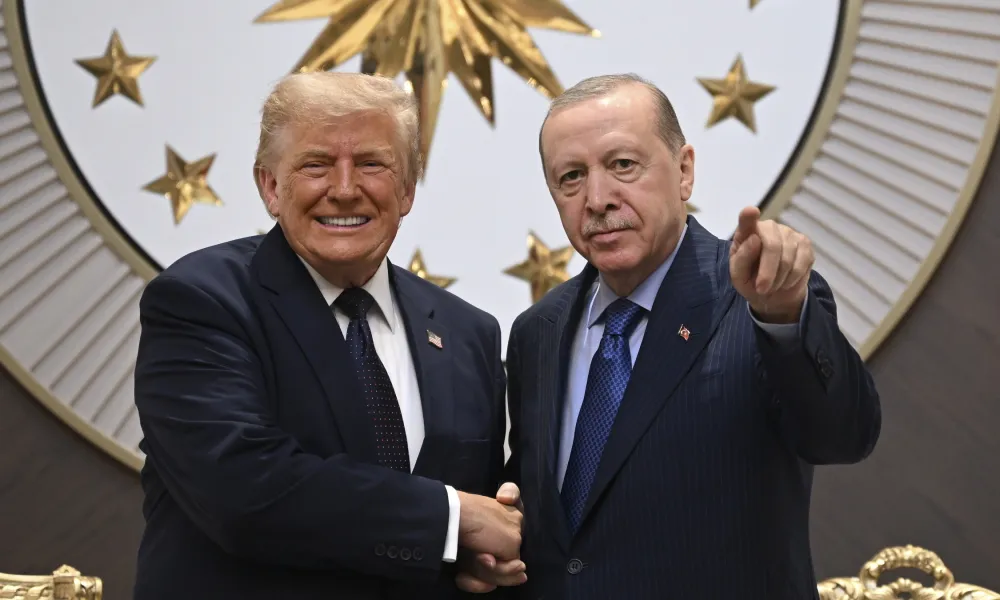
The Ankara NATO Summit suggests that this prolonged period of estrangement may now be giving way to something fundamentally different. Whether every commitment announced by Presidents Donald Trump and Recep Tayyip Erdoğan ultimately survives Washington’s legislative and bureaucratic processes remains uncertain. What already appears clear, however, is that both governments have concluded the strategic costs of sustained confrontation now outweigh the political risks associated with rebuilding cooperation. The summit’s significance therefore lies not only in the announcements it produced but also in the strategic philosophy it revealed.
Rather than revisiting accumulated grievances, Trump and Erdoğan emphasized common interests, defense cooperation, regional stability and leader-to-leader confidence. Their language reflected a relationship increasingly shaped by geopolitical necessity rather than ideological affinity. It also reflected the realities of a new alliance environment in which NATO needs Türkiye’s geography, military weight and industrial capacity, while Türkiye needs access to advanced Western defense technology to sustain its own strategic autonomy.
A changing strategic map
Russia’s war against Ukraine fundamentally altered Europe’s security architecture. The Black Sea is once again central to NATO’s calculations, and Türkiye’s control of the Turkish Straits under the Montreux Convention has acquired renewed strategic value. Ankara’s ability to maintain dialogue with both Kyiv and Moscow, while remaining inside the Western alliance structure, has further increased its diplomatic relevance. Few NATO members possess that combination of geography, military leverage and political access.
At the northern end of the Alliance, Norway has become central to NATO’s High North posture as Arctic security, Russian naval activity and North Atlantic defense return to strategic prominence. At the center, Poland has become the principal land front of NATO’s deterrence posture against Russia. At the southern flank, Türkiye occupies a similarly indispensable position, not only because of the Black Sea but also because of its proximity to the Middle East, the Caucasus, the Eastern Mediterranean and energy corridors linking Europe to Eurasia.
This emerging map gives Türkiye a role far larger than that of a difficult ally to be managed. It makes Ankara a structural component of NATO’s adaptation to a more dangerous international order. The more Washington shifts attention toward China, the more it needs capable regional allies able to carry greater responsibility in their own theaters. Türkiye’s military capacity, defense industry and operational experience therefore become assets that Washington can no longer afford to treat as secondary to political disagreements.
Trump’s return to the White House has accelerated this logic. His administration openly expects European allies to carry more of the burden for Europe’s own defense. That approach does not mean the United States is abandoning NATO, but it does mean Washington wants an alliance in which regional powers do more, spend more and produce more. Türkiye fits that model better than many European allies. It is already a major military power, it has invested heavily in its defense industry, and it has demonstrated willingness to act independently across multiple theaters.
Breaking the defense deadlock
Nowhere was the emerging reset more visible than in defense cooperation, the very field that had become the principal source of bilateral friction over the previous six years. Sitting beside Erdoğan following their bilateral meeting, Trump publicly declared his intention to remove the CAATSA sanctions imposed after Türkiye’s acquisition of the S-400 missile defense system. “We’re going to be taking the sanctions off,” he said, adding, “We don’t want to sanction friends.”
The statement represented far more than political symbolism. It marked the clearest indication since sanctions were introduced in 2020 that Washington is prepared to reconsider one of the defining policies of its relationship with Ankara. If implemented, sanctions relief would have consequences extending well beyond diplomatic atmospherics. The restrictions interrupted cooperation between Turkish and American defense industries, limiting technology transfers, exports and joint industrial projects precisely as both countries expanded their defense manufacturing capabilities.
Their removal would reopen opportunities across aerospace production, propulsion technologies, advanced electronics, maintenance, logistics and integrated NATO supply chains. In the context of NATO 3.0, this matters greatly. The Alliance’s future resilience will depend not only on troop deployments but also on industrial depth, ammunition production, engine technologies, drone systems, air defense and the ability of allies to sustain prolonged military pressure. Türkiye’s defense sector is no longer peripheral to that discussion. It has become part of NATO’s wider industrial geography.
The summit also produced another important step. Washington confirmed it would move forward with export procedures for General Electric F110 engines intended for Türkiye’s indigenous fifth-generation KAAN fighter aircraft. The decision carries significance beyond the aircraft itself. Supporting KAAN helps strengthen NATO’s southern flank while encouraging Türkiye’s rapidly expanding aerospace industry to remain anchored within the Western technological ecosystem rather than pursuing alternative partnerships with Russia or China.
For Washington, this is not simply a concession to Ankara. It is an investment in alliance management. If the United States wants Türkiye to remain militarily interoperable with NATO, it must help preserve Ankara’s access to Western technology. Exclusion creates incentives for strategic diversification. Cooperation, by contrast, allows Washington to shape Türkiye’s defense modernization from within the alliance system.
Reopening the F-35 conversation
Perhaps the summit’s most politically significant development concerned the possible reopening of discussions over Türkiye’s return to the F-35 Joint Strike Fighter program. Trump deliberately stopped short of making a formal commitment. When asked whether Türkiye could again acquire the aircraft, he replied that it was a decision still to be made, describing the F-35 as “the best plane by far” and adding that it was “certainly something we will consider.”
The wording was cautious, but its political implications were unmistakable. For years, the F-35 issue had effectively disappeared from the diplomatic agenda. Türkiye’s removal from the multinational consortium in 2019 came to symbolize the collapse of strategic confidence between Ankara and Washington. The Ankara Summit did not resolve that dispute, but it transformed something previously regarded as politically impossible into an issue once again open to discussion.
That distinction matters. Returning Türkiye to the consortium would require considerably more than presidential goodwill. Congressional legislation, Pentagon certification, industrial restructuring among partner nations, technology security reviews and negotiations with consortium members all remain necessary before any formal reintegration could occur. Diplomacy, however, often begins by changing political assumptions before legal realities begin to evolve.
By publicly reopening a conversation that had effectively been closed for years, the White House altered expectations not only in Ankara but also throughout NATO’s defense planning community. The broader significance extends beyond combat aircraft. The F-35 dispute became the defining symbol of deteriorating strategic confidence between the two allies. Reopening discussions therefore signals something larger than procurement policy. It suggests Washington increasingly evaluates Türkiye according to future alliance requirements rather than past disagreements surrounding the S-400 purchase.
Erdoğan responded with visible confidence. Recalling Türkiye’s substantial financial contribution to the multinational fighter program before its exclusion, he said he believed a positive decision would eventually be made regarding the F-35 program. The Turkish president argued that bilateral dialogue had entered a more open and constructive phase under Trump, expressing confidence that the CAATSA process could be overcome faster than previously expected.
Whether such optimism ultimately proves justified remains uncertain. What is beyond dispute is that the political atmosphere surrounding the relationship has changed dramatically.
From values to interests
Perhaps the Ankara Summit’s most enduring legacy lies not in any individual defense announcement but in the philosophical transformation it revealed. For decades, Turkish-American relations were framed primarily through the language of shared democratic values, common institutions and collective Western identity. Even when disagreements emerged, successive governments continued describing the alliance as one built upon common political principles.
The Ankara Summit suggested that narrative has evolved into something more pragmatic. Neither leader devoted significant attention to ideological affinity. Instead, discussions centered on military capability, industrial cooperation, regional stability, transportation corridors, defense production and geopolitical coordination. The alliance increasingly appears grounded not in shared political identity but in converging strategic interests.
That evolution reflects broader changes throughout international politics. Governments increasingly cooperate because doing so advances concrete national interests rather than because they subscribe to identical political narratives. Trump’s foreign policy openly embraces that transactional logic, while Ankara has long argued that strategic autonomy requires the flexibility to cooperate simultaneously with different regional actors according to changing geopolitical circumstances.
In that sense, Washington and Ankara increasingly speak the same diplomatic language. Strategic autonomy, from Ankara’s perspective, no longer necessarily requires distance from Washington. It requires the ability to cooperate with Washington without surrendering independent decision-making. Trump’s approach, by emphasizing transactions, results and burden-sharing, appears more compatible with that Turkish understanding than the values-heavy rhetoric of previous periods.
A different alliance for a different age
The relationship emerging from the Ankara Summit is unlikely to resemble the Turkish-American alliance of the Cold War or the early post-Cold War years. Both governments openly acknowledge that disagreements over Syria, Russia, the Eastern Mediterranean and regional politics will continue. Neither side expects complete policy alignment, nor does either appear to regard such alignment as a prerequisite for strategic cooperation.
Instead, both appear prepared to compartmentalize disagreements while expanding cooperation where interests clearly converge. That approach may appear less elegant than the traditional alliance built upon shared political narratives. Yet it may also prove more durable. Alliances founded exclusively upon common values often become vulnerable when domestic politics change. Partnerships rooted in enduring strategic interests frequently demonstrate greater resilience because their underlying rationale survives political transitions.
NATO 3.0, if the term is to have meaning, is precisely this kind of alliance. It is not an ideological community moving in perfect political harmony. It is a strategic network of states facing overlapping but not identical threats, balancing American global priorities, European defense anxieties, Russian expansionism, Chinese competition and regional instability. Within that network, Türkiye’s role is too important to be reduced to the disputes of the past decade.
The Ankara Summit should therefore be understood not as the conclusion of Turkish-American normalization but as the beginning of a new strategic framework. The political will to rebuild cooperation has become unmistakable. The practical implementation of that ambition, however, will depend on forces extending well beyond the two presidents. The first test was Ankara. The decisive test will be Washington.