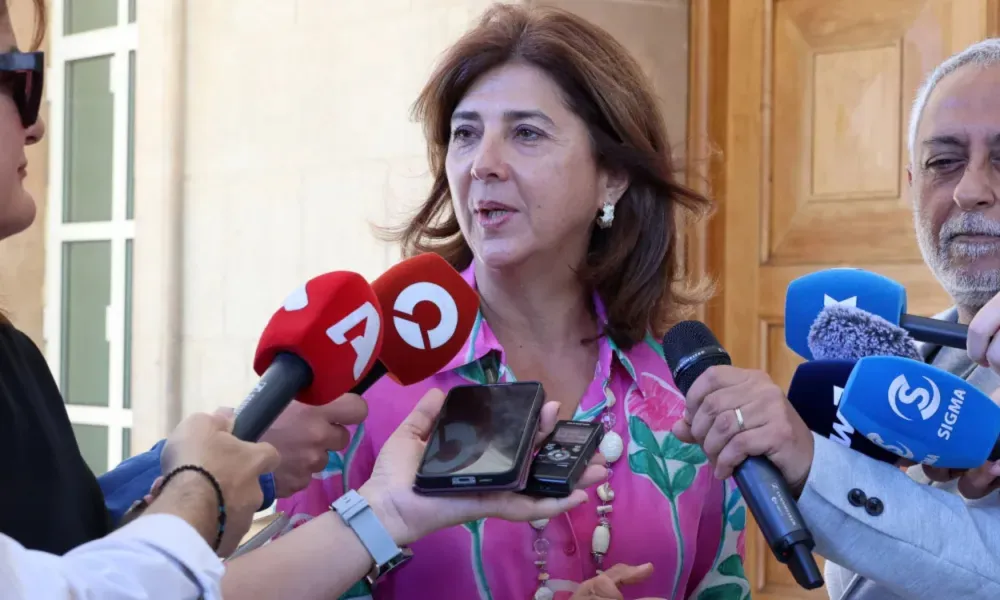

Two extensive interviews given last weekend by United Nations Secretary-General António Guterres’s Personal Envoy for Cyprus María Ángela Holguín deserve to be read together. Beyond their immediate news value, they provide perhaps the clearest public account so far of how the United Nations is trying to shape the next phase of Cyprus peacemaking and avoid another open-ended negotiating exercise that produces years of diplomacy but no settlement.
The interviews, one conducted by Yusuf Kanlı for ANKA Review and the other by Stefanos Evripidou for Politis, are, as might be expected, remarkably consistent on the fundamentals, though their emphasis differs. In Politis, Holguín focuses primarily on political agency and the immediate responsibilities of Turkish Cypriot leader Tufan Erhürman and Greek Cypriot leader Nikos Christodoulides. In ANKA Review, she goes further into the architecture of whatever negotiating process might follow, stressing time limits, accountability, accumulated convergences, sequencing and the need to understand the destination before another formal negotiation begins.
Read together, the interviews describe two stages of the strategy now emerging around Guterres. First, the leaders must demonstrate through practical action that another serious negotiating effort is politically possible. If they do, the United Nations wants a structure different from the indefinite processes of the past: one that preserves what has already been achieved, establishes the rules before negotiations begin and requires political decisions rather than allowing process itself to become the objective.
There is also a politically more sensitive dimension. When Holguín’s prescriptions are set beside the publicly stated positions of the two Cypriot sides, several elements of her emerging methodology appear closer to demands Erhürman has been making than to the approach publicly advocated by the Greek Cypriot leadership.
That does not mean the UN has adopted the Turkish Cypriot negotiating position or that Holguín has departed from the established UN framework for a federal settlement. But on the mechanics of how another process should begin and operate, the overlap between Holguín and Erhürman is becoming difficult to ignore.
That gives the forthcoming Aug. 26 meeting between Erhürman and Christodoulides added significance. It will not determine the Cyprus problem, nor should a dramatic breakthrough be expected from a single encounter. But against the criteria Holguín has now publicly set out, it will offer an early indication of whether the momentum generated around Guterres’s recent engagement is moving toward substantive negotiations or slipping back into another cycle of diplomatic maintenance.
Two interviews, one diplomatic architecture
The principal difference between the two interviews is perspective. Politis asks, in effect, what the leaders need to do now. ANKA Review asks what kind of process should follow if they create the necessary political conditions.
In Politis, Holguín places responsibility squarely on political action. The leaders must engage directly and regularly, make progress on confidence-building measures and allow their teams to work simultaneously on substance and methodology. Declarations of willingness mean little unless they produce visible results.
The ANKA Review interview takes that argument further. There, Holguín says success would mean establishing a time-bound political negotiation with accountability and a genuine commitment to reach a final agreement. Another process without clear sequencing, concrete proposals or accountability, she warns, could simply reproduce earlier failures.
She also speaks of entering negotiations with a concrete framework covering parameters, substance and methodology, and with a clearer understanding of the final destination. That is more than an appeal to resume negotiations. It suggests the UN wants some of the fundamental rules governing the next process settled before formal bargaining begins.
Taken together, the interviews establish a sequence: political proof first, structured negotiation second. The immediate task is to determine whether enough political will exists to justify another enlarged meeting. The next, if that test is passed, will be to prevent renewed negotiations from becoming another indefinite diplomatic exercise.
Where Holguín and Erhürman converge
It is on methodology that the parallel between Holguín’s language and Erhürman’s four-point approach becomes most striking.
Erhürman has consistently argued that another Cyprus negotiation should not reproduce the model that collapsed at Crans-Montana. His approach rests on four broad requirements: acceptance of political equality and effective participation, preservation of previous convergences, a clearly time-framed process and protection against another failure simply restoring the same status quo.
Holguín has not endorsed that package in full. She has not accepted Erhürman’s formulation of what should happen to the status quo after another breakdown, nor has she presented political equality in precisely the pre-negotiation terms demanded by the Turkish Cypriot leader. But on three central methodological issues, the overlap is substantial.
First, Holguín explicitly endorses a time-bound process. Second, she regards accumulated convergences as an asset and a common floor that should not simply be renegotiated from scratch. Third, she insists on accountability and on a process designed to reach a defined conclusion rather than continue indefinitely.
Those themes correspond closely to the logic behind Erhürman’s repeated warning that Turkish Cypriots will not participate in negotiations merely for the sake of maintaining a process.
This does not establish a new UN position on the substance of a settlement. Erhürman remains committed to a federal outcome based on political equality, while Ankara continues publicly to advocate a two-state solution. The UN remains bound by the Security Council framework, and Holguín has given no indication that she is proposing recognition of separate sovereignty or abandoning established federal parameters.
The alignment is therefore primarily procedural, not substantive.Yet procedure matters enormously in Cyprus. Much of the post-2017 dispute has concerned not only what a settlement should contain but whether another negotiation can be trusted not to repeat the failures of previous processes. On that question, Holguín’s interviews mark an important evolution because several Turkish Cypriot methodological concerns are no longer being treated simply as unilateral preconditions. Elements of them are increasingly visible in the architecture the UN itself is describing.
A more difficult message for the Greek Cypriot side
The contrast is clearest over confidence-building measures.
Following Guterres’s recent Cyprus visit, Christodoulides publicly argued that progress on CBMs would be useful but should not become a prerequisite for convening another enlarged 5+1 meeting. The Greek Cypriot concern is that too many preliminary conditions could delay substantive negotiations or turn preparations themselves into an endless process.
Holguín has now articulated a materially different position. In both interviews, she treats progress on confidence-building measures as indispensable to the next stage. In ANKA Review, she explains why: CBMs are not merely symbolic gestures but practical tests of whether the two sides can cooperate, decide jointly, implement agreements and build habits a future settlement would require.
This is more than a semantic difference between something being useful and something being necessary. It goes to the heart of how the Greek Cypriot leadership has wanted to sequence the next phase of diplomacy.
Christodoulides has generally favoured moving relatively quickly toward substantive negotiations and has been wary of allowing CBMs or prolonged discussions over methodology to become additional hurdles. The logic is understandable. If preparation becomes too demanding, substantive talks may never begin.
Holguín appears to be taking a different risk assessment. From the UN perspective, the greater danger is not that preparation may delay negotiations but that premature negotiations may produce another failure.
Where the Greek Cypriot side appears to favour moving into formal diplomacy and dealing with remaining difficulties there, Holguín is demanding stronger evidence beforehand that the political foundations exist to make such diplomacy worthwhile.
CBMs become a threshold
Seen from this perspective, the Aug. 26 meeting assumes greater importance than its likely agenda might suggest. Crossings, technical cooperation and other confidence-building measures matter in their own right, but Holguín’s comments indicate that the UN is examining something larger: whether the two leaders can demonstrate the political capacity to reach and implement agreements.
Her description of confidence-building measures as a sine qua non for another enlarged meeting effectively changes their diplomatic status. CBMs are no longer merely useful gestures that might improve the atmosphere. They are becoming part of the threshold the parties must cross before Guterres takes the risk of convening another high-level meeting.
That position sits more comfortably with Erhürman’s insistence that the next 5+1 must be properly prepared than with the Greek Cypriot argument that such measures should not become preconditions.
The underlying logic is straightforward. A comprehensive settlement would require difficult compromises on political equality, effective participation, governance, property, territory, security and guarantees. It would require both leaders not only to negotiate compromises but to defend them before their respective constituencies and ensure that their administrations implement what was agreed.
Confidence-building measures test precisely those political abilities on a smaller scale. If the sides cannot agree on mutually beneficial arrangements involving crossings, youth cooperation, demining, citizenship issues or renewable energy, the Secretary-General has reason to ask whether another major conference would accomplish anything more than produce another round of disappointment.
The true importance of Aug. 26 therefore lies less in the number of measures announced than in whether the leaders show that they can identify common interests, overcome bureaucratic and political resistance and deliver something tangible. Progress would strengthen the case for moving the process to another level; another cordial encounter with little substance would reinforce doubts about whether the foundations for renewed negotiations actually exist.
Methodology is no longer secondary
A similar, though subtler, difference exists over methodology itself.
The Greek Cypriot side has consistently stressed that negotiations should resume from where they stopped at Crans-Montana and within the agreed UN basis of a bizonal, bicommunal federation with political equality. Its concern has been that extensive preliminary negotiation over Erhürman’s four points could create new preconditions or effectively modify the agreed basis before substantive talks restart.
Holguín’s interviews do not validate any attempt to change the agreed UN settlement basis. There is nothing in them suggesting an alternative framework. But they do validate the proposition that methodology cannot simply be postponed until after negotiations resume.
Methodology is now one of the three areas, alongside CBMs and substance, on which Holguín says progress is required before another 5+1. That gives procedural questions a weight the Greek Cypriot side has often been reluctant to concede in advance.
The difference is not necessarily irreconcilable. Christodoulides has acknowledged the importance of knowing where negotiations would begin. But sequence matters politically. Nicosia has tended to argue that the agreed basis is already clear and that substantive negotiations should resume without creating new entry conditions. Erhürman has argued that previous failures demonstrate that rules, timeframes and political equality must be clarified first.
Holguín appears to occupy a position between the two. She preserves the established substantive framework while accepting that the methodology of the next process must be worked out before the major conference rather than after it.
The convergence document could change the starting point
The question of previous convergences provides perhaps the clearest illustration of this emerging middle ground.
Erhürman has made preservation of previous convergences one of his central requirements. The Greek Cypriot side also says negotiations should resume from where they stopped, which logically implies recognition of previous negotiating work. In principle, therefore, the two positions should not be far apart.
In practice, disputes have repeatedly arisen over what constitutes an actual convergence, whether particular understandings survived the collapse of Crans-Montana and whether individual elements can be reopened.
Holguín’s confirmation that the UN has been compiling an authoritative record of previous convergences could significantly narrow that dispute. In ANKA Review, she describes those convergences as an asset and a common floor that should not simply be renegotiated line by line.
Here again, her approach is close to one of Erhürman’s demands. The Turkish Cypriot leader has argued that the next negotiation must not restart from zero, and the UN is now constructing precisely the institutional record required to prevent that.
But Holguín adds an important qualification. The convergences are not a collection of separately binding agreements. Governance, territory, property, security and guarantees are interconnected, and individual elements cannot be treated as a menu from which either side chooses only what it prefers.
That prevents the convergence exercise from becoming an automatic endorsement of the Turkish Cypriot interpretation of previous negotiations. It establishes continuity without allowing either side to freeze favourable elements while reopening the compromises that made them possible.
This could become one of the most important innovations in the next process. After every breakdown, the sides spend considerable political energy arguing not only about where negotiations should go but about where previous negotiations actually ended. A UN document could substantially narrow the room for retrospective reinterpretation.
Not a Holguín settlement plan
An important nuance must nevertheless be preserved. Holguín confirms that the United Nations is compiling a record of previous convergences, but she rejects reports that she has prepared or circulated a new settlement blueprint of her own.
The distinction is important. A convergence document is retrospective. It records where previous negotiations produced common ground and may establish the starting floor for renewed talks. A settlement plan would be prospective, offering new substantive arrangements intended to bridge remaining differences.
Confusing the two could create precisely the kind of political controversy the UN appears determined to avoid.
At the same time, the convergence exercise could prove almost as politically consequential as a new proposal. If the parties agree on an authoritative record of where previous talks reached, much of the terrain of future negotiations would already have been mapped. The discussion could then focus less on reconstructing old understandings and more on resolving genuinely outstanding disagreements.
No more negotiations for the sake of negotiations
The ANKA Review interview becomes particularly significant at this point because Holguín addresses directly one of the deepest structural weaknesses of Cyprus diplomacy: the tendency of negotiations to become substitutes for settlement.
A process begins with optimism. Meetings become routine, working groups multiply, occasional convergences are announced and diplomatic attention gradually shifts from whether agreement is approaching to whether the process can be kept alive. Months become years, leaders change and political conditions deteriorate until talks eventually collapse. Some years later, diplomacy begins searching for a way to restart them.
Erhürman has explicitly rejected a return to that model. Holguín’s responses suggest that the UN increasingly accepts the legitimacy of that concern.
A time-bound negotiation does not necessarily require an artificial deadline after which everyone simply walks away. It does, however, require an agreed understanding that negotiations cannot continue indefinitely without decisions.
Sequencing matters because parties should know what will be discussed, in what order and according to what methodology. Accountability matters because persistent obstruction or reopening previously settled issues cannot remain without political consequence. Most importantly, an identifiable endgame matters because the parties should know what their negotiation is intended to produce.
Otherwise, process inevitably risks becoming its own justification.
Accountability could alter the incentives
Holguín’s repeated emphasis on accountability may prove as consequential as her support for time limits.
Cyprus negotiations have traditionally relied heavily on confidentiality and constructive ambiguity. That can facilitate compromise because leaders require room to explore politically sensitive options without immediately defending them before their constituencies.
But excessive ambiguity has also created another problem. When negotiations fail, the sides can return home with fundamentally contradictory accounts of what happened. Each can blame the other, reinterpret proposals and sometimes deny that understandings described by the other side ever existed.
An accountable process would presumably make this more difficult.
Holguín has not proposed a formal attribution mechanism and there is no indication that the Secretary-General intends routinely to assign public blame. Yet her language suggests that future negotiations should contain enough structure to establish where progress was made, where it stalled and what prevented agreement.
Combined with a convergence record, time limits and agreed sequencing, that could change the incentives surrounding negotiations. Leaders would retain room for diplomacy, but walking away from compromises or endlessly reopening settled questions could carry greater political and diplomatic costs.
For a conflict in which failure has too often been absorbed without altering the behaviour that produced it, that would represent a notable methodological change.
Political equality remains the unresolved frontier
The most important Turkish Cypriot demand on which Holguín remains more cautious is political equality.
Erhürman has argued that political equality should not itself become a subject for renewed bargaining. His position includes effective Turkish Cypriot participation in federal decision-making and is rooted, he argues, in Security Council resolutions and previous convergences.
Holguín has clearly taken note of that demand and acknowledged the accumulated body of previous work. But neither interview suggests that she has accepted Erhürman’s entire formulation as a formal precondition.
That distinction marks the limit of the apparent UN-Turkish Cypriot convergence.
Timeframes, convergences, preparation and accountability are matters of negotiating architecture on which Holguín can exercise significant influence. Political equality, rotating arrangements and effective participation are substantive components of the settlement itself and remain politically contested.
Describing Holguín’s approach as simply adopting Erhürman’s four points would therefore go too far. A more accurate conclusion is that she appears increasingly persuaded by the Turkish Cypriot critique of the old negotiating method, while remaining deliberately noncommittal on those elements that would predetermine substantive outcomes.
That nuance may become crucial as the process advances.
No appetite for another failed 5+1
One of the clearest messages emerging from both interviews is that Guterres does not appear prepared to convene another enlarged conference merely to demonstrate that diplomacy remains alive.
Traditionally, bringing the sides together was itself considered a way to generate momentum. A conference could create its own dynamics, intensive diplomacy might narrow differences and the pressure generated by the occasion could encourage compromises.
Holguín’s approach reverses part of that logic. The United Nations now appears to want sufficient momentum before convening the conference. Progress on CBMs, substantive contacts and methodological understandings should demonstrate beforehand that an enlarged meeting has a reasonable purpose and that participants are prepared to make decisions.
This is also where the contrast between the current Turkish Cypriot and Greek Cypriot approaches becomes clearest. Erhürman has repeatedly argued that readiness matters more than the calendar and that another 5+1 should not be held simply because diplomatic expectations have created pressure for a date. Christodoulides has generally placed greater emphasis on moving without unnecessary delay into the next formal phase.
Holguín’s latest language suggests that, on this methodological question, the Secretary-General’s envoy is closer to the former argument: there should be another conference, but only when there is enough preparation to give it a reasonable prospect of success.
The important qualification is that Guterres has already secured the parties’ consent in principle for another enlarged meeting. The issue is therefore not whether there should ever be another 5+1, but what must happen before it is convened.
Why the asymmetry matters
The apparent methodological convergence between Holguín and Erhürman could have important political consequences on both sides.
For the Turkish Cypriot leadership, it provides evidence that insisting on a different negotiating method has not simply obstructed diplomacy. Several propositions once presented as Turkish Cypriot conditions are now appearing in the UN envoy’s vocabulary: no open-ended negotiations, preservation of convergences, substantial preparation before another conference and greater accountability.
That could strengthen Erhürman domestically, particularly against critics who argue that his return to the federal paradigm offers insufficient protection against repeating past failures. He can increasingly contend that federal negotiations need not mean a return to the negotiating habits that characterised previous rounds.
For Christodoulides, the challenge is different. He has consistently presented himself as the leader seeking an immediate return to substantive negotiations. If the UN now says another 5+1 requires prior movement on CBMs, substance and methodology, simply declaring readiness may no longer be enough.
That does not necessarily place the Greek Cypriot side at a strategic disadvantage. Christodoulides could embrace the preparatory process, make progress on CBMs and show flexibility on methodology while insisting that the settlement basis remains unchanged.
But the diplomatic burden is shifting from declarations of readiness toward measurable performance.
The same will eventually apply to Erhürman. If the UN progressively addresses his concerns about timeframes, convergences and methodology, he will increasingly be expected to demonstrate that those safeguards unlock Turkish Cypriot flexibility rather than become permanent barriers to negotiations.
Holguín’s formulation is therefore demanding for both leaders, even if its methodological language currently appears closer to Erhürman’s.
Public rhetoric and private diplomacy
Another striking similarity between the interviews concerns the contrast Holguín draws between public rhetoric and quieter diplomatic discussions.
In ANKA Review, she points to working-level engagement touching governance, property, territory, security, guarantees and the European dimension in ways she considers unusually substantive compared with much of the period since Crans-Montana.
Her Politis remarks reinforce the point while introducing an additional frustration: the culture of leaks and speculation surrounding Cyprus diplomacy. She warns that preparing quietly for negotiations is extraordinarily difficult on the island and that unconfirmed speculation can damage the process.
This does not mean public statements can be disregarded. Leaders remain accountable to their communities, and deeply entrenched differences continue to exist. But Holguín is signalling that the public positions repeated by both sides should not necessarily be treated as complete representations of what is happening behind closed doors.
That matters because Cyprus diplomacy has frequently been analysed almost exclusively through public red lines. If working-level discussions are indeed more substantive than public rhetoric suggests, the gap between the two could represent either an opportunity or a danger.
It creates room for compromise, but only if leaders eventually prepare their respective communities for agreements that will inevitably differ from maximalist public narratives.
Ankara and the EU remain part of the equation
Holguín places understandable emphasis on the two Cypriot leaders because much of the immediate agenda lies within their control. But if the process advances toward comprehensive negotiations, its centre of gravity will inevitably broaden.
Security and guarantees cannot be resolved without Türkiye, Greece and Britain. Türkiye in particular remains indispensable to any arrangement dealing with guarantees, troops and the wider strategic balance surrounding a settlement.
The present phase therefore has a two-level logic. Erhürman and Christodoulides must first demonstrate that sufficient Cypriot common ground exists to justify more serious engagement by the guarantor powers. If they succeed, the 5+1 format becomes the mechanism through which bilateral Cypriot preparation broadens into the international negotiation required for a final agreement.
There is also a carefully calibrated European dimension. Holguín makes clear that the UN will not manage Türkiye-EU relations and does not present herself as negotiating European incentives for Ankara. Yet she also acknowledges that progress in Türkiye-EU relations could become important if substantive negotiations begin.
The distinction is revealing. The UN wants the tracks institutionally separate but does not pretend they are politically unrelated. A Cyprus settlement would affect Türkiye’s European relationship, while a more constructive Ankara-Brussels environment could alter the political incentives surrounding Cyprus.
For years, those relationships often interacted negatively. Cyprus complicated aspects of Türkiye’s EU agenda, while deteriorating Türkiye-EU relations reduced Ankara’s incentives for compromise. The emerging question is whether that linkage can now operate in reverse, creating mutually reinforcing movement rather than mutually reinforcing obstruction.
The status quo is no longer cost-free
Perhaps the deepest political message running through Holguín’s interviews is her challenge to the assumption that failure simply preserves the existing situation.
For decades, one of the most powerful arguments against compromise in Cyprus has been the belief that waiting remains relatively safe. If conditions are unfavourable, wait. If the available settlement appears politically costly, wait for a better one. If negotiations collapse, wait for another initiative.
Holguín’s warning is that history does not wait with Cyprus. Regional security conditions change, governments change direction, leaders leave office, international priorities shift and diplomatic opportunities disappear.
The unresolved dispute exists within an increasingly volatile Eastern Mediterranean and Middle Eastern environment shaped by security tensions, energy competition and changing alliances. The alternative to agreement is therefore not necessarily preservation of exactly the same Cyprus under exactly the same international conditions.
Time itself changes the context in which the conflict exists.
A constellation that may not return
This concern explains Holguín’s repeated emphasis on the unusually favourable constellation surrounding the current effort.
There is a Turkish Cypriot leader elected on a federal platform and a Greek Cypriot leader publicly committed to renewed negotiations. Guterres is personally engaged, Holguín is accepted by the parties, direct meetings between the two leaders have resumed, the guarantor powers are involved, the European Union is engaged and the Security Council continues to back the UN effort.
None of those factors guarantees a settlement. Cyprus has experienced favourable diplomatic moments before and still failed to produce agreement. But their simultaneous presence creates an opening that should not automatically be assumed to exist several years from now.
The significance of the present moment therefore lies not in any claim that settlement is imminent but in the possibility that many of the institutional and political elements required for another serious attempt are simultaneously available.
The future of Cyprus peacemaking
That is ultimately why the two Holguín interviews deserve greater attention than ordinary diplomatic interviews. They suggest that the United Nations is not merely attempting to revive negotiations. It is reconsidering the mechanics through which Cyprus negotiations have repeatedly been revived, prolonged and eventually allowed to fail.
The old cycle is familiar. Deadlock produces mediation, mediation produces negotiations, negotiations generate partial convergences, failure suspends them and after several years another initiative begins, often accompanied by arguments over how much of the previous process still survives.
Holguín’s emerging model attempts to break that cycle by preserving accumulated negotiating capital, establishing a clearer common record, testing political will before another international conference, dealing with methodology before procedural disputes consume the process and insisting upon time limits, accountability and an identifiable endgame.
What makes the present moment particularly interesting is that this model is not politically neutral in its practical consequences. On methodology, it resembles several proposals advanced by Erhürman more closely than the approach publicly preferred by Christodoulides. On the requirement for CBMs before another 5+1, the divergence is already explicit.
Yet it would be misleading to conclude that the UN has moved to the Turkish Cypriot position. Holguín has not endorsed every element of Erhürman’s four points, has not accepted Ankara’s two-state policy and has not departed from the established UN settlement framework.
The significance lies in something subtler: the UN appears increasingly to share the Turkish Cypriot diagnosis that the method of negotiation itself must change if another process is to have meaning.
That leaves Christodoulides with a choice. He can resist the elevation of preparatory conditions out of concern that they may delay the substantive negotiations he says he wants, or he can use the preparatory phase to demonstrate that the Greek Cypriot side is capable of producing the practical progress Holguín is demanding.
Erhürman faces the mirror-image challenge. The more the UN incorporates his methodological concerns, the less room there will be to invoke methodology indefinitely as the reason substantive negotiations cannot begin.
None of these mechanisms resolves the underlying differences between the two sides. Political equality, effective participation, territory, property, guarantees and security remain profoundly difficult issues. Nor can methodology substitute for the compromises that only political leaders can ultimately make.
But methodology can determine whether those compromises are ever seriously confronted.
The significance of the Holguín interviews therefore lies in the question they pose about the next phase of the Cyprus problem. The issue is no longer simply whether negotiations can resume. Cyprus has resumed negotiations many times. The more demanding question is whether the parties are prepared to enter a process designed to produce a decision rather than indefinitely reproduce itself.
Politis captures Holguín’s immediate requirement: the leaders must transform dialogue into action. Her ANKA Review interview explains what successful action is intended to unlock: a time-bound and accountable political negotiation, grounded in previous convergences, governed by an agreed methodology and directed toward a clear endgame.
Taken together, the interviews may mark an important point in the evolution of the current UN initiative. They provide the clearest public indication yet of the test Guterres is placing before the parties and suggest that the United Nations has begun drawing lessons from why previous Cyprus processes failed rather than concentrating solely on how to restart them.
Whether that architecture becomes an actual negotiation will increasingly depend on how both sides respond to a framework that is becoming clearer and, for the moment at least, appears methodologically closer to the concerns articulated by the Turkish Cypriot leadership than to the sequencing publicly advocated by the Greek Cypriot side.