
Three UN special rapporteurs have sent letters to the leaders of both communities expressing serious concerns over the obstruction of the ‘Imagine’ programme in Cyprus. Speaking to Politis, Loizos Loukaidis, director of the Association for Historical Dialogue and Research and coordinator of the Imagine programme, explains why the UN was alarmed, stressing that peace education “is about how we build societies that reject violence as a means of resolving differences and create conditions for sustainable development”. He goes on to explain what the Imagine programme is and how it is implemented in Cyprus. “The material developed within the framework of Imagine,” he notes, “is already being used in countries such as Germany, Palestine, Israel, Lithuania, Spain, Georgia, Norway, Nepal, Greece, Turkey and elsewhere.”
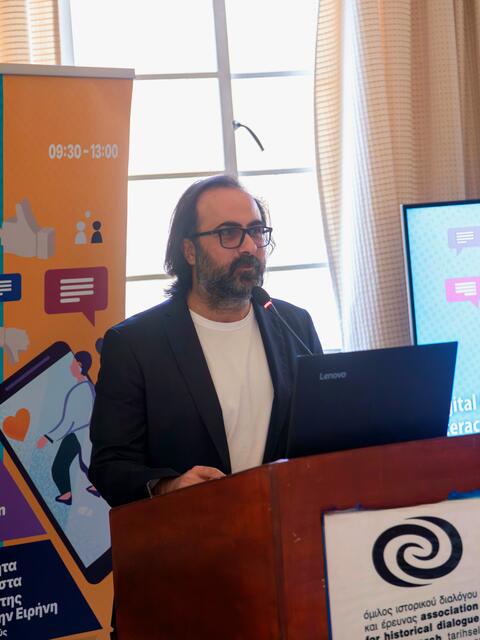
Recently there was an intervention by three UN experts who sent letters to the two leaders regarding the Imagine programme. What is happening?
The letters concern obstacles and political interventions affecting the implementation of the Imagine programme. They were sent by the special rapporteurs on the right to education, cultural rights, and the promotion of truth, justice and guarantees of non‑recurrence. The letters express serious concerns both about the continued suspension of the participation of the Turkish Cypriot authorities since 2022, and about delays, misinformation and the hostile public rhetoric that developed in the Greek Cypriot community around the programme, particularly regarding bicommunal student visits.
Why did this programme raise concerns even at the UN? What is its value?
Precisely because Imagine is not an ordinary educational programme. It is perhaps the only systematic process in Cyprus that brings students and educators from both communities together through structured activities of dialogue, cooperation and education for peace. In their letters, the rapporteurs note that the programme builds trust, promotes intercultural dialogue, strengthens critical thinking, helps students recognise stereotypes and prejudices, enhances understanding of the ‘other’, and contributes to the development of a culture of peace and solidarity.
They describe Imagine as “the only functional mechanism in Cyprus that systematically cultivates trust between Greek Cypriots and Turkish Cypriots” and call for its reinstatement within its previous operating framework. What is important here is that the UN does not treat the issue as a simple disagreement over an educational programme. It directly links it to violence prevention, reconciliation, combating racism and creating conditions to prevent the recurrence of conflict and human rights violations in the future.
The rapporteurs themselves explicitly connect peace education with violence prevention and the avoidance of renewed conflict. It is no coincidence that Imagine is repeatedly referenced in the UN Secretary‑General’s reports on Cyprus as a good practice in peace education and an important confidence‑building measure, and that it has received international recognition and awards. This is particularly significant for a divided society such as Cyprus, where fear, misinformation and one‑dimensional narratives can easily be reproduced. For this reason, such interventions carry particular weight.
What is peace education?
Peace education is not limited to the Cyprus problem or to improving relations between the island’s two largest communities. It is a comprehensive educational approach concerned with how we build societies that reject violence as a means of resolving differences and create conditions for sustainable development.
Peace is not merely the absence of war, but a positive, dynamic and participatory process in which dialogue is promoted and conflicts are resolved through mutual understanding and cooperation. Furthermore, peace education involves cultivating knowledge, skills, values and attitudes that enable people to appreciate and understand diversity as a source of progress, reject racism and intolerance, develop empathy and critical thinking, and participate democratically in society and public life.
For Cyprus, this is particularly important because we grow up in a divided society where contact between communities remains limited – not only between Greek Cypriots and Turkish Cypriots, but also with other religious communities and newly arrived populations – and where one‑dimensional narratives about history and identity are often reproduced without meaningful dialogue.
Students and educators
What exactly is Imagine and when did it start?
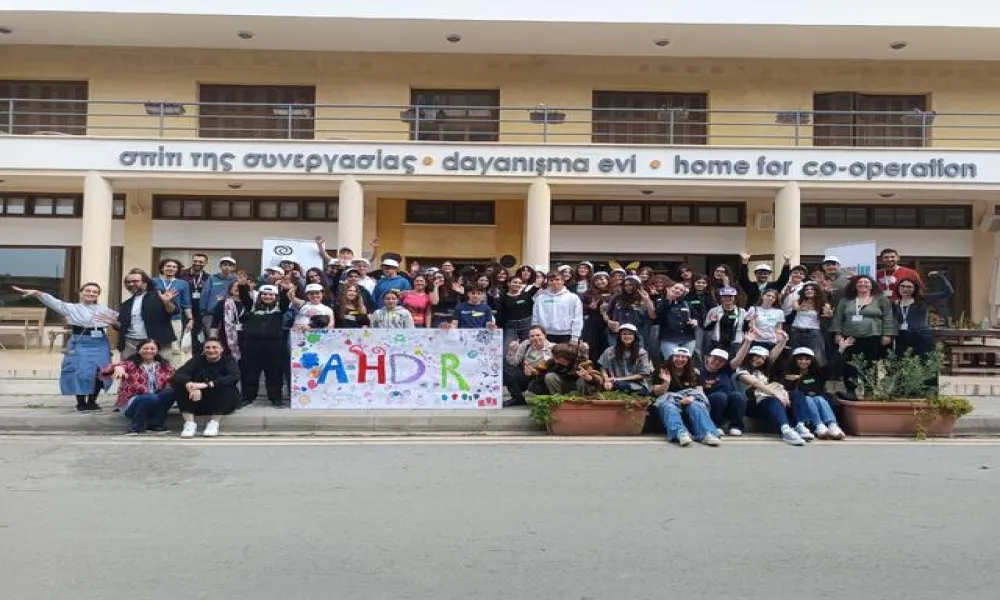
It is a bicommunal programme for education against racism and for a culture of peace, launched in 2015 by the Association for Historical Dialogue and Research (AHDR) and the Home for Cooperation. In 2017, the programme was officially incorporated into confidence‑building measures under the auspices of the Bicommunal Technical Committee on Education, with the support of the two leaderships of that period. Since then, it has been funded by the German Foreign Office.
The programme brings together students and educators from both communities through single‑community and bicommunal workshops, teacher training sessions and conferences, educational visits and other activities that promote cooperation, critical thinking and intercultural dialogue. All activities are voluntary, and in the case of minors, written parental or guardian consent is always required.
Its main objective is to create safe spaces where young people and educators can get to know one another beyond fears, prejudices and stereotypes that often keep them apart. Since the suspension of participation by the Turkish Cypriot side, AHDR has continued to implement Imagine in a restructured form, while simultaneously advocating for its reinstatement in its original framework as a confidence‑building measure.
To date, more than 8,800 students have taken part in bicommunal activities, while more than 3,800 educators have participated in workshops, training sessions and conferences on education for peace. A stable network of educators has also been established, with many returning to the programme and acting as multipliers within their school communities.
Coexistence
Why does it provoke fear among some people? Does it touch sensitive aspects of the Cyprus problem?
It does not touch sensitive aspects of the Cyprus problem, nor does it deal with political negotiations. Nevertheless, peace education is inherently a political process because it promotes social change, and this understandably ruffles feathers, as seen in some of the reactions.
Any process that invites us to critically examine stereotypes, prejudices and monolithic perceptions of identity and our relationships with others often generates discomfort or fear.
Peace education does not ask anyone to ‘forget’ their identity or history. It does, however, invite us to recognise that in a democratic and multicultural society we must be able to coexist with people who have different experiences, narratives or identities.
In recent years, there has been progress in the education systems of both communities. There is material addressing peace, anti‑racism, gender equality, democracy and active citizenship. Unfortunately, however, on both sides education systems continue to place greater emphasis on the transmission of knowledge than on cultivating skills such as conflict management, empathy and coexistence.
At the same time, in periods of social insecurity, rising nationalism and political polarisation, many people tend to retreat into more fearful and one‑dimensional perceptions of identity. This is not unique to Cyprus. When peace education is targeted through misinformation and hate‑laden public rhetoric, silence is not neutrality. It is tolerance of the normalisation of division, radicalisation and violence.
Nevertheless, our experience shows that the vast majority of parents and educators want to give children opportunities for contact and acquaintance with the other community. When the programme operated with the participation of both sides, approximately 94 per cent of parents surveyed gave positive consent for participation. This demonstrates curiosity, need and willingness for communication.
Regional hub
We know that people from abroad also make use of the programme.
In recent years, we have expanded the scope of our work beyond Cyprus. AHDR and the Home for Cooperation have evolved into a regional hub for the exchange of knowledge and practical experience among educators, academics, experts and civil society members from countries experiencing conflict, division or intense social tensions.
The example of Imagine, and its continuation under difficult conditions – pandemic, suspension of talks, attacks – offers hope that education for peace, although not a panacea, remains necessary and useful. The material developed within the framework of Imagine is already being used in countries such as Germany, Palestine, Israel, Lithuania, Spain, Georgia, Norway, Nepal, Greece, Turkey and elsewhere. At the same time, the programme has been presented as a good practice in countries including South Korea, Japan, France, Ireland, Belgium and Serbia.
This shows that Imagine is not only a Cypriot programme, but an experience that can contribute more broadly to international dialogue on education, reconciliation and violence prevention.
Leaders are being called upon to take CBMs. Could Imagine be upgraded?
As I mentioned earlier, Imagine is already a confidence‑building measure. This has been recognised by both the UN and the Bicommunal Technical Committee on Education since 2017. The problem lies in the lack of stable political and institutional support for its continuation and the inability to protect such initiatives from nationalist reactions and political opportunism.
The bridges built with great effort over all these years are fragile. We must not allow them to be torn down by those who long for the darkest pages of our history.