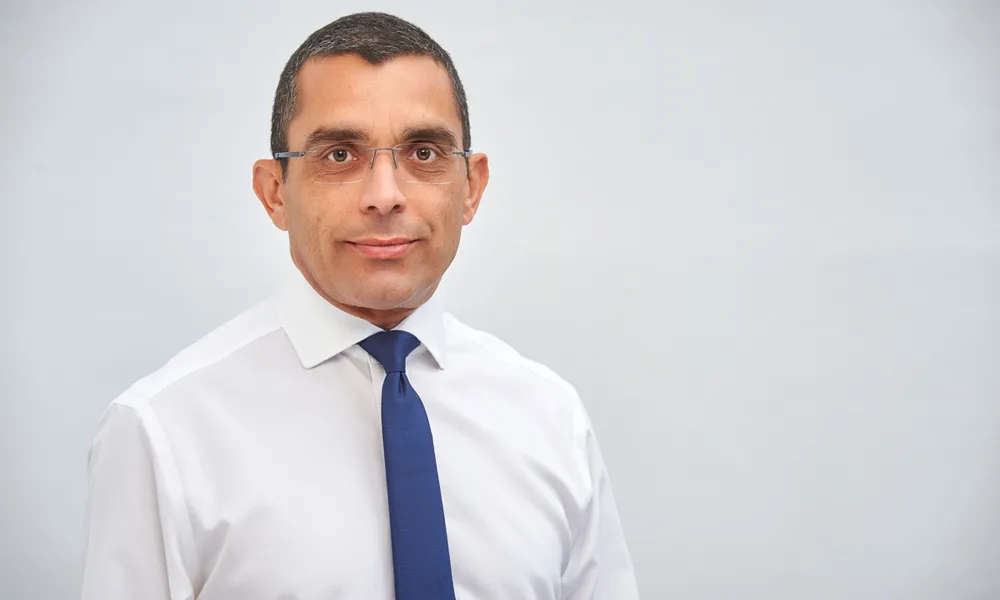

"DIKO's decision on the 2028 presidential election will be made when it should be made," DIKO MP Chryses Pantelides says in an interview with Politis, keeping DISY among the centrist party's possible options.
He makes clear that the gap between DIKO and AKEL remains substantial, while stressing that DIKO is prepared to support efforts to resolve the Cyprus problem under certain conditions. He also argues that DISY's backing of Nikolas Papadopoulos for the presidency of the House of Representatives "might have created a different political environment."
Responding to accusations that DIKO is helping normalise the far right, Pantelides contends that the oppositional stance of AKEL, ALMA and Direct Democracy is forcing the state to increasingly turn to ELAM.
The Cyprus issue
President Christodoulides is seeking the resumption of talks on the Cyprus issue. Is DIKO ready to support efforts to reunify the island?
The Democratic Party is always ready to support any effort aimed at achieving a proper and functional solution to the Cyprus problem.
It has supported President Christodoulides' effort to restart negotiations from the outset, in a clear and constructive manner.
Allow me, however, to note that I speak of "negotiations" rather than the "talks" you referred to, in order to emphasise that what we should pursue is a genuine negotiation process, one through which we seek and secure as many positive outcomes as possible for the Republic of Cyprus and the Greek Cypriot community.
I say this because I strongly disagree with those within the Greek Cypriot community who believe that, in a new process, President Christodoulides should accept what former President Anastasiades did not accept at Crans-Montana.
I also disagree with the idea of ‘locking in’ Anastasiades' 2017 concessions as part of a ‘strategic or interim agreement’.
Presidential election
After the election, DIKO called for greater participation in government and improved communication with the administration. If these demands are met, will the party support Nikos Christodoulides in the 2028 presidential election?
The Democratic Party's decision regarding the 2028 presidential election will be taken at the appropriate time, in the appropriate way, and on the basis of the circumstances and information available to the party at that point.
The party's demand for better cooperation with the government and stronger participation in decision-making concerns the present.
Allow me to say that this is entirely reasonable, especially after the recent parliamentary elections.
The Democratic Party essentially maintained its electoral and parliamentary strength in a difficult and unprecedented political environment. It disproved predictions that it would collapse or disappear and is now the only governing party represented in parliament.
As I remarked on a television programme after the election, President Christodoulides and his government should themselves be seeking to strengthen cooperation with DIKO in the months ahead, particularly within parliament but also beyond it.
Relations with DISY
Before the election you stressed the importance of cooperation with DISY and argued that it should continue afterwards. Does this cooperation have prospects in the run-up to the presidential election?
The first thing I would say is that cooperation with DISY was and remains necessary in order to implement the government's programme, carry out the Recovery and Resilience Plan, and keep the country on a stable fiscal, developmental and European course.
This is practical cooperation, in the sense that it has evolved, and I believe will continue to evolve, within parliament on a weekly basis.
We should not overlook the fact that most of this government's bills and reforms would never have become law without DISY's support.
As I said earlier, DIKO's decision on the 2028 presidential election will be made when the time comes and on the basis of the circumstances that exist then.
Those circumstances will naturally include the positions, intentions and conduct of other parties, including DISY.
Was DIKO hurt by DISY's decision to seek the presidency of the House of Representatives? Would support for Nikolas Papadopoulos have changed the political landscape?
Support for Nikolas Papadopoulos would have made Nikolas Papadopoulos president of the House.
In my view, that would have been a very positive development for parliament because of his abilities and twenty years of parliamentary experience.
That said, my opinion of Nikolas does not diminish the competence or successful tenure of Annita Demetriou as House president. We supported her in the second round of voting, with full awareness and for purely political reasons.
To answer your questions directly: No, DISY's decision did not hurt DIKO, because DIKO is resilient, dignified and politically battle-tested.
And yes, it might have created a different political environment. You call it upheaval; I would call it greater stability.
The far right
How do you respond to those who accuse DIKO of normalising the far right after its call for cooperation with ELAM in the election of the House president?
My response is that they rely on clichés and empty slogans to rally their supporters while deliberately ignoring the substance of the issue.
The reality is that what fuelled ELAM's significant rise over the last fifteen years was precisely the effort by Cyprus's traditional parties to isolate and exclude it, thereby allowing it to present itself as an anti-establishment force.
Since you mentioned the call for cooperation in electing the House president, let me repeat something important.
As long as AKEL, ALMA and perhaps Direct Democracy continue voting against anything proposed by the government purely for oppositional reasons, the practical need for the state to function will force political actors to seek support from ELAM as well.
Therefore, if anyone is normalising ELAM, intentionally or unintentionally, it is AKEL, ALMA and perhaps Direct Democracy, because their approach makes ELAM's role more important than it should be.
AKEL
Is the political distance between DIKO and AKEL now so great that cooperation in the presidential election is impossible?
My personal view is yes.
The political distance between DIKO and AKEL in 2026, within the European, economic and social environment in which Cyprus lives and operates, is substantial.
Anyone who fails to recognise that is either ignoring reality or thinking solely in electoral terms.
I respect AKEL, but this is the reality.
To think, "We disagree on many things, but let's avoid saying so in case we cooperate later," is not politics. It is opportunistic tactical manoeuvring.
I was re-elected in May under the banner of "Seriousness, Responsibility, Clear Speech," and that is the same straightforward approach with which I answer your question.
Political responsibility
Some believe the Defence Minister should have accepted political responsibility and resigned over the wildfire caused by the National Guard in the Kalo Chorio area. Do you agree?
We should wait for the findings of the investigation before saying anything definitive.
Like every military organisation, the National Guard operates according to specific procedures, standing orders and protocols. I therefore expect the report to be clear and precise regarding what happened and what did not happen.
"Politicians are not all the same"
Mr Pantelides, if a citizen told you, "All politicians are the same," what decision or position of yours would you point to in order to convince them otherwise?
First of all, the composition of the new parliament leaves no room for doubt about how different politicians are from one another.
If a citizen repeated the stereotype that "all politicians are the same," I would ask them to follow my work on a daily basis and evaluate me as an individual.
That is how citizens should assess every politician, separately and on their own merits.
Those who do so quickly realise that we are not all the same. In fact, it is difficult to categorise politicians because we are all different, with our strengths and weaknesses, our advantages and shortcomings.
The same is true in every profession.
Are all journalists the same? Are all engineers, teachers, workers, doctors, lawyers, plumbers, salespeople or tradespeople identical? Of course not.
The same applies to political figures.
Ultimately, politics matters not because I am different from, or similar to, others, but because through every initiative, every idea, every action and every opinion I contribute to improving people's lives.