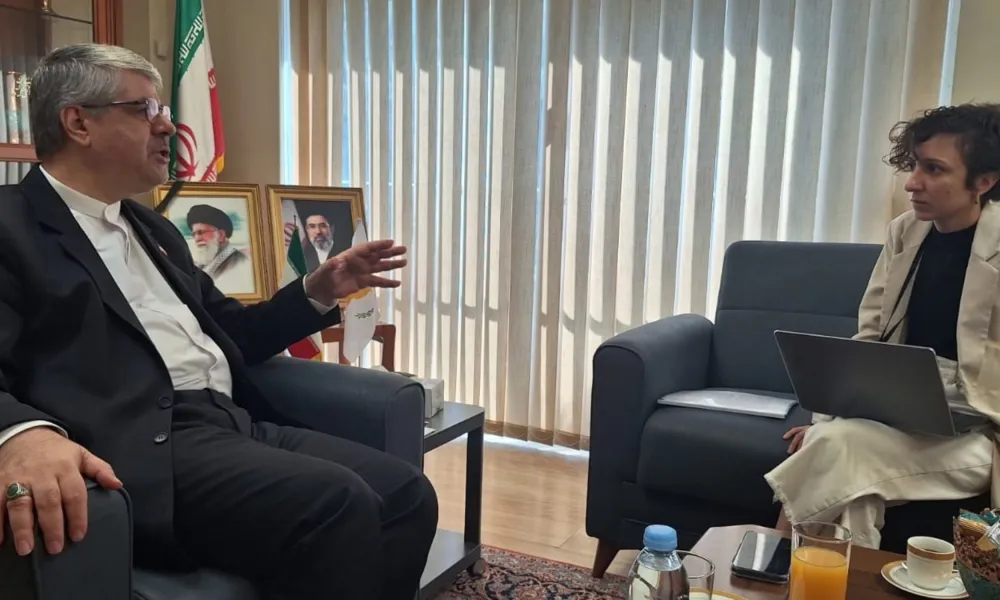

More than 200 days have passed since the United States and Israel launched massive joint air strikes on Iran, killing several senior government officials and plunging the region into a war that continues to this day. Despite a ceasefire and diplomatic efforts to reach an agreement, the conflict has now spread as far as the Red Sea, disrupting critical trade routes and threatening the global economy. Cyprus itself was caught in the middle when a drone came down in the British Sovereign Base Area at Akrotiri. Tehran has nevertheless repeatedly said that Cyprus is not an enemy, and presents itself as seeking peace, calling on the parties to return to dialogue. Iran's Ambassador to Cyprus, Alireza Salarian, received Politis at the embassy on Armenias Street to discuss the situation in the Middle East, the role of Cyprus and life in Iran in wartime.
"We are ready to negotiate"
Seven months after the war began, Salarian said "the illegal aggression of the US and Israel" has increasingly continued through economic pressure since the day of the attack on 28 February. "Iran has acted, and will continue to act, within its right to defend its national interests, its territorial security and its national sovereignty," he said. "The important question is on what legal basis this attack was carried out. No legitimate international organisation approved or supported such an attack." Even key European partners of the United States did not support the action and said they had not been informed in advance, he said. Two days before the attack, Iran had been taking part in negotiations on its nuclear programme in Geneva in good faith, he said. "Even though President Trump withdrew from the JCPOA in 2018, during his second term we were ready to negotiate. And we still are." He pointed to a statement by the secretary of Iran's Supreme National Security Council that Iran is ready to negotiate and end the war across the region.
Asked about Israel's current involvement, given the threats coming from the American side, Salarian said Israel is now in the background. "Mr Netanyahu's lobby has very good relations with Trump and certain officials in the White House, and I believe that is why they persuaded him to attack Iran and continue the war in the region," he said.
A new round of sanctions
Salarian said sanctions and the naval blockade of the Persian Gulf mainly affect oil exports, but ordinary citizens are directly affected by sanctions, particularly on airlines. Private airlines operating flights to and from Iran currently face punitive measures, he said. Although governments such as those of Turkey and Pakistan have good relations with Tehran, businesses have no choice but to comply. Iran's trade with European countries, mainly Germany, Italy and France, used to reach $30 billion, he said. "The interesting fact is that Cyprus is also affected by these sanctions," he said. Cypriot exports to Iran reached $35.3 million in 2022 alone, but have now fallen to around $500,000, mainly in the pharmaceutical sector.
"The Gulf countries want peace"
On how the spread of the conflict across the wider region is affecting bilateral relations, Salarian said Foreign Minister Abbas Araghchi is in close contact with his counterparts in Saudi Arabia, Egypt, Turkey, Qatar and even the UAE. "Unfortunately, however, the war has damaged trust between the countries of the region," he said. "We have always pursued the diplomatic path, unlike the US, which has threatened Iran many times. But more pressure produces the opposite result. I think they have not learned the lessons of the past." The Gulf states want peace and want to export their products, particularly oil, he said, since disruption to oil exports also affects transport, chemicals and agriculture. Asked about the Mecca Agreement, amid rumours that Iran could also join, he said Iran is waiting for a proposal. "We have good relations with the founding countries, particularly Turkey and Pakistan, so an invitation would be seen as a positive development," he said.
Relations between Tehran and Nicosia
President Trump recently threatened Iran with annihilation, prompting Tehran to respond that any country helping the United States would be considered a potential target. Asked where this leaves Cyprus, Salarian said Iran has had very good relations with Nicosia since the start of the crisis, and that the two foreign ministers remain in contact. "We fully understand Cyprus' position and constraints in relation to the British Bases, and I believe the Cypriot government has managed to maintain a fair position," he said, noting that Cyprus also has good relations with the United States and Israel. "But they have tried to balance this relationship and emphasise diplomacy and a neutral stance. So far we have managed to deal with the challenges successfully and we hope to continue to do so in the future."
Last year, the Interior Ministry recorded around 1,000 Iranians living permanently in Cyprus across four cities, mainly Limassol and Larnaca, Salarian said. They work mainly in business and technical fields. Until five years ago, there was a direct flight between Tehran and Larnaca lasting just two and a half hours, which was also very useful as a stopover for other European countries.
Life in Iran in wartime
Salarian said some strikes on southern cities had unfortunately cost the lives of Iranian citizens, but that life in Tehran is fairly normal and infrastructure is functioning. "Iran is a huge country that produces a large number of goods on its own. Despite the sanctions, imports continue and we can still export to neighbouring countries such as Russia, China and Iraq. The blockade has affected us, but not in the way the Trump administration expected," he said.
Asked about the Iranian government's record on women's rights, which has drawn repeated international criticism, Salarian said things are not as they used to be. Many women now walk in the streets without a headscarf, and the rule applies only in official government buildings, he said. Some women wear the chador as a religious symbol, but it is not compulsory. Asked what has changed, he said people have shown their support for the government and the armed forces by holding demonstrations in the central square every evening, in which women without the hijab also take part.
Relations with the Houthis
Asked where President Trump's statement that the Houthis have agreed not to attack the United States leaves Iran, Salarian said Iran has always supported the people of Yemen and believes the Yemeni issue should be resolved through dialogue among Yemenis themselves. "They have suffered for a long time. We support their political right to decide for themselves," he said. "There is a blockade imposed by Saudi Arabia. In practice, we have no way of sending them weapons anyway." He said Iran is also in close contact with Riyadh to find a solution, "because both countries are Muslim at the end of the day".
On the war in Ukraine, Salarian said Iran has not supported Russian aggression against Ukraine from the start, but sees double standards. "Europe condemns Russia and supplies Ukraine with billions in defence spending. Why does it not also condemn the attacks on Iran?" he said. "Unfortunately, foreign intervention does not stop wars, and countries such as Lebanon, Yemen and the Persian Gulf states are suffering damage."
Asked about the Cyprus problem and Turkey, Salarian said he hopes the island will one day be reunified, "because more than 50 years is enough". Iran has good relations with the Turkish Cypriot community and with Turkey, he said, adding that he is optimistic about the future. "A united Cyprus can become one of the economic hubs of the region, because of its strategic location," he said.