
Cyprus is taking a leading role in one of Europe's most ambitious new initiatives for advanced digital skills. The Virtual Worlds Academy of Skills (ViWAS) is being coordinated by Prof. Fotis Liarokapis, Research Director at the CYENS Centre of Excellence, placing the country at the centre of European efforts to prepare professionals for the digital world of tomorrow.
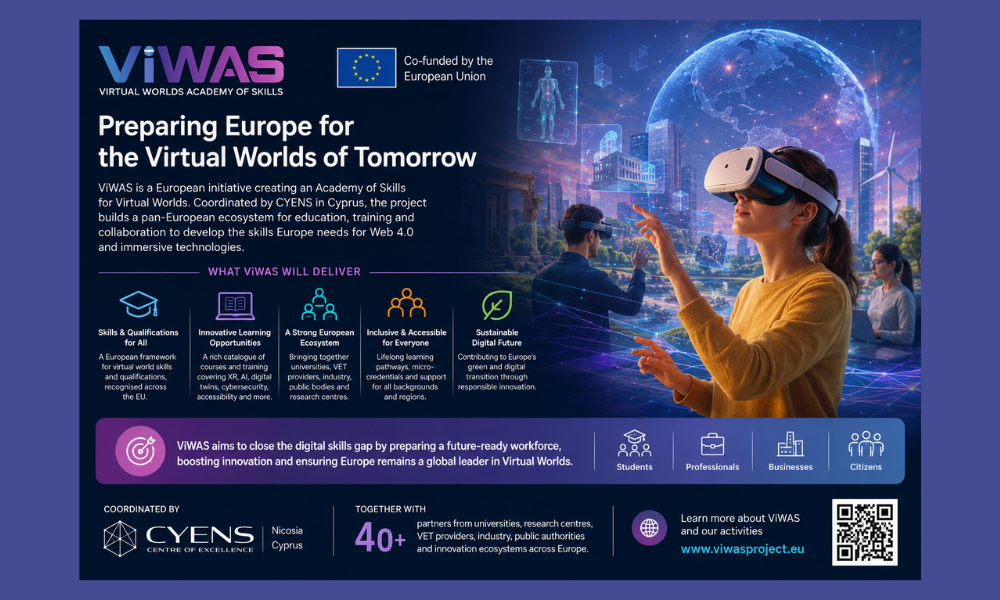
Under his leadership, a consortium of universities, research centres, businesses, vocational education providers and public organisations from across Europe is working together to ensure that Europeans have the knowledge and practical skills needed to thrive in the age of virtual worlds.
Technologies already in everyday use
Although the term virtual worlds may sound futuristic, their applications are already here. Doctors use immersive technologies to train for complex medical procedures, while engineers can practise dangerous tasks safely in digital environments before entering the real world. Museums create interactive experiences that allow visitors to explore history in entirely new ways, businesses are adopting digital twins to improve productivity, and schools and universities are beginning to transform traditional learning into immersive educational experiences.
As these technologies become more common, Europe will need thousands of professionals with the right expertise. Today, however, education in this field remains fragmented. Courses vary from country to country, qualifications are not always recognised, and many people simply do not know where to begin.
A European academy with common standards
ViWAS will create a European Academy dedicated to virtual worlds, bringing together existing knowledge while developing new learning opportunities for students, teachers, professionals and lifelong learners. It will establish common European standards for skills and qualifications, making it easier for people to study, work and build careers across Europe.
The Academy will develop a wide range of practical courses covering technologies such as Extended Reality (XR), artificial intelligence, digital twins, immersive design, cybersecurity and digital creativity.
Learning by doing
Unlike traditional education, ViWAS places strong emphasis on practical experience. Participants will develop skills inside immersive digital environments, where they can safely experiment, solve real-world problems and collaborate with others. The Academy will also promote flexible learning through short courses and micro-credentials, making it easier for professionals to continuously update their knowledge as technology evolves.
Not only for tech specialists
The project recognises that virtual worlds will affect almost every profession. Teachers, architects, artists, healthcare workers, engineers, tourism professionals, entrepreneurs and public servants are all likely to work with immersive technologies in the coming years. The Academy is therefore designed to be inclusive, supporting people of different ages, backgrounds and experience levels, while encouraging greater participation from women, people with disabilities and citizens living in remote areas.
A significant achievement for Cyprus
Coordinating such a large European initiative highlights the country's growing role in research, innovation and advanced digital technologies, demonstrating that Cyprus can actively contribute to shaping Europe's digital future rather than simply following it.
Technology will continue to evolve, but its success depends on whether society is prepared to use it responsibly and creatively. By investing in education today, Europe is investing in the skills that will define tomorrow's economy, and Cyprus is helping lead that effort.
More information is available at viwasproject.eu.