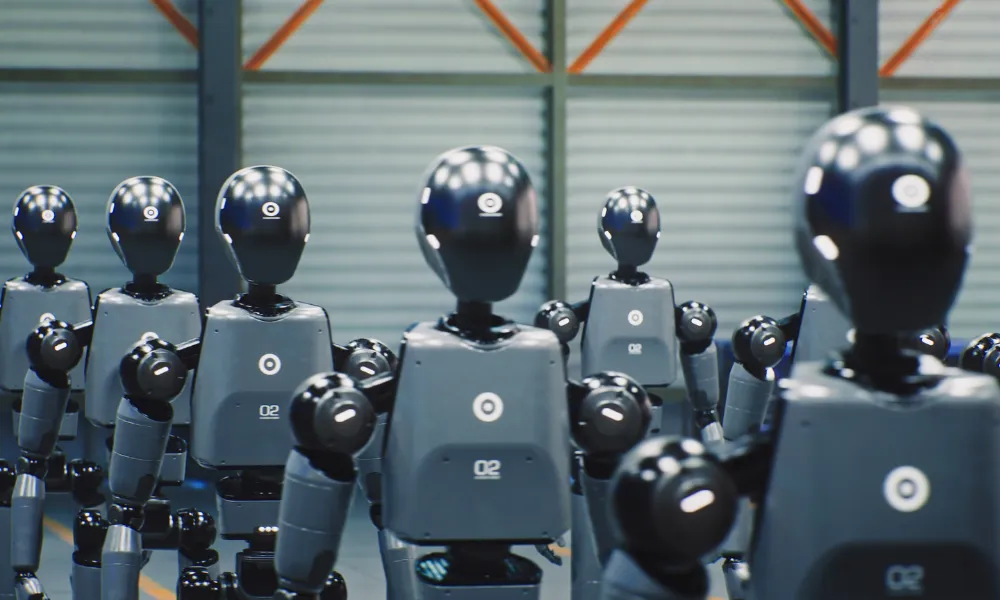
Drones have already changed the way modern wars are fought, especially in Ukraine, where relatively cheap unmanned systems have become central to surveillance, targeting and attacks. Now some defence companies are asking whether robots on the ground could eventually follow a similar path.
Humanoid robots have mostly been sold as the future of factory floors, warehouses and, eventually, homes. But the same technology is also attracting military interest. The appeal is clear: a robot shaped like a person could move through buildings, climb stairs, open doors, use tools and operate in spaces designed around the human body.
One company pursuing that idea is Foundation Robotics, a San Francisco start-up developing a humanoid robot called Phantom. The machine is still far from battlefield-ready. Its current version lacks the toughness, autonomy, battery life and hand dexterity needed for real combat conditions. But the company’s ambition is to build a robot that can go where soldiers would otherwise face the greatest danger.
Useful helper or future weapon?
The first military roles would likely be practical rather than cinematic. A humanoid robot could carry supplies, inspect hazardous areas, map buildings, recover equipment or help remove casualties from places too dangerous for troops. In urban warfare, supporters say such machines could be sent into rooms, corridors or chokepoints before human soldiers, reducing the risk of ambushes and close-range fighting.
The more difficult question is whether these robots should ever be armed. Foundation says it has research contracts with the US military and that some of its units are being tested in Ukraine. The US work is described as focused on weapons handling rather than firing, while testing in Ukraine reportedly includes weaponisation.
That is where the debate becomes much more serious. Supporters argue that armed robots could keep soldiers away from lethal situations and make some operations more precise. Critics warn that they could make the use of force feel easier, weaken human responsibility and create serious accountability problems if civilians are harmed or targets are wrongly identified.
The technology is not there yet
For all the excitement, humanoid robots still face major practical limits. They are difficult to power, balance and control. They need strong hands, stable movement and AI systems able to cope with damaged buildings, uneven ground, smoke, noise, civilians and enemy deception. That is a much harder environment than a laboratory or warehouse demonstration.
Many experts also question whether the human shape is even the best option for war. Drones, tracked vehicles, wheeled robots and four-legged machines may be cheaper, faster, more stable and easier to repair. A humanoid may fit the human-built world, but it also carries the burden of trying to copy one of the most complex machines in nature: the human body.
For now, robot soldiers remain closer to an engineering ambition than a battlefield reality. But military interest is real, and the debate is already moving beyond science fiction. The question is no longer only whether humanoid robots can be built. It is what limits should be placed on them before they move any closer to the front line.
With information from BBC