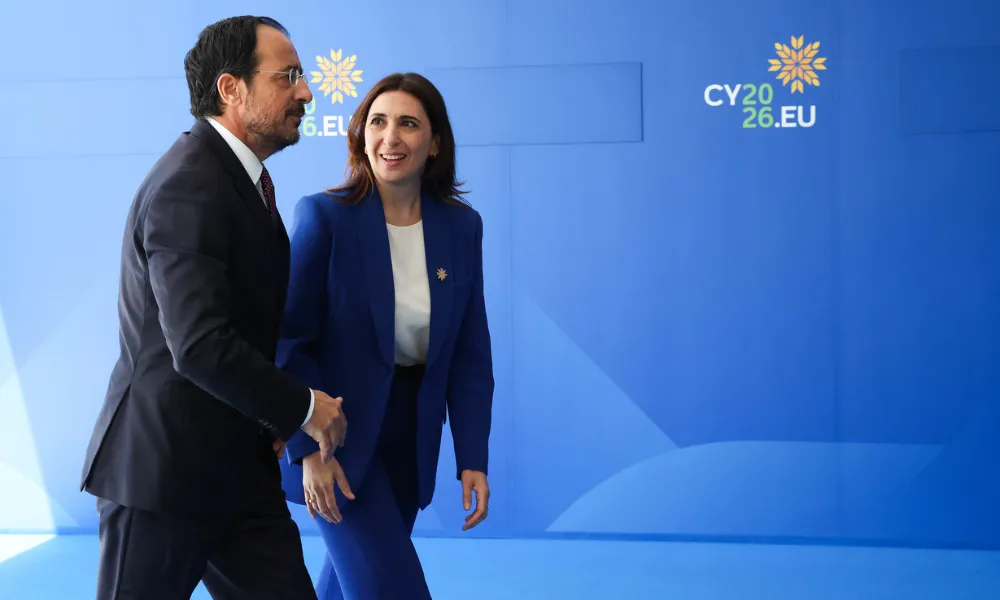

The term of the Deputy Minister for European Affairs, Marilena Raouna, are deeper and plainly pre-electoral, turning at the same time a routine disagreement between the executive and legislative branches into a head-on confrontation with the opposition. The opposition's rejection of an urgent request was presented more or less as an act of national irresponsibility. This is an exaggeration that helps neither public dialogue nor trust in the institutions.
A high-tension clash of direct confrontation has erupted between the government and the two largest parties, the Democratic Rally (DISY) and AKEL, over parliament's rejection of the request for a six-month extension of the term of the Deputy Minister for European Affairs, Marilena Raouna.
The rivalry over this particular issue reveals a different conception of how power is exercised, of the limits of the political management of institutions, and of the government's real priorities. It is not a simple disagreement, but one intensified by the harsh reactions it provoked on both sides, chiefly by the manner in which President Christodoulides framed his first objections to the rejection of the six-month extension. The President of the Republic presented parliament's decision as a blow to national interests and to the country's European course. He argued that the presence of Ms Marilena Raouna is necessary for the negotiations on the European Union's new Multiannual Financial Framework, and implied that the stance of DISY and AKEL undermines crucial national objectives.
An unfounded position
The President of the Republic's entire reaction and approach, as well as that of his representatives, however, highlights an unfounded position: that any negotiation with the European Union depends on the continued presence of one specific person in one specific post, for another six months. The Republic of Cyprus has institutions, ministries, a permanent civil service, a diplomatic corps, a permanent representation in Brussels and dozens of experienced officials who have been handling European matters for more than two decades. The country negotiated all previous multiannual financial frameworks without the existence of a Deputy Ministry of European Affairs and secured significant European funds. If, then, the government now argues that without Ms Raouna Cyprus's negotiating position is placed at risk, it essentially devalues the entire state apparatus that has long served European affairs.
"They did not respect the majority"
The President of the House and of DISY, Annita Demetriou, spoke of "carelessness" on the part of the government in relation to the submission of the request to extend the duties of the Deputy Minister for European Affairs, Marilena Raouna, expressing the view that the House of Representatives cannot be blackmailed and that the Democratic Rally is being wrongly targeted at this moment. "At the end of the day, in my humble opinion, this is not a fitting conduct of rivalry, which we wish to continue," she noted.
It is nevertheless striking, the intensity with which the President of the Republic reacted, chiefly, against the Democratic Rally. Instead of confining himself to a political disagreement on substance or procedure, he chose to present the party as a force acting contrary to its European identity. The DISY press spokesman, Onoufrios Koulas, speaking on Politis radio "107.6 & 97.6", on the programme "Second Look" with Yiannis Seitanidis, argued that the party's parliamentary group took a specific and unanimous decision, and attributed the tension that followed to statements by the President of the Republic and government officials. "Instead of respecting, for example, the decision of the majority of the House, it triggered an otherwise unnecessary confrontation," he said. The government's reaction looks more like an attempt at political pressure than the calm management of a parliamentary disagreement.
"This is not anti-Europeanism"
The same applies to the criticism of AKEL. Instead of explaining why its request was submitted literally at the last minute, the government chose to turn a parliamentary decision into an ideological confrontation. Thus the substance of the discussion was lost amid mutual accusations of pro-Europeanism and anti-Europeanism.
According to the party's general secretary, Stefanos Stefanou, disagreement with government choices does not constitute an anti-European stance, commenting on the President of the Republic's references to the party's position. "What is well known is the President's reaction when he faces criticism. He blames everything on the opposition or on supposed anti-Europeanisms. Of course we have a different conception. That, however, does not mean that anyone who disagrees with the government is an anti-European," he noted.
Pre-election tricks
Beyond the substance of the two major parties' criticism, however, it is clear that the government's insistence on extending Ms Raouna's term gives rise, at the very least, to political suspicions with a scent of the next presidential elections. This is highlighted by the government's insistence on extending the term of a structure created exclusively for the Cypriot Presidency of the Council of the European Union. The Presidency has been completed, while it is clear that the mechanism under Ms Raouna has finished its work. In every democratic state, when a special mission is completed, the temporary structures are terminated and the officials return to their organic posts, or their mission is concluded.
Diplomatic sources express their puzzlement as to whether the retention, at public expense, of a mechanism that no longer has a reason to exist is justified. As they point out, "the Republic of Cyprus already has the services that handle European matters, and there is no evident institutional need to extend a temporary structure, solely because of the presence of one specific person."
According to this political reading, which is reinforced by Nikos Christodoulides's practices to date, the extension of the term concerns not only the continuity of European policy, but also the preservation of an organised team that could serve as a valuable tool ahead of the 2028 presidential elections. The government rejects this interpretation behind the scenes and insists that its sole criterion is serving the public interest. Yet its choice to turn a six-month issue into a major political conflict reinforces the suspicions of those who believe that political calculations also lie behind the request.
Unfortunate handling
Equally problematic was the communications management of the affair. Instead of the government attempting to reach an understanding with the parties, presenting its positions in good time and seeking broader consensus, it chose confrontation. The voting-down of an urgent request was presented more or less as an act of national irresponsibility. This is an exaggeration that helps neither public dialogue nor trust in the institutions.
The House has every right to examine whether a proposal justifies the character of urgency. Disagreement with that judgement cannot automatically be turned into a questioning of the parties' European orientation.
The picture taking shape is that President Christodoulides treated a political defeat in the House as a personal challengeand chose to respond head-on against the two largest parties. This choice may serve a broader political strategy, within which the government is already attempting to shape the political scene of the next pre-election period, drawing dividing lines and presenting every objection as an obstacle to the government's choices.