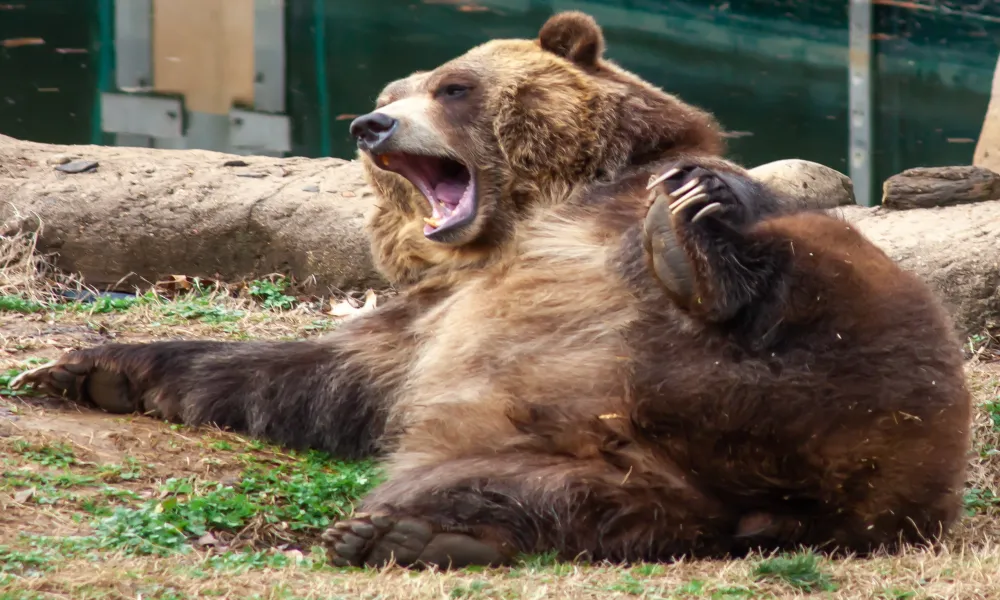

A bear that escaped from Melios Zoo Park has been located and returned to the facility unharmed, after an urgent warning to residents of Palaiometocho and the surrounding area. The incident comes six months after the Supreme Constitutional Court dismissed an appeal by the zoo’s owner against the authorities’ refusal to renew its operating licence.
Animal located near the facility
According to an update from the Police, the bear was found by the owner of the zoo park, a short distance from its premises.
The animal was carefully guided back to the park and is safe.
The Police and the Game and Fauna Service assisted in the operation.
Community council warning
Earlier, the Palaiometocho Community Council had issued an urgent announcement saying the bear had escaped from Melios Zoo Park. The announcement prompted mobilisation and concern in the area.
The council urged residents of the community and neighbouring areas to be particularly careful. It warned that the animal could pose a risk to human safety. Residents were told not to approach it and not to attempt to chase or trap it.
The council also advised that children and pets be kept in safe places.
Court ruling on the zoo’s operation
In April 2026, the Supreme Constitutional Court dismissed an appeal by businessman Menelaos Menelaou, the owner of Melios Zoo Park. The court upheld an earlier Administrative Court ruling on the zoo’s operating status.
Menelaou had filed three separate appeals. They challenged the authorities’ refusal to grant new planning permits, to extend an existing permit, and to renew the zoo’s operating licence.
The courts found serious violations. These included the illegal expansion of the park onto private and state landwithout the required permits and deviations from approved plans. They also included the keeping of animals that did not meet the necessary safety conditions, among them large carnivores.
The ruling also noted that the water supply was inadequate. The licence Menelaou relied on covered irrigation only, and the local council had refused to connect the facility to the public water network.
The Supreme Constitutional Court found that Menelaou’s grounds of appeal were either unsubstantiated or had been raised too late. It found he had provided no evidence to counter the authorities’ findings on the illegal use of land and the water supply deficiencies. The court also noted there was no proof that the state land had been exchanged, as Menelaou had claimed.
The appeal was dismissed in full, and Menelaou was ordered to pay €4,000 in costs. Politis to the Point reported at the time that the ruling brought the zoo’s operation to a definitive end.
Earlier concerns over licensing and animal welfare
The zoo has drawn criticism from animal rights groups for several years.
In February 2020, a group called Animal’s Rights Group Europe & Melios’ Animals Support Group launched an online petition calling for the removal of Congo the lion from Melios Zoo, according to Eurogroup for Animals. The group sought the lion’s return to Pairi Daiza Zoo in Belgium, from where it had been transferred to Cyprus. It claimed that the contract between the Belgian zoo and Melios had expired. At the time, the petition had gathered more than 57,000 signatures.
The group also claimed that the zoo’s operating licence had expired in 2017. It said the facility nonetheless remained open to the public and continued to acquire new animals.
BirdLife Cyprus has also said it was following conditions at Melios Zoo Park closely. The organisation noted that many of the species kept there are protected under international treaties and strict laws. It called on the authorities to apply strict checks on the park’s compliance with international zoo standards and wild animal welfare.
The organisation also pointed to the lack of a government facility for housing confiscated animals. It described this as a significant gap that needs to be addressed urgently. In its view, the gap raises questions about whether it discourages stricter controls.