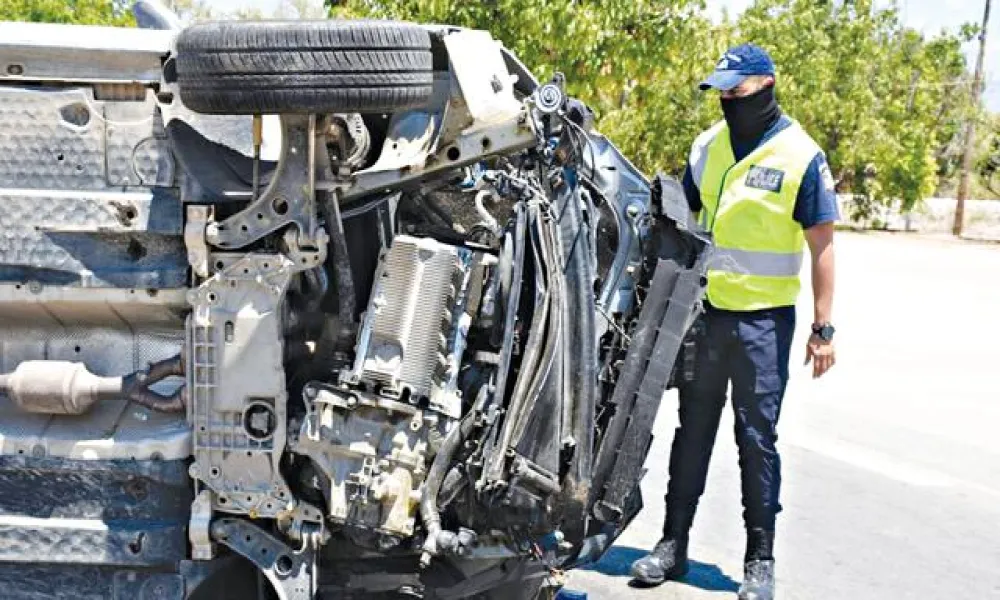


A school designed to re-educate dangerous drivers has been on the books in Cyprus since 2018 and has never opened. The School for the Re-education of Traffic Offenders was legislated that May, following a bill tabled in parliament by then Justice Minister Ionas Nicolaou. The Cabinet had first decided to establish it a year earlier, in May 2017, with an original operational target of May 2018. Eight years later, it remains on paper.
When the law passed, the plan was clear enough: operating costs would be covered by the Ministry of Justice and Public Order, and a tender for teaching staff would be issued promptly. That tender was not issued until 2025, seven years late, and was ultimately cancelled after the sole bidder, a university institution, was found not to meet the required conditions.
The school had been earmarked for the Traffic Police headquarters building in Latsia, intended as a regional centre serving residents outside Nicosia, with plans for gradual expansion to other districts.
Five ministers, one cancelled tender
Five successive Justice Ministers held responsibility for implementing the law between 2018 and late 2025: Giorgos Savvides, Emily Yiolitis, Stefi Drakou, Anna Koukkidis-Prokopiou and Marios Hartsiotis. None managed to get the school operational. The closest any came was under Hartsiotis, when the tender was finally issued, only to collapse when the single response came from an institution that did not meet the criteria. The tender was cancelled in November 2025.
One month later, on 8 December 2025, Kostas Fytieris was sworn in as the sixth Justice Minister to inherit this file. The challenge now falls to him.
What needs to happen is for Fytieris to engage seriously with the matter and move decisively, consulting with the rectors of both public and private universities to explore partnerships and, where appropriate, offer incentives to attract credible bidders when the tender is relaunched. The goal is a functioning school, not another failed procurement process.
Under the legislation in force since 1 June 2018, the school will be compulsory for three categories of driver: those ordered to attend by a court; those whose licence has been suspended by a court for three months or more; and those who have accumulated 12 or more penalty points. Drivers who have reached 10 or more penalty points may apply voluntarily to attend, with the possibility of having points removed upon successful completion of the course.
The curriculum, fees and point-reduction entitlements are to be set by the Justice Minister by gazette notice, tailored to the nature of the offences committed by each participant.
Fines are not enough
The argument for urgency is not bureaucratic. Cyprus introduced its speed camera network on 1 January 2022, comprising 90 fixed and 20 mobile cameras. Four years on, the system has generated significant revenue from fixed-penalty fines but has not produced the expected reduction in fatal road accidents. Over the past three years, 110 people have died on Cypriot roads. Revenue generation was never the point. Prevention is.
Justice Minister Fytieris and Transport Minister Alexis Vafeadis, in his capacity as chairman of the Road Safety Council, are both obligated to find an immediate solution. Fatal and serious road accidents remain at troublingly high levels, and the state cannot afford further delay on a measure that could meaningfully change driver behaviour and, in doing so, save lives.