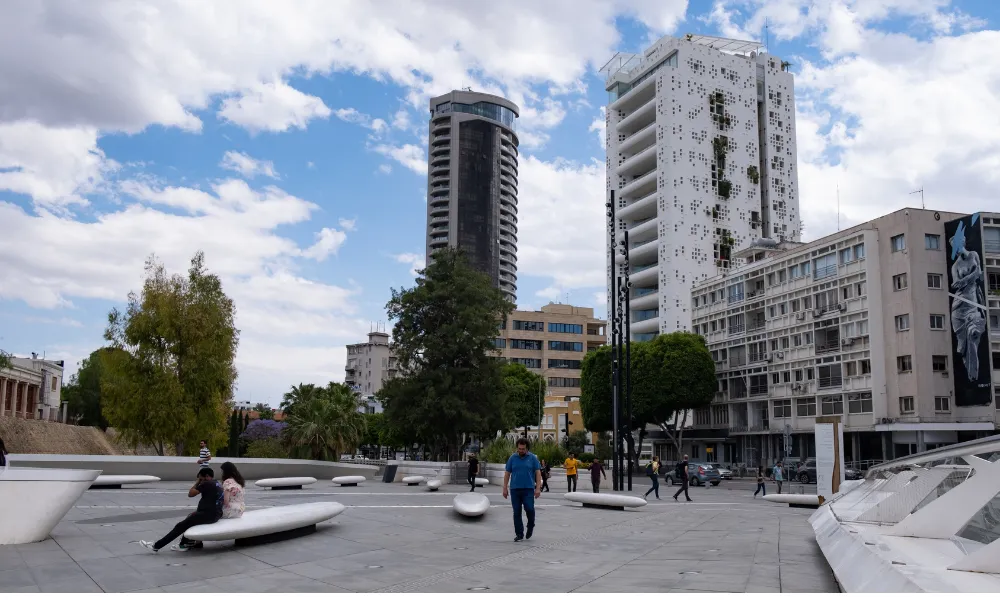
A tax on abandoned properties, incentives to bring residents back to the city centre, a special implementation mechanism under political supervision and immediate interventions on Makarios Avenue are among the measures proposed by the Cyprus Scientific and Technical Chamber, ETEK, in a regeneration plan submitted to the President of the Republic.
The report, prepared by ETEK, seeks to answer a question that has troubled the capital for years: why, despite millions of euros in investment, regeneration projects, studies and action plans, the centre of Nicosia continues to face abandonment, limited residential activity, empty premises and weak economic activity.
According to ETEK, the problem is not a lack of ideas, but the absence of a mechanism capable of coordinating, monitoring and enforcing the implementation of decisions. This is the main conclusion of the Structured Democratic Dialogue Workshop organised by ETEK in cooperation with Nicosia Municipality. Representatives of public services, professional organisations, universities, business bodies and organised groups took part in the process, submitting a total of 103 proposals for the future of the city centre.
The proposals were assessed, prioritised and organised into a framework of 12 specific measures, which ETEK says could form the basis of a real revitalisation strategy.
Delivery Office to end fragmentation
One of the most important recommendations concerns the creation of a dedicated Delivery Office for Nicosia’s urban centre.
The office would effectively act as a coordination hub, operating with a clear political mandate from the President of the Republic and bringing together the Interior Ministry, the Finance Ministry, the Transport Ministry and Nicosia Municipality.
It would monitor the progress of projects, resolve issues of overlapping responsibilities, set timetables and publish annual updates on the progress of interventions. According to ETEK, the current diffusion of responsibilities across multiple services is one of the main reasons why important interventions are delayed or left unfinished.
Incentives to bring residents back
One of the central conclusions of the workshop is that no revitalisation can succeed without a permanent population.
The report underlines that the decline in residents in the centre has created a vicious cycle. Fewer residents mean lower consumption, more empty shops, less movement on the streets and, ultimately, reduced interest in investment.
To reverse this trend, the report proposes financial and tax incentives for young professionals, young families and students, as well as programmes to make use of existing buildings for the creation of new housing in the city centre.
Empty buildings in the spotlight
One of the most discussed proposals in the report is the creation of a register of inactive properties and the imposition of an inactivity fee on buildings that remain closed and unused for long periods.
According to the recommendation, revenue from the measure would be returned to the centre through revitalisation projects and actions. At the same time, the report proposes the systematic recording of all abandoned properties and direct communication with their owners, in order to identify the obstacles preventing their use.
ETEK also recommends the creation of an institutional framework that would allow inactive listed buildings to be used for cultural, educational and social purposes when they have remained abandoned for years.
Less bureaucracy, more investment
Another key conclusion of the workshop is that bureaucracy discourages major investment in the centre.
For this reason, the report proposes a fast-track licensing process for changes of use, renovations and small-scale interventions, as well as the creation of a dedicated one-stop shop to support owners and investors.
The aim is to reduce delays that often prevent the use of empty ground-floor units and inactive buildings.
Makariou Avenue as a pilot project
Makariou Avenue is identified as the first testing ground for the new strategy.
ETEK proposes a series of immediate, low-cost interventions that could be implemented in the coming months. These include more shade and greenery, improved lighting and signage, upgraded street furniture, the activation of ground-floor shops, cultural and commercial events, and better organisation of access to the area.
The logic is that Makariou Avenue can serve as a pilot project. If the measures prove effective, the model could gradually be extended to other parts of the city centre.
Creative economy and a new identity
Beyond urban planning interventions, ETEK argues that Nicosia needs a new identity.
The report recommends strengthening the creative economy through workshops, cultural spaces, temporary uses in empty buildings, themed routes and activities that will give people reasons to visit and remain in the centre.
The ambition is for the centre to stop being treated solely as a commercial district and to develop into a place of residence, work, creativity, culture and everyday life.