
Cyprus cannot afford to remain a spectator in a project "of such scale and importance" as the Great Sea Interconnector (GSI), energy expert Charalambos Ellinas told the Cyprus News Agency (CNA), commenting on the agreement that brought French investment group Meridiam into the project as majority shareholder.
Ellinas described the development as "very significant", noting that the GSI now has its own momentum because it has secured an independent investor capable of attracting additional investment.
At the same time, he expressed disappointment that Cyprus had not played a more visible role in the latest developments.
"We have ended up being spectators," he said, adding that following statements issued by the Ministries of Finance and Energy last week, "it appears we did not, and do not, have a clear position" and "remained behind the scenes".
He noted that no Cypriot official was present during the announcement of the agreement, although he assumed President Nikos Christodoulides had likely been briefed by Greek Prime Minister Kyriakos Mitsotakis.
New prospects for the interconnector
According to Ellinas, Meridiam's participation significantly improves the prospects for the project and increases the likelihood that it will ultimately be completed.
"The GSI now has its own momentum because it has an independent investor, which creates opportunities for other investors to participate as well," he said.
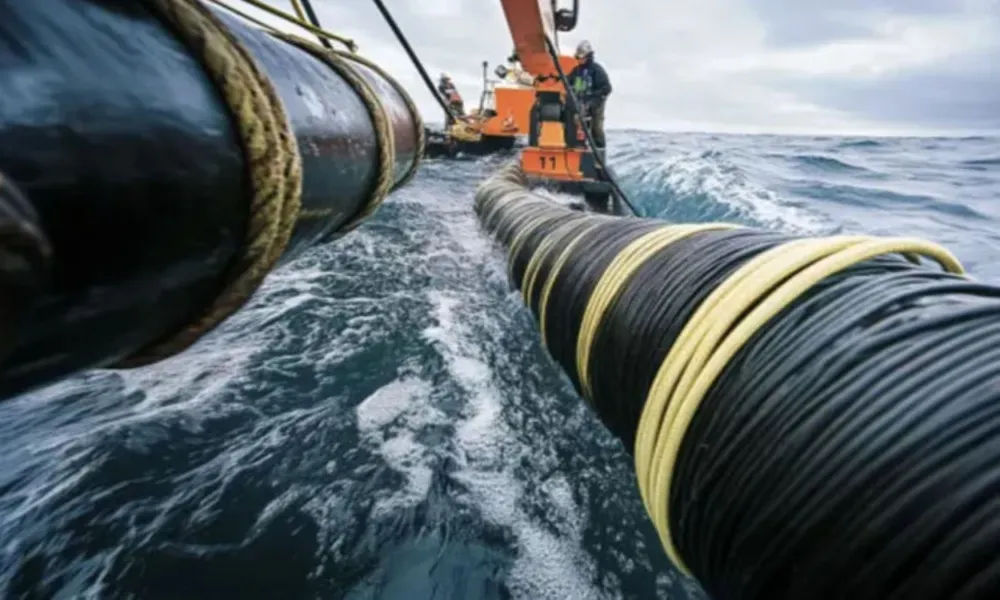
He added that an agreement has already been signed with Nexans to proceed with seabed surveys and argued that France's involvement creates a new possibility for political support that could prevent Turkey from obstructing survey work.
Ellinas said the development gives the project greater momentum and comes at a time when Cyprus has recently faced electricity supply challenges.
"The presence of the GSI will provide Cyprus with energy security," he said.
Delay does not mean cancellation
The energy expert said the project is likely to face delays, noting that Nexans has already announced a two-year delay in cable construction and is currently discussing a revised timetable with ADMIE.
According to Ellinas, Nexans could not remain indefinitely on hold while waiting for decisions regarding the project because it is engaged in numerous other international contracts.
"It is not stopping. It is simply being frozen through agreement with ADMIE," he said.
He added that he does not expect the delay to be excessive because the latest developments have created new opportunities for the project to advance.
EIB viability study less relevant
Commenting on the European Investment Bank's viability assessment, Ellinas argued that Meridiam's investment changes the picture entirely.
"For me the EIB study was unnecessary. Now this development makes it completely unnecessary," he said.
He argued that a private company choosing to invest in a project of this scale demonstrates that it considers the project not only viable but potentially profitable.
Investors will arrive with or without Cyprus
Asked whether the GSI could move forward without financial participation from the Republic of Cyprus, Ellinas noted that the annual €25 million commitment over five years remains protected by legally binding agreements.
However, he pointed out that, based on recent statements by the Finance and Energy Ministries, Cyprus currently does not intend to proceed with the previously discussed €100 million equity investment.
Ellinas said that position should be reconsidered.
"Cyprus cannot allow others to have excessive control over the project and have no say itself," he said.
He described the GSI as one of the most important energy projects for Cyprus and the country's most significant project in terms of energy security.
At the same time, he said the project could still proceed without Cypriot equity participation because other investors, including companies from the United Arab Emirates and the United States, may be interested.
"For me there is no issue. Investors will be found with or without Cyprus," he said, while reiterating that it would be unacceptable for Cyprus to remain merely an observer.
Energy security and lower electricity costs
Ellinas said Cyprus would benefit from the project even without direct participation because the interconnector would facilitate electricity imports.
He dismissed suggestions that battery storage alone could resolve Cyprus' energy security challenges.
"The idea that batteries solve the problem is ridiculous," he said.
He argued that batteries provide only short-term solutions and cannot compensate for major disruptions caused by failures at electricity generation units.
By contrast, he said the cable would allow Cyprus to import electricity from Greece at lower prices.
"It will definitely bring reductions," he said.
Seabed surveys the next crucial step
Ellinas identified the planned seabed surveys as the next critical milestone for the project's progress.
"We should soon hear how the seabed surveys will proceed," he said.
He expressed the view that once that issue is clarified, Nexans will be able to resume activity on the project.
Concluding, Ellinas noted that Meridiam has been studying the GSI for years, maintains an office in Athens and is familiar with the project's fundamentals.
"The announcement now opens the way for the GSI to be implemented," he said, describing Meridiam's participation as a sound investment.
Source: CNA