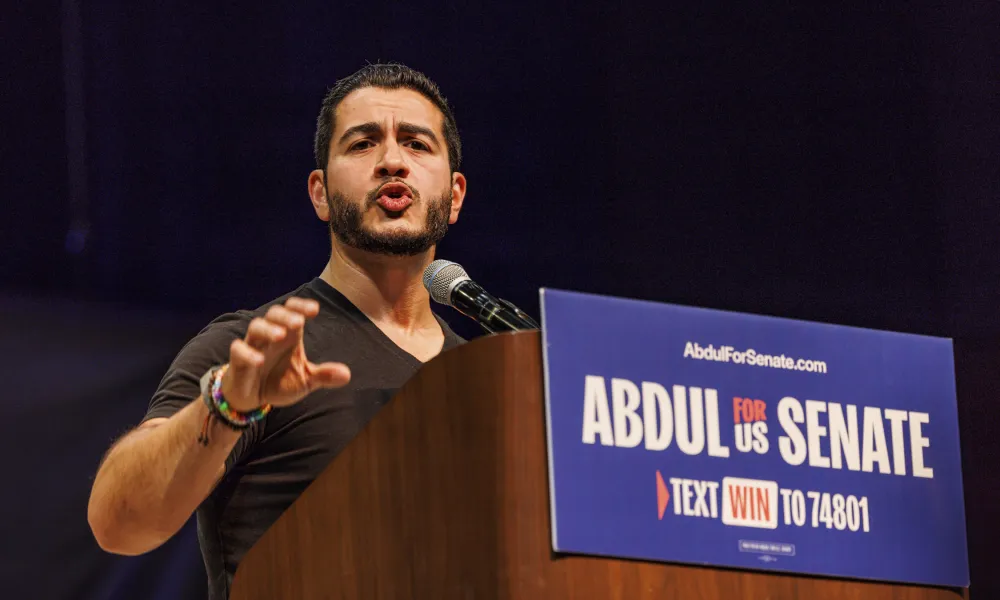



Dr Abdul El-Sayed's narrow victory in Michigan's Democratic Senate primary has set off a national reckoning over the direction of the Democratic Party, drawing an aggressive response from Republicans and prompting one of Israel's most powerful lobbying groups to consider an unprecedented step in the general election.
El-Sayed, a 41-year-old doctor who built his campaign around healthcare, the economy and an end to unconditional US military aid to Israel, defeated the more moderate Representative Haley Stevens by a narrow plurality, becoming the first progressive to win a statewide Democratic primary in a state President Donald Trump carried in 2024. He will face Republican former congressman Mike Rogers in November, in a race widely seen as pivotal to Democrats' chances of winning back the Senate.
Republicans and Trump go on the attack
Republicans moved quickly to frame El-Sayed as too extreme for Michigan. Digital advertising from the party's Senate campaign arm and an allied political action committee described him as dangerous and the most radical Senate candidate in the country. Rogers issued a statement casting the race as a stark choice, saying voters faced a decision between "common sense or complete insanity."
Trump escalated the attack further during a Wednesday appearance in Las Vegas, turning what had been billed as a speech on the economy into a broadside against the Democratic Party's progressive wing. He argued that recent primary wins by left-leaning candidates represented a creeping threat of communism to American life, calling it "the greatest threat" facing the country. Neither El-Sayed nor the other progressive Democrat who won a Michigan House primary this week identifies as a democratic socialist, although Trump has repeatedly and inaccurately equated the progressive label with communism, a far more radical ideology that seeks to abolish private property altogether. Trump also singled out El-Sayed's stance on Israel directly, accusing him without evidence of harbouring hatred toward Jewish people, a characterisation El-Sayed has rejected, saying his criticism of Israel's military campaign in Gaza should not be conflated with antisemitism.
AIPAC weighs a rare intervention
The pressure on El-Sayed is not limited to the Republican Party. The American Israel Public Affairs Committee, which spent $32 million in an unsuccessful effort to help Stevens defeat him in the primary, is now considering a further, larger financial campaign to back Rogers in the general election, according to people who have spoken with the group's leadership. Such a move would mark a significant departure for AIPAC, which has traditionally described itself as bipartisan and only began spending in federal races in 2022.
El-Sayed, for his part, has treated the group's involvement as a badge of honour rather than a threat, telling supporters during the primary that he was happy to see AIPAC spend against him again in the general election, framing the money as evidence of outside interests trying to dictate American foreign policy. Referring to the financial backing behind Stevens' campaign, he told supporters in the early hours of Wednesday morning that his campaign had "taken $70 million on the chin and kept fighting back."
A test case for November
The Michigan race has become one of the clearest illustrations yet of the divide running through the Democratic Party, between candidates who lean into anti-establishment energy on the left and those seen as better positioned to appeal to swing voters. Michigan is essentially a must-win contest for Democrats, who need to hold the seat along with Georgia while flipping several Republican-held states to retake a Senate majority.
Analysts are split on what El-Sayed's win means for the party's chances. Some have argued his progressive positions make him an easier target for Republicans at a moment when Democrats want the political conversation focused on Trump's low approval ratings and the cost of living, rather than on ideological labels. Others point to the record turnout the primary drew and El-Sayed's ability to energise both young voters and Michigan's large Arab American community, which has grown increasingly hostile to Israel's conduct of the war in Gaza, as evidence that his approach may translate more broadly than his critics expect.
Whether Michigan proves to be the exception or the model for Democrats heading into the midterms will become clearer as more states hold their primaries and as El-Sayed's general election campaign against Rogers takes shape.
Source: Reuters, The New York Times