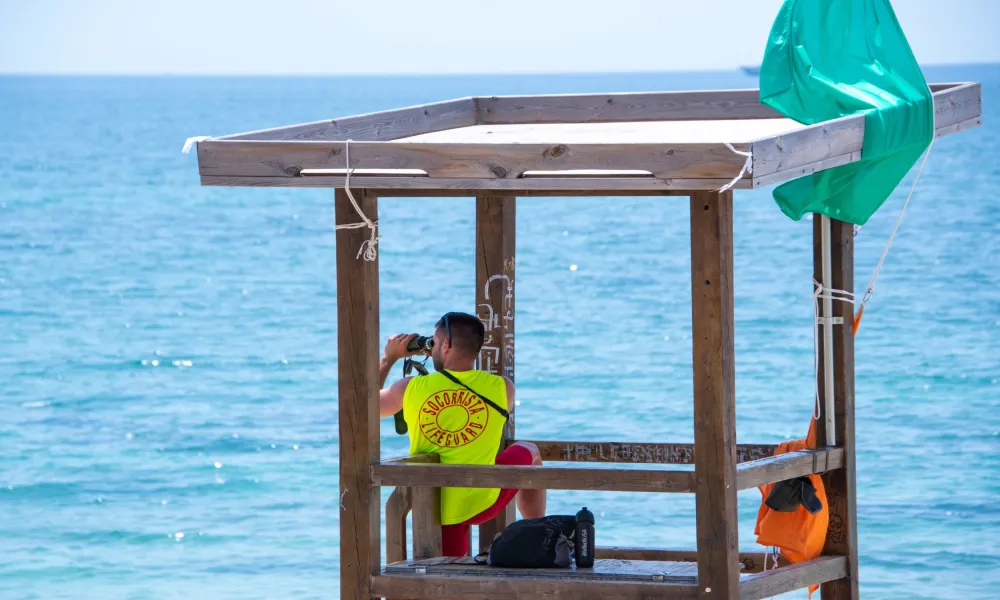

The problem of inadequate lifeguard coverage on beaches in Larnaca district had been known to the competent authorities for months, with the Ministry of Interior officially acknowledging, just four days before the latest fatal incident in Pyla, that only 10 of the district's 19 lifeguard towers were staffed.
The issue had been raised before Interior Minister Constantinos Ioannou on 23 June, when DIKO MP Andreas Apostolou, referring to drownings that had occurred in the sea area of Voroklini, requested that Mr Ioannou explain why the area is not staffed with lifeguards throughout the entire summer season.
In his response, dated 11 August, the Interior Ministry stated that there are a total of 19 lifeguard towers in Larnaca district. Of these, only 10 were staffed.
According to the official response, the lack of continuous staffing is due to the "limited availability of qualified lifeguards" and the need to prioritise beaches with higher visitor numbers or greater levels of risk.
Four days later, on 15 August, a woman drowned at the CTO beach in Pyla while in the sea with her two underage children.
According to the competent authorities, the incident occurred approximately 20 minutes after the lifeguard shift ended at 6pm.
Certification system
Antonis Oikonomides, Director of Local Government, acknowledged that the current lifeguard certification system has shortcomings and will be changed from 2027.
Speaking to the Cyprus News Agency, he said the problem does not lie in the number of approved positions or in salaries, but in the shortage of a sufficient number of certified candidates.
At present, employment on beaches requires an approved qualification from the Cyprus Lifesaving Federation, with Oikonomides referring to disagreements and interpersonal issues between lifesaving clubs and the federation that have affected the certification process.
The ministry is now proceeding with a new system in cooperation with the Human Resource Development Authority (HRDA) through certified providers, while separate standards are being prepared for beach lifeguarding and pool lifeguarding.
At the same time, Oikonomides identified seasonality as a second major problem.
Part of the workforce is employed for only four months, significantly limiting interest in the positions.
377 positions and 114 towers
Figures obtained from the Interior Ministry show that for 2026 there are 377 approved lifeguard positions nationwide, both permanent and seasonal, while the initial staffing programme included 114 lifeguard towers.
However, it was not possible to obtain an updated number showing how many of the 114 towers are staffed at any given time, as staffing levels change throughout the season and district administrations continue their efforts to fill vacant positions.
Operating hours
Operating hours are also not uniform.
According to Oikonomides, depending on the beach, shifts may end at 5pm, 6pm or 7pm, based on visitor numbers, risk levels and local conditions.
He rejected the idea of universally extending operating hours, stressing that:
"At some point lifeguards have to finish work."
He added that 24-hour coverage is not possible and also raised the issue of personal responsibility among bathers.
At the same time, however, another incident in Limassol highlighted the crucial role of the immediate presence of lifeguards.
At 5.30pm on Sunday, lifeguards at Akti Olympion intervened and rescued a couple from Nepal who were in danger of drowning.
The Lifeguard Unit stated that, without the timely intervention, the situation could have led to multiple fatalities.
The ministry is also planning expenditure of €500,000 per year for the 2026-2028 period on equipment, including defibrillators, radios and jet skis.