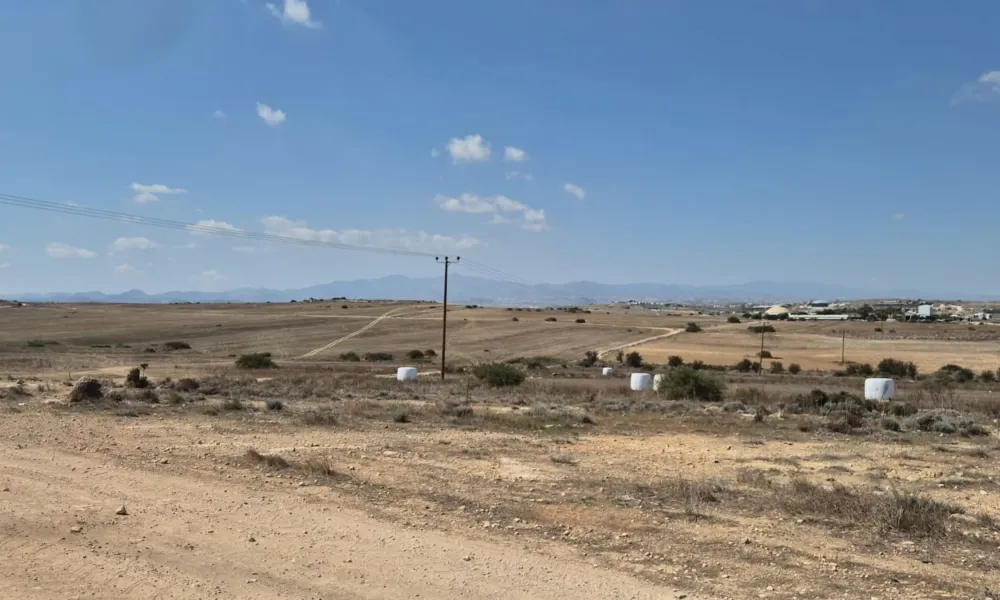

The government has chosen Agios Sozomenos as the location for Cyprus’ new Central Prisons, but the project will have to navigate a complex landscape of quarries, high-voltage pylons, archaeological sites, military installations and environmental restrictions.
The state-owned plot designated for the project covers more than three million square metres. However, the precise location of the prison complex within the site, its road access and its impact on existing activities in the area are still being planned.
Politis visited the area with Potamia Deputy Mayor Ioannis Minas to examine the site chosen for one of Cyprus’ largest public projects in the coming years.
Land Registry information obtained by Politis identifies plot 127, at the Vrysoudia locality of Agios Sozomenos, which falls under Potamia, as state land covering 3,152,137 square metres.
According to Minas, the site begins near the Latouros quarry area and extends beyond the Elmeni quarry towards the main road leading to Geri and Kallithea.
Quarries, antiquities and environmental restrictions
The conditions on the ground illustrate why the precise location of the development matters.
Within the site and its immediate surroundings are quarrying activities, high-voltage pylons, military installations, farming and livestock operations, alongside archaeological and environmental considerations.
The Alykos Potamos-Agios Sozomenos area forms part of the Natura 2000 network, while the historic Church of Agios Mamas is also nearby.
All these factors raise the question of exactly where within the more than three-million-square-metre site the new prison will be built.
New prison to accommodate 1,750 inmates
The government has already announced its decision to use Agios Sozomenos and has outlined plans for a 1,750-place correctional facility.
Convicted prisoners will be transferred to the new complex, while individuals on remand will remain at the existing Central Prisons.
The new facility has been described as a “small town”, incorporating areas for education, vocational training and treatment, as well as a small hospital.
The project is expected to cost approximately €300 million, with the government aiming to begin construction before the end of 2027.
‘They decided for us, without us’
The announcement, however, caught the local authority by surprise.
“They decided for us, without us,” Minas told Politis.
He said he learned of the plans through media reports, while simultaneously receiving repeated calls from concerned residents.
“My phone was non-stop. I had no idea what to tell them. I was trying to find the announcement in the media so I could read it and inform people,” he said.
During the visit, Minas could only speculate about where the complex might eventually be located.
“From what we can see, what we as a municipality imagine is that it will be somewhere around here,” he said, pointing towards one of the open areas in the northwestern section of the plot.
“We do not believe there is space on the eastern side where the prisons could be built,” he added, noting that a military camp and biological treatment facilities are located there.
Minas also raised questions about existing land uses and the proximity of farms and pig farms.
“I don't know how this announcement was made without first asking for some suggestions and views,” he said.
Northern section under consideration
The picture became somewhat clearer on 23 September, when it was announced that the necessary infrastructure could be developed in the northern section of the state-owned plot, at a distance from the archaeological site.
However, this does not yet represent a final decision on the prison’s exact location.
The basic parameters of a preliminary Master Plan are also under discussion, after which spatial planning, urban planning, environmental and other assessments and licensing procedures will follow.
In other words, the political decision to locate the project in the area has been made, but its precise footprint, access routes and individual impacts are still being determined.
Access road officially closed for six years
Road access will be a significant issue.
One of the main roads leading towards the site has remained officially closed for approximately six years following a rockfall.
According to Minas, the main Agios Sozomenos road was originally built as part of compensatory projects linked to the operation of Potamia’s biological treatment facilities.
Following the rockfall, the relevant authorities installed barriers and closed the road.
In practice, however, it continues to be used.
“Some farmers broke the barriers, opened the road, cleared it and people now use it normally, at their own risk. On paper, it is closed,” Minas said.
According to the deputy mayor, farmers, workers and tankers serving the biological treatment facility use the road, as do military vehicles and residents of the wider area.
A correctional complex capable of holding 1,750 prisoners, however, would generate the daily movement of hundreds of staff, visitors, suppliers and official vehicles.
Local community wants answers
Despite his criticism of how the project was announced, Minas stressed that the local community is not rejecting the development outright.
“We are completely ready to welcome everyone. Let them come and tell us that they have a plan and what that plan is. Even today, nobody has come to present it to us,” he said.
He does not believe the presence of prisoners inherently creates a security problem, pointing to the existing Central Prisons in Agios Dometios, which are located within an urban area beside houses and apartment buildings.
Instead, he said the concern stems primarily from the lack of information and the uncertainty this creates.
Residents have even heard reports suggesting that other facilities could eventually be developed in the area, although no official announcement has been made to that effect.
“The announcement sounds good. Now, whether it will be good in practice, whether it will be implemented, where it will be implemented and who it will affect, we want them to come and tell us: ‘This is our plan’,” Minas said.
Local benefits should also be considered
Minas argued that discussions should address not only the potential negative effects but also possible benefits for Potamia, Dali, the wider municipality, Geri and Latsia.
“Let us put everything on the table, let everyone benefit and let a collective decision be made,” he said.
The central issue nevertheless remains unresolved.
The government has selected Agios Sozomenos, determined the capacity of the new prison, provided an indicative cost and timetable, and identified the northern part of the state-owned plot as the initial geographical area under consideration.
What has yet to be finalised is what matters most to those living and working nearby: exactly where the prison will be built, how it will be connected to the road network, which existing activities will be affected, how it will coexist with archaeological and protected areas, and what changes it will ultimately bring to everyday life across the wider area.