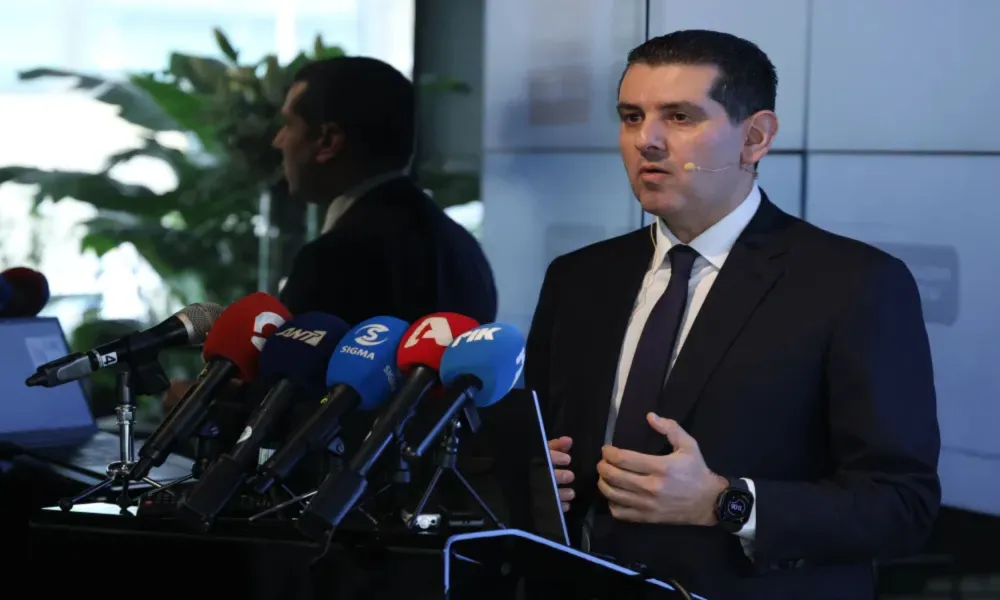

In an interview with Politis, he notes that the Republic's revenues are determined through contracts signed between the state and energy companies, and that the Cronos field, which contains more than 3 trillion cubic feet of natural gas, is expected to enter production in 2028.
Regarding the Aphrodite field, the minister also signalled developments during the second half of 2027.
Damianos also addresses other major issues, including electricity supply adequacy and the ongoing issue of the Cyprus-Greece electricity interconnection.
The Eni-Total consortium is moving ahead with commercial exploitation of Cronos from 2028. Will the Cypriot consumer and taxpayer benefit?
The Final Investment Decision (FID) taken by Eni and TotalEnergies for the development of the Cronos field represents a particularly important step for the Republic of Cyprus, as it is the first development project involving a Cypriot hydrocarbon discovery that is now entering the implementation phase.
This development transforms the discoveries made to date in Cyprus' Exclusive Economic Zone into a concrete development project and opens the way for the commercial exploitation of the country's energy resources. At the same time, it confirms the confidence of major international energy companies in the prospects of the Republic of Cyprus and strengthens its role as a reliable energy partner in the Eastern Mediterranean.
The Cronos field, with reserves exceeding 3 trillion cubic feet of natural gas, is expected to enter production in 2028.
The natural gas will be transported and processed through the existing infrastructure of the Zohr field in Egypt and then liquefied at the Damietta terminal for export to international markets, with Europe as the principal destination.
As far as benefits for Cypriot consumers and taxpayers are concerned, a realistic approach is required. The revenues of the Republic of Cyprus are determined through the contracts signed between the state and the companies involved.
At the initial stage, a significant share of revenues will be directed towards covering the cost of developing the project. Afterwards, the revenue-sharing mechanism between the Republic and the companies will be activated in accordance with the agreements that have been signed.
The Republic's first revenues are expected after production begins, with the initial amounts naturally being more limited, given that this is a field of a specific size.
The greater value of Cronos, however, lies in the fact that it signals Cyprus' entry onto the map of natural gas-producing countries and creates the conditions for the exploitation of other fields within Cyprus' EEZ.
The essence is that Cyprus is now moving into a new phase, where its energy resources can be utilised in a manner that will generate long-term benefits for the economy and the country as a whole.
When is the Final Investment Decision expected for Aphrodite and what is the outlook for the other confirmed fields in Cyprus' EEZ?
The Final Investment Decision for the Aphrodite field is expected during the second half of 2027.
The project is advancing through its maturation phase, while significant progress has been made regarding the outstanding issue with Israel over the Ishai reservoir. Progress has been achieved on the commercial aspects and only the legal component remains to be completed.
Based on the current schedule, production from Aphrodite is expected to begin in 2031.
With regard to the other confirmed fields in Cyprus' EEZ, the ExxonMobil-QatarEnergy consortium has submitted declarations of commerciality for the Glaucus and Pegasus fields, a development that constitutes an important step towards their further development.
According to the consortium's plans, the Final Investment Decision for those fields is expected in 2029, with production beginning in 2033.
Cyprus continues to have among the highest electricity prices in Europe and reductions depend on the arrival of natural gas. The Vasilikos project remains unresolved. Have you decided how you will proceed with its completion? Are there alternatives?
The government's position is clear: the Vasilikos project must be completed, as it represents critical infrastructure for the introduction of natural gas into Cyprus and for reducing electricity generation costs.
The terms of the new procedure have been determined, the tender has already been issued and the award of the contract is expected as soon as possible.
The important point at this stage is that the process proceeds in a way that ensures the timely completion of the project without further delays or legal complications.
Completion of the Vasilikos project remains the government's primary option, because it will enable the importation of natural gas for electricity generation and contribute to energy security and the gradual reduction of electricity costs.
Electricity supply capacity is again under pressure this year. You have announced plans for energy storage infrastructure. Private producers say the requirements are excessive, including the need for building permits. Are you considering simplifying procedures?
Electricity storage constitutes an important tool in our energy planning because it contributes significantly to the better utilisation of renewable energy generation and to the flexibility of the electricity system.
Specific actions are already under way in this direction.
The Transmission System Operator is promoting the development of an energy storage system with a total capacity of 120 MW, while storage projects are also progressing both within the Electricity Authority of Cyprus (EAC) and the private sector.
With regard to issues raised by investors concerning licensing procedures, the ministry is evaluating the existing framework with the aim of ensuring the timely development of the necessary storage infrastructure, without compromising safety requirements or the smooth functioning of the electricity system.
The electricity interconnection with Greece also remains pending. At the same time, a study is progressing regarding an interconnection with Lebanon. Is that not contradictory? Are interconnections part of energy policy or not?
Electricity interconnections form part of our energy planning, since Cyprus remains the only member state of the European Union that is not electrically interconnected.
The Cyprus-Greece interconnection through the Great Sea Interconnector is a strategically important project that is being examined based on updated technical and economic data.
We are awaiting completion of the evaluation by the European Investment Bank so that we can have a clearer picture of the project's parameters.
At the same time, investigating the possibility of an electricity interconnection with Lebanon is not a contradiction.
This is a preliminary feasibility study, supported by the World Bank, aimed at evaluating the viability of a possible interconnection.
Our position is that every option which strengthens energy security, reduces the country's electricity isolation and enhances regional cooperation should be assessed on the basis of technical and economic criteria.
In this environment, what is the role of the EAC? In an open and competitive electricity market, does the state still have a place as the owner of a company involved in generation, supply and distribution?
The launch of the competitive electricity market represents an important development for the energy sector because it ensures free and equal access to the market for all participants.
Within this new environment, the EAC continues to play an important role.
As I have stated before, it remains a strategic partner of the state in the energy transition, in achieving the country's energy goals, in ensuring energy security and in providing quality services to citizens.
The full maturation of the market requires cooperation among all stakeholders so that the benefits of competition reach consumers in practice.
How do you assess the implementation of e-kalathi? Are you planning changes?
The operation of the e-kalathi platform represents an important step towards strengthening market transparency and providing consumers with better information.
Through the platform, citizens can compare prices and make more informed purchasing decisions.
Combined with other market-monitoring and consumer-information tools, it contributes to stronger competition and improved market functioning.
The Consumer Protection Service of the Ministry of Energy, Commerce and Industry continues to evaluate the available tools with a view to continuously improving consumer information and protection.