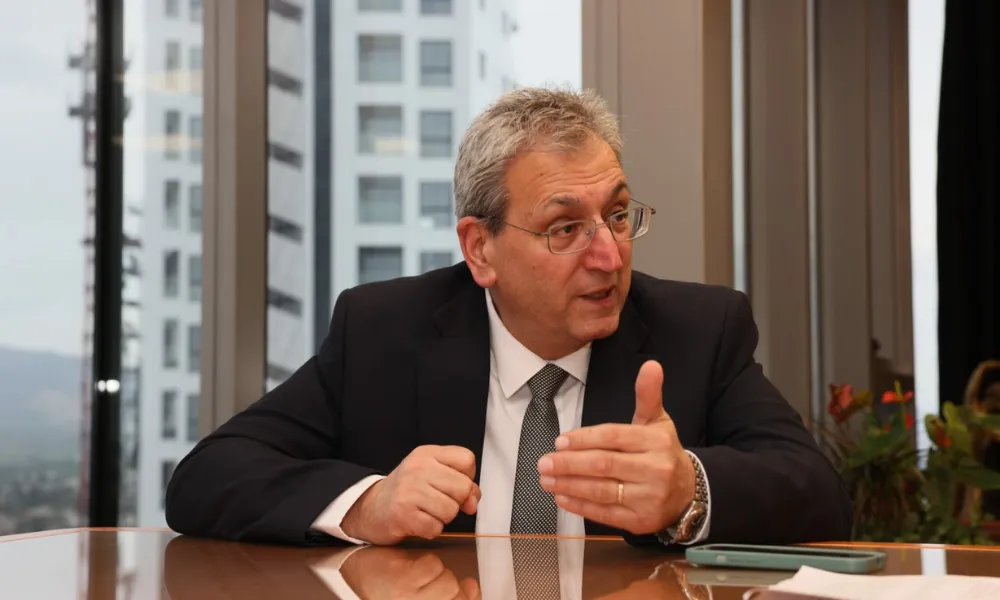

The pension reform will bring increases for around 123,000 pensioners, said Minister of Labour and Social Insurance Marinos Mousiouttas, speaking on Wednesday at an event held by the citizens' organisation "55 Plus Minus Together – Cyprus" on pension reform.
"More than 50,000 of them will receive an increase of more than €100 a month within five years, while more than 8,000 will see pension increases exceeding €200. Depending on the case, the increases range from 5% to 55%," he added.
He noted that on 3 September, the draft pension reform bill was put out for public consultation on the "e-Consultation" electronic platform.
"The text is open to every citizen, not just institutional bodies, and the deadline for submitting views, comments and observations closes today, 16 September. At the same time, social dialogue is in its most intensive phase. The draft was handed to the social partners in mid-August, and since then we have been meeting twice a week, with thematic sessions, so that we don't speak vaguely about the whole but specifically about each chapter separately. The dialogue is demanding and, yes, there are disagreements. That doesn't worry me. The opposite would worry me," he added.
Timeline remains clear
The Minister said the timeline remains firm. "The bill will be tabled in the House of Representatives within September, so that the legislature can begin processing it. And the Christodoulides government's target remains unchanged: for the new system to take effect from 1 January 2027, so that pensioners see the increases in their accounts by the end of January," he said.
He added that the reform, designed with the support of the International Labour Organization (ILO), serves three goals: ensuring adequate income for those who worked a lifetime, restoring fairness between generations and within the same generation, and keeping the Social Insurance Fund sound for decades to come.
Basic pension is the core change
Turning to what changes in practice, the Minister said the revised basic pension lies at the heart of the reform.
"Its amount will no longer depend on complex calculations that few understand, but on something simple and clear: the total time you are registered and insured. And this is where the major shift lies. This time counts not only the contributions you paid yourself, but also contributions subsidised by the state for periods of your life that, until now, the system treated as gaps," he added.
He noted that the retirement age remains at 65 and is not being raised.
"However, anyone who wishes, and only those who wish, will be able to keep working and contributing until 67, with a correspondingly higher pension at the end. We are giving people a choice, not imposing an obligation. I also want to repeat that the contribution rate to the Social Insurance Fund is not increasing either. The coefficient used to calculate the basic pension rises on a sliding scale, from 1.1 at 63 to 1.3 at 65 and up to 1.5 at 67, so that every extra year of work genuinely counts," he added.
Early-retirement penalty to be eased
Referring to the 12% actuarial reduction applied to those retiring at 63, the Minister said it has for years been "a source of bitterness for thousands of our fellow citizens."
"Scrapping it entirely would undermine the Fund's sustainability. We are therefore pushing for a substantial easing of it, bringing the reduction down to around 7.5%. Two things matter here in particular. First, the easing will apply for life, not for a transitional period. Second, it will cover both current pensioners and those who retire before the end of the five-year transition," he added.
He said a guaranteed minimum increase of €30 a month is being introduced for every existing Social Insurance Fund pensioner with a pension of up to €600, to be paid from the very first month the reform takes effect.
"I know that to some, €30 will sound like little. But for a household counting every euro before going to the pharmacy, it isn't little. It's €390 a year. Every year. And it's the floor, not the ceiling, since for the lowest pensions the overall boost from the reform is much larger. The increases will be phased in over a five-year transition, from 2027 to 2031, with most of them front-loaded in the early years, and a more favourable calculation coefficient for those who retire within that period," he said.
Under the current design, the Minister said, 30% of the total increase is paid in the first year and the same again in the second.
"That means 60% of the increase is in the pensioner's pocket within the first two years. As an indicative example, a pensioner with a full working life who currently receives €504 could see a total increase of around €250 by the end of the five years. Other things are changing too. Recipients of the Social Pension are being brought into the Social Insurance Fund as a special category, with their rights safeguarded, while the transitional protection period for future recipients is being significantly extended. For those who cannot afford to contribute, the state will take on the contributions, based on income criteria. Invalidity and widowhood pensions, as well as the orphan's allowance, are being overhauled, together with the increases for each dependent child," he added.
New contributions on dividends, interest and rent
The Minister said the reform also widens the system's funding base, introducing a new contribution requirement on income that has not previously contributed to social insurance, such as dividends, interest and rent, up to a set ceiling corresponding to the annual amount of basic insurable earnings.
"It's a matter of basic fairness, since the burden cannot fall on wages alone. And then there's the Fund's reserve. We're talking about a sum in the region of €12 billion, which the state has borrowed over time from workers' contributions. This money does not belong to the government. It belongs to those who worked and contributed. The borrowing is ending, annual surpluses will now be deposited into the Fund's own investment account, and arrangements have been agreed for the gradual repayment of the existing debt, taking the state of the economy into account," he added.
The repayment, the Minister said, is set on a 40-year horizon, while actuarial studies show the Fund will run surpluses for the next four decades.
"A new governance and investment oversight framework is being introduced, aligned with European requirements. The Fund is ceasing to be a passive lender and becoming a prudent manager of insured people's assets. As for the second pillar, occupational pension schemes, the relevant dialogue continues through September. It needs time to mature, and its benefits will mainly be felt by future generations. But we did not agree to freeze what can be done today while waiting for something that will take years. Today's pensioners don't have the luxury of waiting," he said.
Part of a wider package
The Minister of Labour said the pension reform does not stand alone.
"It adds to the tax reform in effect since 1 January 2026, which, with a higher tax-free threshold and deductions that reflect a household's real burdens, leaves more money where it is actually needed. Two reforms, one logic: that growth only means something when it reaches every family's table," he concluded.
Source: Cyprus News Agency (CNA)