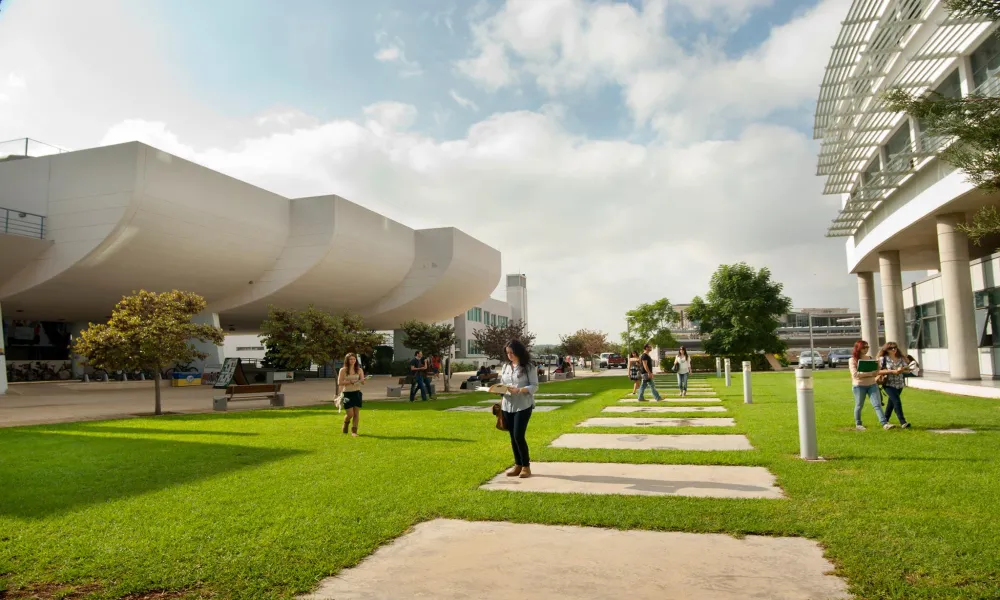

Academics and researchers from the University of Cyprus’s Department of Psychology, Department of Computer Science and Department of Law are taking part in an international Council of Europe competition and have already been selected to represent Cyprus as the team Ctrl + Alt + Dialogue.
The team’s innovation secured a place at the Council of Europe after its proposal, Civic Bridge AI, developed within the framework of the Council’s Democracy Hackathon ‘Hack the Hate, Renew Democracy’, was selected from among hundreds of submissions from the 46 member states. It has earned one of just 20 places in the grand final in Strasbourg.
On 16 June, the core four-member Ctrl + Alt + Dialogue team travels to the Palais de l’Europe in Strasbourg for the competition, which runs from 17 to 19 June. Their aim is to present an artificial intelligence application that detects hate speech on social media, evaluates its severity anonymously and, based on the principle of proportionality, proposes targeted educational interventions grounded in Council of Europe conventions, as well as theoretical frameworks from social and developmental psychology and findings from the University of Cyprus’ Laboratory of Genetic Social Psychology.
How the idea was born
Civic Bridge AI began as a dynamic response to a pressing problem: hate speech and polarisation flooding social media, particularly among adolescents. An interdisciplinary team combining social and developmental psychology, computer science, educational practice and the authentic voice of a 17-year-old student designed and developed a functional minimum viable product (MVP) app under the demanding conditions of the hackathon.
What the Civic Bridge AI application does
Civic Bridge AI operates as a ‘safe digital laboratory’ for pupils, young people, educators, parents, journalists and policymakers. Using artificial intelligence, it creates realistic, interactive educational scenarios based on real incidents of hate speech on social media, while maintaining the anonymity of both perpetrator and victim.
Rather than teaching theory, it trains users to recognise toxic language, interpret it with support based on each country’s legal framework and European Commission against Racism and Intolerance (ECRI) references, contextualise it within institutions and oversight mechanisms, deconstruct it and transform it into healthy, democratic dialogue. Civic Bridge AI does not remove content. It transforms the social dynamics of racism and xenophobia.
Why Civic Bridge AI stood out
The proposal fully meets the Hackathon’s fourth challenge, ‘Think out of the box’, which calls for solutions that prevent, contextualise and transform hate speech – beyond simple content removal – using an intersectional approach covering ethnicity, gender, religion, sexual orientation, age and origin. Civic Bridge AI combines this educational philosophy with the power of artificial intelligence.
Ctrl + Alt + Dialogue: The four-member team in Strasbourg
Dr Charis Psaltis: Professor of Social and Developmental Psychology at the University of Cyprus, with research interests in intergroup relations, transformative justice and genetic social psychology. Co-director of the University of Cyprus Laboratory of Genetic Social Psychology.
Dr Moysis Symeonides: Postdoctoral researcher in the Department of Computer Science at the University of Cyprus (Laboratory for Internet Computing – LInC). Specialist in applied machine learning, cloud computing and distributed systems.
Dr Anna Zapiti: Researcher at the University of Cyprus Laboratory of Genetic Social Psychology, primary education teacher specialising in peer interaction, cognitive development and social representations of gender.
Maximos Psaltis: 17-year-old student at The English School. Provides the authentic student perspective, with an interest in engineering, contributing to the application’s design so it meets the needs of adolescent users.
Civic Bridge AI support team
Dr Dimitris Paschalidis: Computer scientist specialising in natural language processing, artificial intelligence systems and integration of large language models, responsible for technical architecture and application development.
Professor Dr Aristotelis Constantinides: University of Cyprus Department of Law, chairman of the board of the EU Agency for Fundamental Rights (FRA), adviser on human rights and legal framework.
Dr Chara Makriyianni: EUROCLIO ambassador, school director, chair of the Scientific Advisory Council (2021–2025) of the Council of Europe Observatory on History Teaching in Europe, adviser on educational design and pedagogical implementation.
Voula Antoniou: Producer, director, adviser on audiovisual communication and presentation.
What comes next
From 17 to 19 June, during the ‘No Hate Speech’ Week, the Ctrl + Alt + Dialogue team will be at the Council of Europe headquarters to present Civic Bridge AI. The event will conclude with a speech by Council of Europe Secretary General Alain Berset.
The winning teams will receive funding, mentoring and full implementation support, enabling their applications to achieve impact on a pan-European scale.
For more information: Democracy Hackathon.