
As the Ministry of Education increases funding to tackle school violence and announces new initiatives, its own services acknowledge they lack sufficient staff to meet schools' growing needs.
Educational psychologists struggling to carry out preventive work, counsellors shared across two or three schools, and rising numbers of requests for intervention paint the picture behind the ministry's 2027 budget, which amounts to €1.7 billion, up 5%.
The findings emerge from a written response by Education Minister Athena Michaelidou to AKEL MP Christos Christofides. They take on added significance following the presentation of the budget to the House Finance Committee, where the minister identified the creation of a safe and inclusive school environment as a key priority. Funding of €5.6 million is earmarked for tackling violence and delinquency in 2027.
Not enough time for prevention
The Educational Psychology Service employs a total of 76 people, including administrative staff and employees under different employment arrangements.
The service itself describes its level of staffing as "very low". According to the response, the large number of requests for student assessments absorbs much of the available time, limiting the ability of psychologists to carry out preventive work in schools.
As a result, the service says some children's psychoeducational needs remain unmet.
The finding is particularly significant as the role of the service extends beyond assessments to include support for families and teachers, crisis management and preventive programmes.
The situation is especially indicative in Limassol and Paphos, which are served by a joint district office without a senior educational psychologist in management. Those responsibilities are carried out on a temporary basis, while the service notes that the workload affects both the quality of support and case supervision.
The difficulties are not limited to psychologists.
The Counselling and Careers Education Service, which employs 234 staff members, reports that several counsellors cover two or three schools simultaneously. As a result, they are not present daily at each school and counselling support is provided on a fragmented basis.
Additional staff are also being sought by the Health Education and Citizenship Committee, while the Immediate Intervention Team links its staffing needs to the increase in violent incidents and requests from schools.
New measures in schools
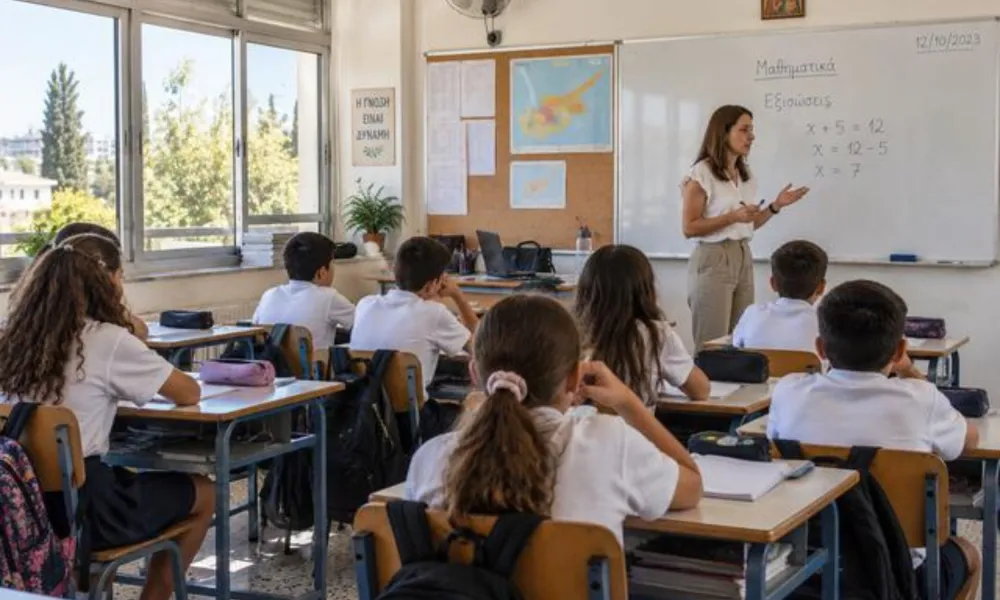
Against this backdrop, the ministry plans to introduce a pilot programme placing social workers in primary and secondary schools with high rates of delinquency.
It is also promoting early-intervention programmes in pre-primary education, the introduction of a second kindergarten teacher in classrooms, anti-bullying initiatives and a school counsellor for primary education.
Among the social policy measures is a pilot programme providing free breakfast in kindergartens.
The presentation does not specify, in all cases, the number of schools involved or the timetable for wider implementation.
The expansion of free compulsory pre-primary education is continuing, with the admission age now set at four years and four months. According to the presentation, around 1,925 children are benefiting from the measure this year.
Funding for primary summer schools is increasing from €3.7 million to €4.3 million, while optional all-day schools are also being expanded.
The minister also announced plans for a policy on gifted children and grants for pupils with talent in the arts.
In special education, funding will rise to €36.2 million from €28 million in 2026, while the ministry is also promoting changes to the legislative framework.
Michaelidou included modernising the teacher appointment system and implementing teacher evaluations among her priorities, issues that continue to generate debate and questions over their implementation.
In terms of educational content, plans include reducing the curriculum load, strengthening skills-based learning and introducing a policy on the use of artificial intelligence.
Air conditioning and prefabricated classrooms
At the same time, school infrastructure remains a major challenge.
The ministry's presentation increases infrastructure funding to €53 million from €43 million in 2026 and refers to 23 large-scale projects.
However, written parliamentary responses reveal that several planned projects remain at the study stage, including the new Paralimni Sports Gymnasium, with an estimated cost of €13 million.
The same programme includes the continued construction of two new technical schools in Limassol and Aradippou, with a combined estimated cost exceeding €60 million. The figure relates to the projects' total cost rather than 2027 funding alone.
A total of €10 million has been allocated for air-conditioning units in 2027, with installations continuing through school boards in an effort to cover all schools.
At the same time, around €2.7 million has been earmarked for infrastructure needs linked to the expansion of pre-primary education, including prefabricated classrooms.
Planned works also include maintenance, fire-safety upgrades and electromechanical inspections.
According to the minister's presentation, security cameras are operational in 150 schools, while installation has begun at a further 25 schools.