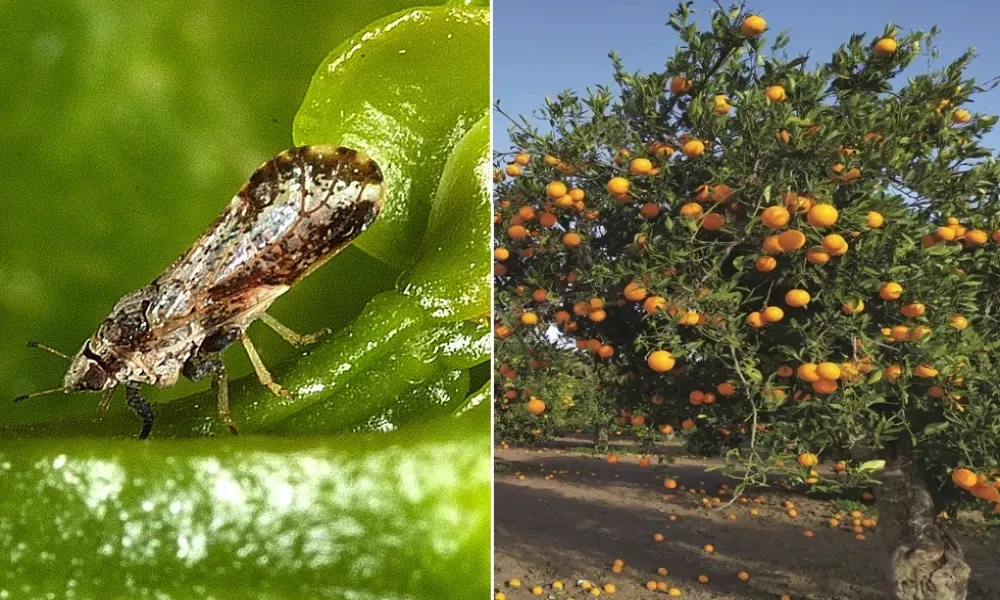

On 4 and 5 June, the Republic of Cyprus' Department of Agriculture carried out a simulation exercise for a scenario in which the bacterium behind citrus greening disease, known as Huanglongbing (HLB) and often referred to as "yellow dragon disease," is detected on the island. HLB is considered the most destructive citrus disease in the Americas, Asia and Africa. The exercise took place in a citrus orchard in Limassol district, in the same area where the Asian citrus psyllid, Diaphorina citri, the insect that is the bacterium's main carrier, was first detected on the island in 2023.
Since 2023 the insect has spread across the entire island, though fortunately without the HLB bacterium itself being detected. It is worth noting that the insect has so far not been found in any other EU member state, only in Cyprus, and the European Commission is monitoring the situation closely. "Carrying out the exercise is itself a strong signal of readiness," a department official told Politis, adding that the Department of Agriculture is not waiting for the bacterium to appear but is actively preparing to deal with it if and when it does.
Joint containment
The most significant development linked to these preventive exercises, however, is that at the most recent meeting of the bicommunal Technical Committee on the Environment, where the main topic was the success of coordinated action by both sides in significantly reducing the numbers of the Asian citrus psyllid, Greek Cypriot and Turkish Cypriot scientists opened discussions on joint participation in future simulation exercises.
"The aim is to develop a joint procedure, in case the bacterium appears, so that we can contain it in time," the Greek Cypriot co-chair of the committee, Michalis Loizidis, told Politis. As an example, he said, Turkish Cypriot scientists would be informed in advance of any exercise held in the government-controlled areas, in case they wished to take part in a personal capacity.
Falling numbers
Before developing a joint procedure for tackling the bacterium directly, the two sides agreed, around a year and a half ago, to release a shared beneficial insect, the parasitoid Tamarixia radiata, imported from California in the United States, for the biological control of the Asian citrus psyllid, since Tamarixia radiata feeds on the psyllid.
In the months that followed, joint efforts, coordination and the mutual exchange of information between scientists on both sides bore fruit. After the release of the shared beneficial insect, psyllid numbers fell significantly. Loizidis said both sides represented on the committee were very pleased with this positive development across the whole island. "The situation is under control," he said, adding that the insect's concentrations and numbers had been brought down to a point where they no longer caused the concern they once did, and that if the bacterium does appear, which is considered likely at some point, it would now be far easier to deal with than before.
Dialogue within the bicommunal Technical Committee on the Environment also covers the exchange of information and experience on plant health conditions on both sides. This is considered essential, since plant pests do not stop at the Green Line and can move freely on the wind or through the movement of plant material carried by people and animals.
The numbers behind it
The Greek Cypriot co-chair's account is consistent with the findings of surveys carried out by the Ministry of Agriculture in the area under the Republic's control. A Department of Agriculture official said surveys conducted in October and November 2025 by a joint team of experts from the department, the Agricultural Research Institute, the Cyprus University of Technology and Spain's Valencian Institute for Agricultural Research (IVIA), covering 23 selected sites across the island, found "a significant reduction" in the insect's population compared with the same sites in 2024. The official added that while the insect had been detected in 100% of orchards surveyed in July 2024, a year later adult insects were found at only 38.5% of the sampled sites, with very low densities at the large majority of them.
According to the Department of Agriculture, even more significant than these encouraging results is the parasitism rate. At the site with the highest insect density, 96.2% of nymphs were found to be parasitised by Tamarixia radiata, confirming that the parasitoid has become firmly established and is exerting strong biological pressure on the pest population.
A second native parasitoid species, Tamarixia citricola, also emerged during the programme. These findings were recently published in a leading entomology journal (Urbaneja et al., Journal of Applied Entomology, 2026).
The threat remains
"Diaphorina citri populations remain generally low at the large majority of monitored sites," the Department of Agriculture official said, adding that the picture had clearly improved compared with 2024. Even so, the official said, the threat remains and surveillance cannot be allowed to ease. D. citri has shown it can recover quickly under favourable conditions, particularly during the growth of new shoots, which provide the main substrate for egg-laying and nymph development. For this reason, the Department of Agriculture continues to carry out surveys at regular intervals, particularly in areas with a history of the insect's presence.