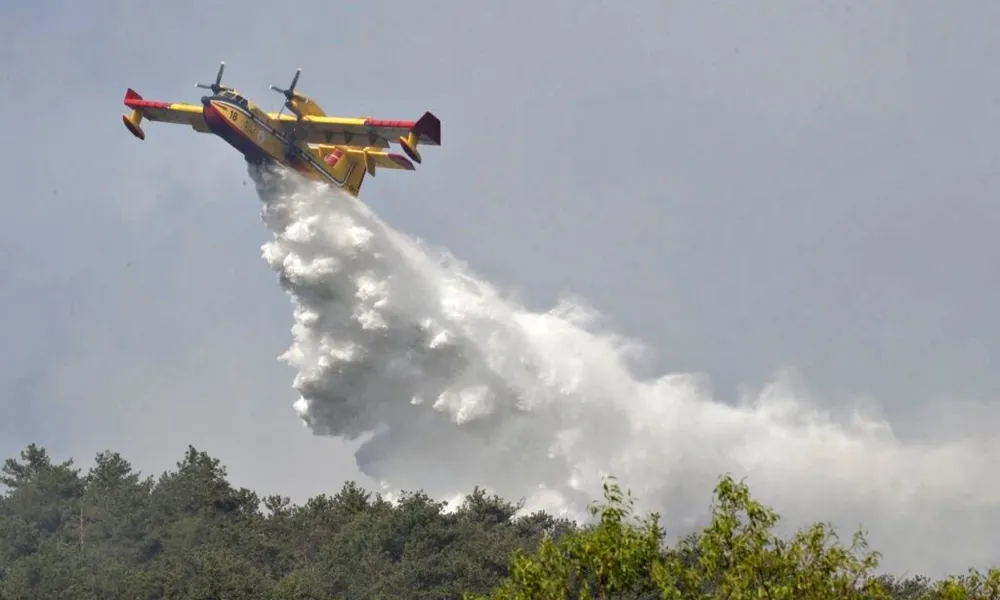

The effects of a forest fire continue for many years after the flames are extinguished, as burned ecosystems remain highly vulnerable and recovery can take decades or even centuries, a senior Forestry Department official said on Tuesday.
Glafkos Kyriakou, First Forestry Officer and spokesperson for the Forestry Department, told CNA that a new and critical phase begins after a wildfire, with environmental, social and economic consequences extending long beyond the immediate destruction.
The time required for recovery depends on the type of vegetation affected, the intensity of the fire, weather conditions in subsequent years and the level of human intervention aimed at restoring the natural environment, he said.
Soil erosion
One of the first problems following a forest fire is soil erosion caused by rain and wind, particularly in areas with steep slopes.
At the same time, the risk of landslides increases, while the loss of fertile topsoil slows the return of the forest to its previous condition.
Kyriakou said the destruction of vegetation also reduces the ground's ability to absorb rainfall and affects wildlife, as animals and birds lose sources of food, shelter and breeding habitats and are forced to move elsewhere.
As a result, biodiversity and the natural balance of the ecosystem are disrupted, while natural forest regeneration is also affected because many animal and bird species play a role in dispersing seeds.
Air quality
He also pointed to deteriorating air quality caused by the large quantities of carbon dioxide released during wildfires.
The destruction of trees further reduces a forest's capacity to absorb carbon, adding to the effects of climate change, he said.
Beyond the environmental impact, wildfires also affect local communities, agriculture, livestock farming, tourism, infrastructure and, in some cases, public safety.
Regeneration
Kyriakou said Cyprus' forests possess significant natural regeneration mechanisms and that the Forestry Department seeks to keep intervention in natural areas to a minimum.
Practices once commonly used, including the construction of terraces and contour strips with tractors or manual labour, have largely been abandoned, he said.
Today, authorities favour less invasive methods, including limited manual interventions, cultivation of small areas and seed placement, allowing nature to recover through its own mechanisms.
Following every fire within a state forest, local forestry officials prepare a management plan setting out how the affected area will be restored after receiving the necessary approvals.
Kyriakou said such plans are prepared for all fires occurring in state forests across Cyprus.
In private areas, however, the department cannot intervene or carry out planting work without a request from landowners.
"When we are asked, we stand by the owners to help them," he said, noting that support schemes are available.
He cited the "Plant for the Climate" programme, launched during the winter season, under which native tree and shrub species are provided free of charge.
The species distributed are selected according to local climatic and soil conditions and are well adapted to Cyprus.
Community support
Through the programme, thousands of plants have been provided to communities and private individuals, while the Forestry Department has also supported restoration efforts in fire-affected areas of mountainous Limassol and Larnaca.
In mountainous Limassol, the department has assumed full responsibility for planting in community parks in affected villages, he said.
Kyriakou stressed the importance of avoiding species that are unsuitable for local conditions, require large amounts of water or extensive maintenance, or could influence the behaviour of future fires.
The scheme is open to all applicants and can be used for planting in public or private spaces. Applications for more than 50 plants require a simple planting plan.
Kyriakou also referred to major forest fires that occurred during the 1974 Turkish invasion.
He said some affected areas were reforested through artificial planting carried out by the Forestry Department, while others were left to regenerate naturally and today support rich vegetation.
However, he emphasised that it takes many decades for trees to regain the size they had before a fire, although Cyprus' forests are often capable of recovering through natural regeneration processes.
Source: CNA