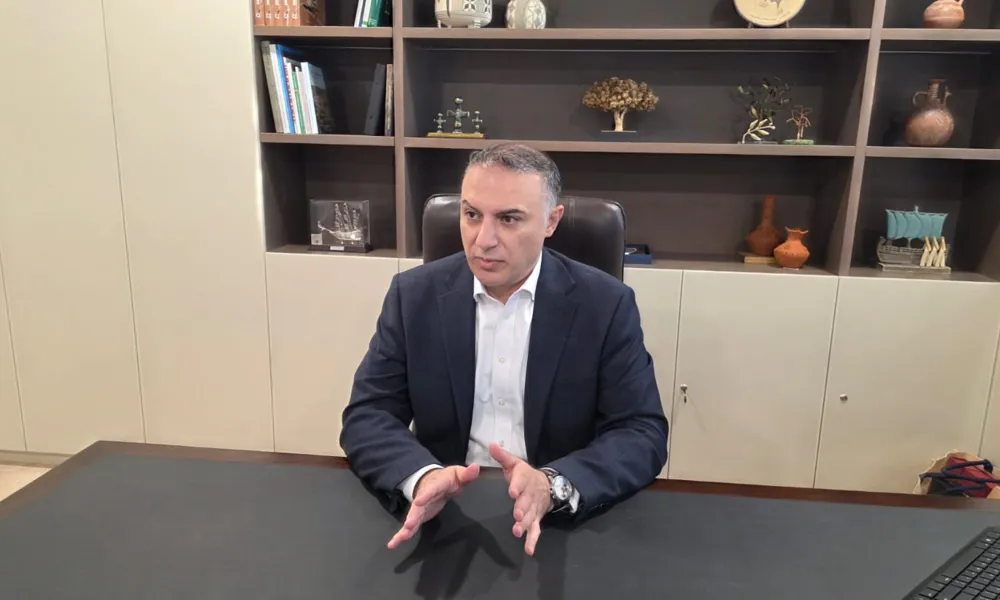
Agriculture, Rural Development and Environment Minister Christos Senekis has rejected suggestions that completing the Akamas road network will lead to weaker environmental protections, insisting that development and access to the peninsula will remain subject to strict controls.
In the second part of an interview with Politis, Senekis addressed environmental policy, potential pressure from vested interests, Akamas, the Pay-As-You-Throw waste scheme, environmental inspections and changes to government plans for a new Civil Protection structure.
He also clarified that the firefighting operations and personnel of the Department of Forests will no longer be transferred to the Interior Ministry, despite an earlier government proposal.
‘No interest is above the law’
Asked how he would respond to potential pressure from vested interests regarding decisions taken by the Department of Environment on developments and activities near environmentally sensitive areas, Senekis said the law must remain paramount.
“No interest is above the law,” he said.
Every decision, he added, must be based exclusively on the institutional framework, scientific evidence and transparency, with no place for personal, political or financial pressure in the process.
No change to Akamas protection
Addressing concerns about the protection of turtles at Lara beach, following the revival of a local authority request for an organised beach, Senekis rejected suggestions that completion of roadworks could usher in an “environmental Middle Ages” in Akamas.
He said completion of the road network does not imply either a relaxation or abolition of environmental protection.
Instead, the government aims to end what he described as an absence of comprehensive management that for years allowed uncontrolled visitor numbers while creating serious obstacles to fire prevention and the protection of the area’s fragile biodiversity.
The projects, he said, are intended to establish organised and effective management while fully respecting the Republic’s obligations under the Natura 2000 network.
“Our position is clear: access with rules, visitation with controls and protection without compromises,” Senekis said.
For Lara-Toxeftra specifically, the minister said the protection regime has been clearly established since 1989.
Restrictions protecting turtle nesting beaches are enforced through daily patrols and systematic inspections by the Department of Fisheries and Marine Research.
Senekis stressed that completion of the roadworks will not alter this protection regime.
Forestry Department will retain its role
Senekis also addressed the government’s earlier plans to transfer Department of Forests personnel and activities involved in forest protection to the Interior Ministry as part of the creation of a Civil Protection structure.
He said the fundamental objective has not changed: Cyprus needs an effective National Civil Protection Mechanism with clearly defined responsibilities and unified coordination during emergencies.
The initial government decision established the overall direction of the reform, but the subsequent planning process placed greater emphasis on ensuring effective cooperation among all participating services while retaining the operational capacity and expertise of each.
“As far as the Department of Forests is concerned, there is no question of moving it,” Senekis said.
He stressed that this does not undermine the broader Civil Protection plan.
Instead, the objective is to ensure that all competent services operate as components of the same mechanism during a crisis, with clear responsibilities and without overlapping duties.
That, he said, is the essence of the National Civil Protection Mechanism: enabling the state to respond immediately, coherently and effectively when emergencies arise.
Pay-As-You-Throw needs to accelerate
Addressing delays in implementing Pay-As-You-Throw by local authorities, Senekis acknowledged that Cyprus needs to close the gap between planning and implementation.
The Municipal Waste Management Plan 2022-2028 provides for separation at source, separate waste collection and the introduction of Pay-As-You-Throw.
The solution, he said, lies in accelerating these measures and working with local authorities to resolve the practical difficulties that remain.
Senekis acknowledged concerns raised by municipalities over infrastructure, financing and implementation costs, admitting that progress has not been fast enough.
He argued, however, that mutual blame between central government and local authorities would not solve the problem.
The state and local authorities have different responsibilities, he said, but share the same objective.
€25m secured for waste reforms
The government has secured €25 million through the THALIA 2021-2027 programme and is promoting technical support for local authorities, equipment procurement and the development of necessary infrastructure.
Senekis said consultations with the unions of municipalities and communities, as well as the relevant ministries, are being intensified to ensure that the transition is practical and fair for both local authorities and citizens.
Cyprus, he said, cannot continue treating landfill disposal as the primary solution for its waste.
The country must shift from a system in which waste is viewed as a burden towards one in which it is treated as a resource.
Pay-As-You-Throw forms part of that transition, he said, but its success will ultimately depend on implementation.
Environmental inspections under pressure
Senekis also addressed concerns that the autonomous Environmental Inspection Branch, established following a Cabinet decision, is operating below expectations.
He said the creation of a separate environmental inspection unit was designed to address a longstanding weakness: the absence of sufficiently systematic inspections and effective enforcement of environmental legislation.
The branch has been operating for around 18 months and has 12 staff members responsible for inspecting more than 1,000 installations across Cyprus, governed by a range of different and complex laws.
Its responsibilities include environmental crime, environmental liability and transboundary movements of waste.
More than 600 inspections carried out
According to Senekis, the branch has conducted more than 600 inspections to date, reflecting the work already carried out and the progress made.
He acknowledged, however, that the underlying problem has not been resolved.
The ministry now wants to use the experience gained during the first 18 months to strengthen the branch’s operational capacity.
This will include better prioritisation of inspections based on risk and closer cooperation with other competent authorities.
Senekis said the objective is to identify violations promptly, ensure environmental damage is repaired and enforce the law wherever necessary.