
Germany’s Christian Democratic Union (CDU) has suffered a historic electoral setback after failing to enter the state parliament of Mecklenburg-Western Pomerania, the first time the party has fallen short of representation in a state legislature in the history of the Federal Republic.
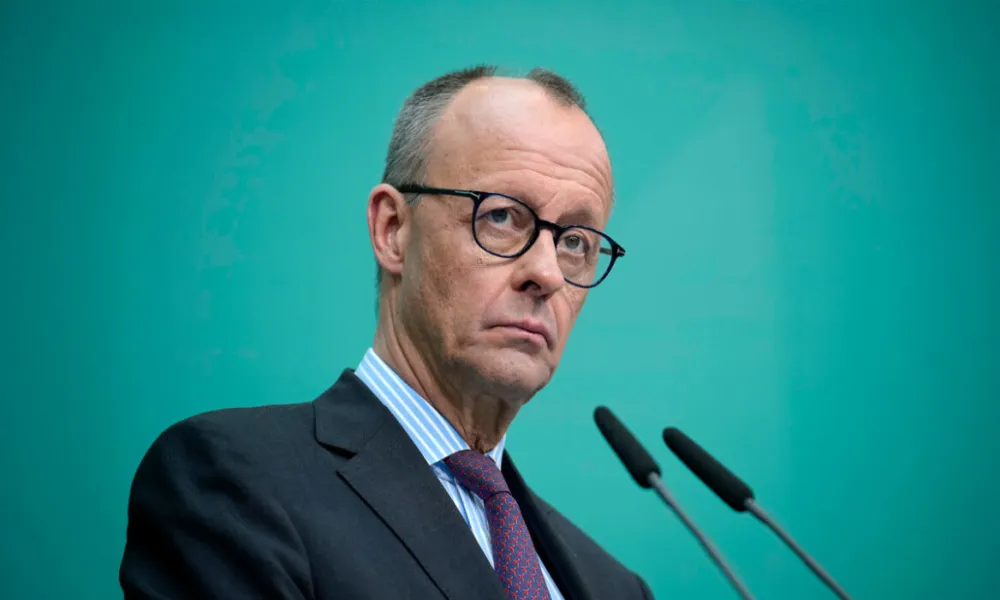
The defeat, in a region that includes former chancellor Angela Merkel’s former constituency, has increased pressure on Chancellor Friedrich Merz, who described the result as a “catastrophe” even before the final outcome became clear.
According to the official results available so far, the CDU received 4.9%, narrowly missing the 5% threshold required to enter the state parliament.
Merz moves quickly to contain fallout
Merz issued his reaction unusually early, just 14 minutes after the first projection was announced.
Already facing mounting pressure from within his party and weak polling numbers, the chancellor had previously secured the backing of the CDU leadership to remain in office and continue his reform programme.
His rapid response to the election result, however, was interpreted less as a demonstration of strength and more as an effort to establish a common message for party officials appearing in public throughout the evening.
German public broadcaster ARD said Merz’s decision to comment on a state election reflected the scale of the internal pressure he faces.
It suggested his strategy was essentially to buy time, noting that no further state elections are scheduled until April 2027 and that Merz hopes economic news will improve as investment financed through Germany’s special fund begins to have an effect.
German media question Merz’s future
Der Spiegel said the question of the chancellorship was now inevitably being raised.
The magazine argued that with the three state elections of the summer completed, Merz and his coalition now have an opportunity to concentrate on reforming Germany and making the country more resilient to crises.
It said that if CDU figures genuinely want to replace Merz, they should either act immediately or stop undermining him, warning that a prolonged crisis surrounding the chancellorship would be damaging and humiliating for both the government and the country.
The Handelsblatt also questioned what Merz intended to achieve by buying more time.
Its commentary argued that voters primarily want a functioning state and improvements in their everyday lives rather than sweeping disruption, identifying Merz himself as the principal loser of the election.
According to the newspaper, his greatest opponent is neither CDU state premiers nor the Alternative for Germany (AfD), but Germany’s political and economic stagnation.
Weak support among young voters
Welt focused on what it described as the decline of Germany’s traditional political centre and warned of growing centrifugal forces within the political system.
The newspaper highlighted particularly poor CDU results among younger voters in Mecklenburg-Western Pomerania.
The party received just 2% among voters aged 16 to 24 and 3% among those aged 25 to 34.
The Süddeutsche Zeitung similarly delivered a harsh assessment, describing the CDU as lacking both personality and an appealing political message.
Its commentary characterised the party as a shadow of its former self and described falling below the 5% threshold as an unprecedented humiliation for an institution traditionally regarded as one of the pillars of the German political system.
Possible ‘grassroots revolt’
Berlin newspaper Tagesspiegel highlighted what it described as a loss of trust in the main actors of federal politics and growing support for parties at both ends of the political spectrum.
It suggested the CDU would need an outlet for its frustration and that this could force Merz to pursue reforms faster and more decisively.
The chancellor could also face pressure to relinquish the CDU leadership, allowing him to focus exclusively on governing.
Such a move, the newspaper suggested, could help contain internal criticism, although Merz could also be forced into a tougher stance towards his coalition partner.
Bild, meanwhile, warned that the Mecklenburg-Western Pomerania result demonstrated there were “no guarantees” for the CDU and raised the possibility of a grassroots revolt against Merz.
Schwesig likely to remain in power
Despite finishing behind the AfD in Mecklenburg-Western Pomerania, SPD politician Manuela Schwesig is expected to remain state premier, most likely through a coalition with The Left and the Greens.
Throughout the campaign, Schwesig repeatedly expressed dissatisfaction with Merz and openly disagreed with his approach to pension policy, even when that brought her into conflict with her own party leader and Finance Minister Lars Klingbeil.
Her political survival despite pressure from the AfD could now make Schwesig one of the strongest figures within the SPD.
Klingbeil faced an awkward moment when Schwesig argued that she had lost votes because of Germany’s support for Ukraine and the ending of Russian energy supplies, policies also supported by her own party.
Historic change in Berlin
The political picture in Berlin is markedly different.
Elif Eralp is set to become the first governing mayor of Turkish origin in the German capital, home to the largest Turkish community outside Turkey.
Barring an unexpected development, she is expected to govern in cooperation with the SPD and Greens.
However, her positions on the socialisation of housing and reducing police powers, along with allegations of antisemitism directed at her party, could complicate coalition negotiations, particularly with the Social Democrats.
Controversy at Left victory celebration
The first controversy emerged on the night of The Left’s election victory.
Issa Remmo, a leading figure associated with the well-known Remmo clan, attended the party’s victory celebration and reportedly said that for the first time he felt supported by a Berlin political party.
A representative of The Left responded that organisers had not screened everyone attending the event.
The representative also suggested the party wanted to celebrate its result privately after the initial media attention, saying the priority was that it appeared likely to elect the city’s mayor and that other matters could be dealt with afterwards.
The Remmo family, which has Arab roots, is widely known in Germany because of reported links to organised crime. Family members have been associated with drug trafficking, money laundering and major robberies, including the 2017 theft of a 100kg gold coin from Berlin’s Bode Museum.
The Left dominates among young voters
Despite the controversy, The Left has considerable reason to celebrate its Berlin performance, particularly its success among younger voters.
The party received 43% of the vote among 16 to 24-year-olds and 49% among voters aged 25 to 34, establishing itself as the strongest party among younger sections of the electorate.
The wider results leave Germany’s traditional parties confronting an increasingly fragmented electorate, while the historic CDU defeat threatens to intensify questions over Merz’s leadership and the future direction of the governing coalition.
Source: ANA-MPA