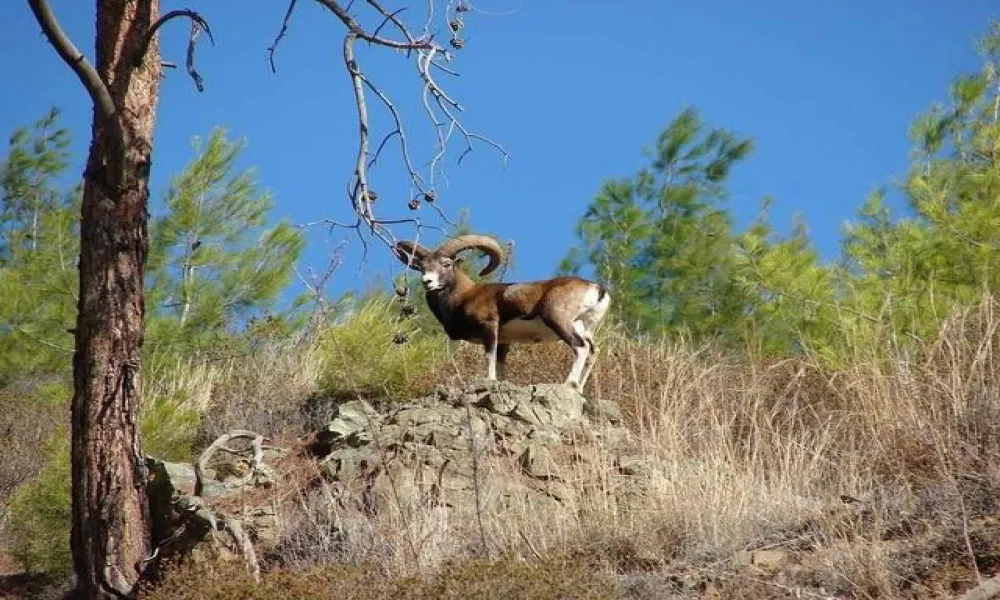

Cyprus' native mouflons have entered their breeding season, with herds merging into larger groups across the Paphos Forest and northwestern Troodos areas as adult males engage in fierce battles for mating rights.
According to the Game and Fauna Service, male mouflons are currently competing for dominance using their heavy, curved horns, a behaviour that peaks during the autumn breeding season.
A recent camera recording from one of the service's watering points captured an adult male in full winter coat. Visible wear on its horns suggested it had taken part in numerous dominance battles over the years and was preparing for another breeding season competition.
Monitoring in the field
Game and Fauna Service officers are closely monitoring herds and collecting data on population numbers, density, age structure and herd composition.
They are also tracking the presence of goats, sheep and feral dogs, which pose potential disease risks to the species.
Although final figures for 2026 have not yet been confirmed, officials estimate the mouflon population currently stands between 2,700 and 3,000 animals.
Early vegetation boosts conditions
One of the most notable features of this year's season has been the unusually early growth of grass following rainfall during the summer months.
According to senior veterinary officer Nicos Kassinis, the fresh vegetation is providing highly nutritious food after the stressful summer period, when available forage was dry and of lower quality.
The improved grazing conditions are expected to strengthen the animals before winter.
Disease risks remain
Officials continue to monitor threats from packs of feral dogs, which prey on mouflons and have been associated with the transmission of echinococcus disease.
There are also concerns about flocks of goats and sheep crossing from the occupied area of Ampelikou, west of Lefka, through the buffer zone and into government-controlled areas.
Kassinis said concerns remain over the potential spread of diseases such as foot-and-mouth disease.
Watering points still in use
Despite cooler temperatures and recent rainfall, mouflons continue to visit watering points maintained by the Game and Fauna Service.
Camera recordings show the facilities remain heavily used both day and night.
Battles for dominance
Every autumn, hormonal changes and breeding instincts lead adult males to engage in dramatic head-to-head clashes.
Each area is typically dominated by a mature male that secures mating rights.
"If there are two or three large males in the same area, conflicts occur," Kassinis said.
In some cases, the animals' horns become entangled. If discovered quickly, wildlife officers can separate them, as happened near Lefka in 2021. In other cases, the animals may die, including incidents where locked males have fallen from cliffs.
Larger herds during autumn and winter
While summer groups often consist of only two or three animals, breeding season brings much larger gatherings.
Typical herds now contain between seven and 15 mouflons, although groups of 30 to 40 animals have occasionally been recorded during winter.
The largest herds are usually found near forest edges where food is more abundant, while smaller groups are more common deeper inside forests.
Separation after the breeding season
By late February, when females begin giving birth, mature males leave the herds and live alone or in bachelor groups.
Females remain together with their young and related females until the autumn breeding season begins again.
More than 8,000 years in Cyprus
The Cyprus mouflon is the island's largest endemic mammal and one of its national symbols.
The species has lived in Cyprus for more than 8,000 years. Archaeologists believe it was originally brought to the island by prehistoric settlers in a domesticated form before later returning to the wild.
The mouflon was driven close to extinction by poaching during the early 20th century, with numbers falling to only a few dozen animals in the 1930s.
Thanks to strict protection measures introduced by the Game and Fauna Service, the population has since recovered significantly.