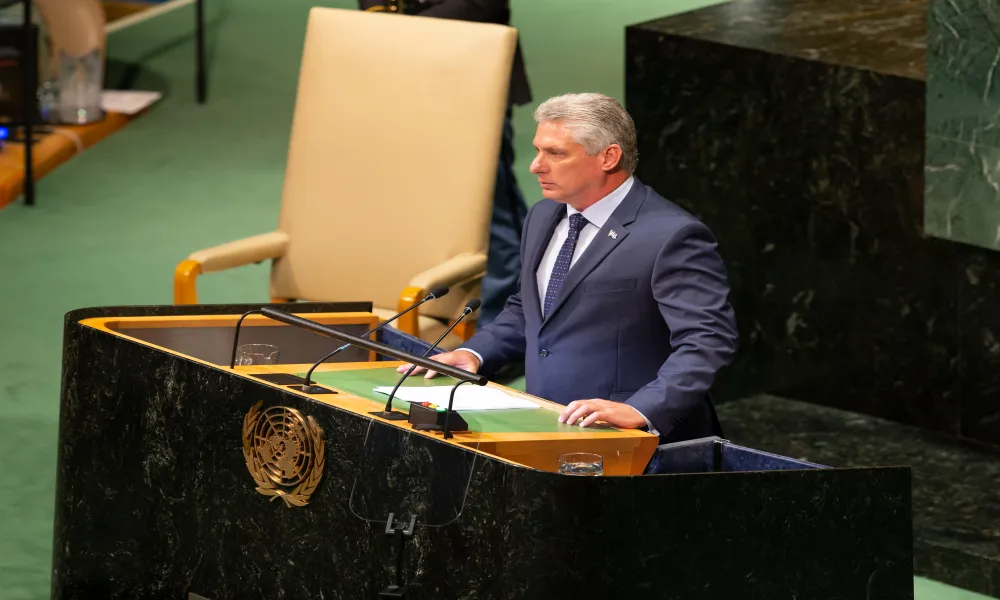

The UN General Assembly has once again adopted a resolution calling for an end to the United States' economic embargo against Cuba, although this year's vote received the lowest level of support in three decades.
The non-binding resolution, presented by the Cuban delegation, was approved by 130 votes in favour, 17 against and 25 abstentions.
The result represents the smallest number of supporting votes since 1995, despite the measure being submitted annually since 1992.
Havana accused Washington of diplomatic pressure
For weeks before the vote, the Cuban government accused the United States of conducting a diplomatic campaign aimed at persuading countries to withdraw support for the resolution.
The text calls for the lifting of the US economic, commercial and financial embargo imposed on the communist-run island.
This year's resolution also included references to the impact of what Cuba describes as an oil blockade that has affected the Caribbean nation over the past nine months.
In previous decades, the resolution attracted near-unanimous backing at the UN. In both 2004 and 2005, more than 182 member states voted in favour. The United States and Israel have traditionally opposed the measure.
Cuban leaders condemn embargo
Cuban President Miguel Díaz-Canel welcomed the outcome, arguing that the international community had once again rejected the embargo despite pressure from Washington.
"The world once again voted overwhelmingly against the blockade, despite the pressure and coercion exercised in the most brazen way by the United States to change the course of this vote," he said in a post on X.
Speaking at UN headquarters, Cuban Foreign Minister Bruno Rodríguez accused Washington of attempting to determine Cuba's future and control its resources.
"The blockade kills and punishes our population silently more than ever before," he told delegates.
US rejects blockade claims
Ahead of the vote, US Ambassador to the United Nations Mike Waltz rejected allegations that Cuba is subject to a blockade.
He argued that shortages experienced by the Cuban population are the result of what he described as a corrupt communist system.
Waltz said the United States sold $875 million worth of goods, including fuel, to private-sector businesses in Cuba between January and August.
He added that the Cuban government was opposed to the growth of the island's private sector.
The debate between Washington and Havana became increasingly heated during discussions at the United Nations, with both sides exchanging sharp criticism over Cuba's political and economic situation.
Long-running dispute
According to Cuban government estimates, the US embargo, which has been in place since 1962, caused economic losses of approximately $8 billion between March 2025 and February 2026 alone.
The figure, Havana says, does not include the impact of more recent restrictions, sanctions and oil-related measures introduced by Washington.
Despite the decline in support this year, the vote demonstrated that a substantial majority of UN member states continue to back calls for an end to the decades-long embargo.
Source: ANA-MPA