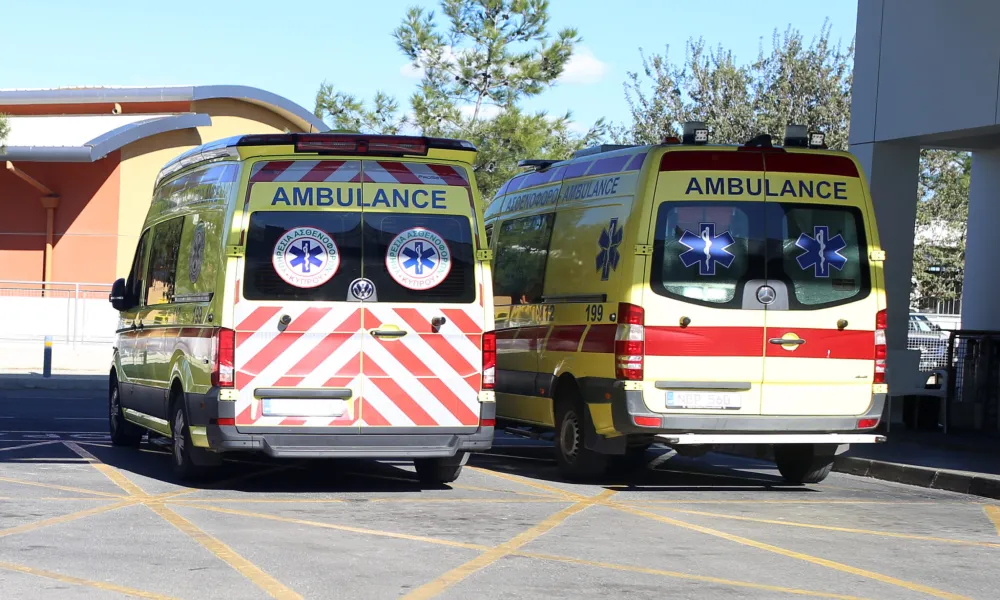

Ambulance services in Cyprus are set for a significant overhaul under a new framework that will introduce two types of ambulances with distinct roles and colours: yellow ambulances for emergency responses and white ambulances for scheduled patient transport.
Behind the visual distinction lies a broader operational reform. Ambulance crews responsible for saving lives in emergencies will be freed from routine transport duties that currently consume resources and personnel.
The changes were outlined by Riana Constantinou, head of the Ambulance Service, who described the reforms linked to the creation of the National Ambulance Agency.
According to Constantinou, the initiative is not merely an administrative change but a reform that will directly affect the public and improve the service's ability to focus on emergency response, specialised incidents and crisis management.
Which ambulance should you call?
For emergencies, the number remains 112.
Emergency calls will continue to be handled by the yellow ambulances of the National Ambulance Agency, and these services will remain free of charge, Constantinou said.
The white ambulances, which will not form part of the agency itself, will be used for scheduled patient transport.
Examples include:
- Transporting bedridden patients to hospital appointments.
- Assisting individuals with mobility difficulties who need to attend scheduled medical visits.
The colour distinction is intended to help the public immediately recognise whether an ambulance is designated for emergency response.
More importantly, however, the objective is operational.
Under the new system, ambulance crews assigned to emergencies will no longer spend valuable time carrying out routine patient transport.
More than 128,000 responses in 18 months
Constantinou explained that the current service is responsible for both emergency incidents and scheduled transportation.
The heavy volume of planned patient transfers has placed additional pressure on the system and has also affected patients waiting to be transported to appointments.
She acknowledged that the service is not always able to provide those transports on time.
The scale of the workload is reflected in the figures.
Over an 18-month period, ambulance crews responded to 128,178 incidents, with a median response time of 10.3 minutes.
The figure relates to cases where ambulances were dispatched rather than simply telephone calls received by the service.
Constantinou stressed that the median response time does not mean every ambulance arrives within ten minutes, as some incidents naturally require longer response times.
National Poison Centre planned
Regarding implementation of the legislation approved by the House of Representatives several months ago, Constantinou said preparations are progressing in cooperation with the Ministry of Health and the State Health Services Organisation (OKYPY).
She expressed the expectation that full readiness will be achieved between late November and the beginning of the new year.
At the same time, a National Poison Centre is planned under the National Ambulance Agency.
The centre will provide:
- Round-the-clock advice.
- Coordination of assistance in poisoning incidents.
- Support for overdose cases.
- Guidance in incidents involving exposure to chemical substances.
The planned reforms aim to create a more specialised and efficient emergency medical system while ensuring that routine patient transport is handled separately from life-saving operations.