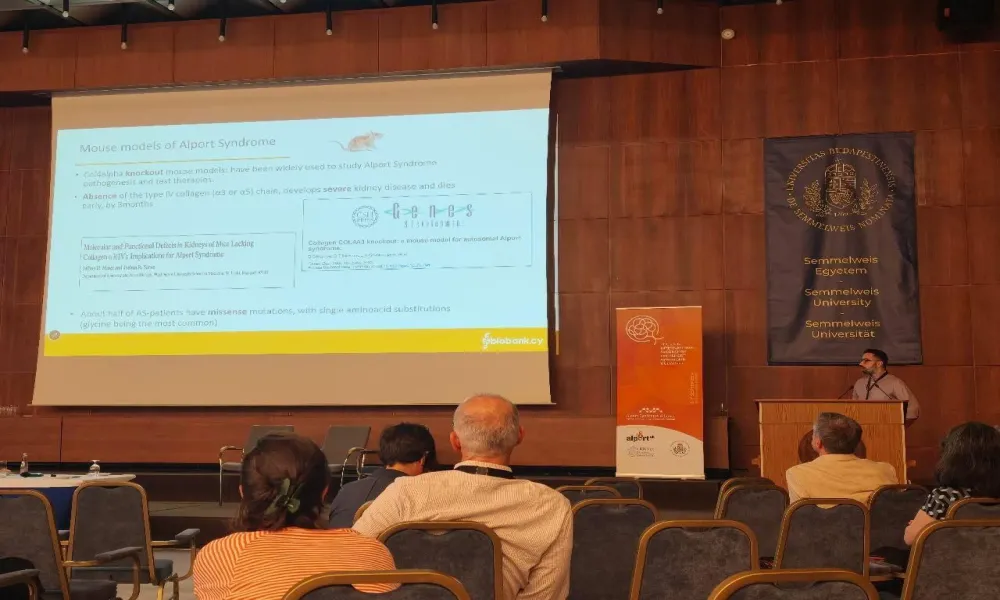

The European research project ALP-RARE, coordinated by the biobank.cy Centre of Excellence at the University of Cyprus, has been officially launched with the aim of developing new treatments for Alport spectrum disorders, a group of rare inherited kidney diseases that occur more frequently in the Cypriot population. The project was presented on 8 September at the International Workshop on Alport Syndrome 2026 in Budapest.
What are Alport spectrum disorders
The disorders are linked to pathogenic variants in the COL4A3, COL4A4 and COL4A5 genes, which encode type IV collagen, a key structural component of the kidney's filtering membrane. They most often lead to blood and protein in the urine and, potentially, end-stage kidney disease.
Current treatments can slow the progression of the disease but do not address its underlying genetic cause.
A three-year preclinical programme
ALP-RARE will study three therapeutic pathways, alone and in combination with existing non-specific treatments, using animal models that carry genetic defects similar to those found in patients.
Dr Gregoris Papagregoriou, Senior Scientist at biobank.cy and coordinator of the consortium, said: "We are not starting from scratch. We are evaluating and, above all, combining existing therapeutic approaches with newer small-molecule interventions, some of which have already been studied and published by members of the consortium."
"The ultimate aim is to create drug profiles that can move very quickly into human clinical trials, and that can substantially slow the progression of the disease and preserve kidney function for longer," he added.
Preclinical studies in Cyprus
biobank.cy will carry out most of the preclinical studies, in mice carrying a COL4A3 variant found exclusively in the Cypriot population, previously identified by the centre under Prof. Constantinos Deltas. The studies are coordinated by Dr Christoforos Odiatis.
A role for patients
Active patient participation is a core element of the project, extending to setting research priorities. Through ALP-RARE, patients will, for the first time, be able to help establish measures for assessing their own condition and wellbeing during a clinical study.
Christof Finkler of the German patient association Alport Selbsthilfe e.V., an official project partner, said: "The ALP-RARE programme aims to develop and establish new treatments that delay damage and preserve kidney function. As patients, we understand and support this goal."
The European consortium
The consortium includes the Karolinska Institutet and RenCo Pharma AB in Sweden, Ludwig Maximilian University of Munich and University Medical Center Göttingen in Germany, Erasmus Medical University Rotterdam in the Netherlands, Meyer Children's Hospital Firenze in Italy and the German patient organisation. It is also supported by University College London and the European Kidney Patients' Federation.
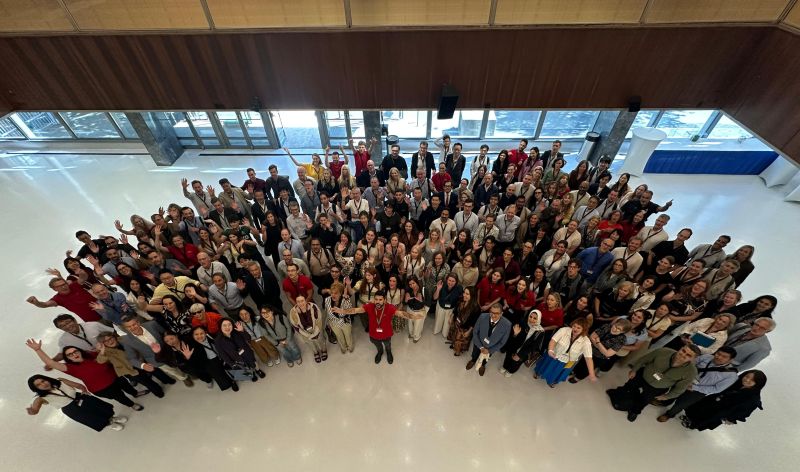
Prof. Daniel Gale of University College London said: "Through collaboration at consortium level, we hope to gather the evidence needed to move the most promising new approaches towards clinical trials and, ultimately, towards better treatments for patients."
Funding
The project was selected for funding under a competitive call of the European Rare Diseases Research Alliance (ERDERA), with national support in Cyprus from the Research and Innovation Foundation (RIF).