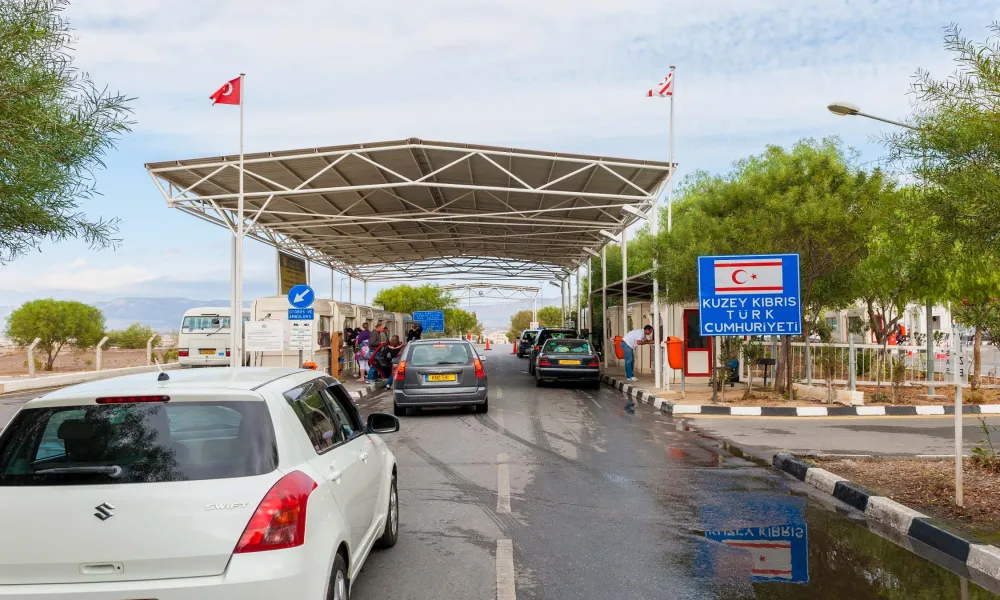



The House Finance Committee has unanimously turned down, for the second consecutive meeting, a request to release €146,000 to upgrade the traffic camera system and its "Photo Radar List", which would enable out-of-court fines to be delivered at the checkpoints. MPs raised questions about the system's operation, the legal basis of the procedure, the interconnection of records and the large number of undelivered fines.
What the request covers
The request concerns amendments that would allow two-way connectivity between the traffic camera system and Police systems, as well as the management of the serving and monitoring of fines.
Position of the Electrical and Mechanical Services
Achilleas Pilias, representing the Department of Electrical and Mechanical Services, said the existing contractor had been required to modify its system and connect it to Police systems. He said the connection had been completed and the procedure could now be implemented, adding that the funds had not yet been released by Parliament when the relevant instructions were given.
Mr Pilias said there had been an opinion from the Law Office stating that the service of fines could proceed. He noted, however, that further integration of the systems was required, and clarified that the system had operated in a test environment without being placed into full production.
Personal data and legal basis
AKEL MP Aristos Damianou asked whether the interconnection of records had been approved by the Commissioner for Personal Data Protection. Mr Pilias replied that it had been approved from the start of the contract in 2022.
Mr Damianou argued that the original contract had not provided for serving fines at crossing points and that releasing the funds was, as he put it, an attempt to legalise a practice he considers illegal.
"Fines cannot be served at crossing points to Greek Cypriots," he said, adding that the procedure concerns pedestrians passing through the checkpoints. He expressed the view that the practice creates political issues and turns the crossing points into a "hard border".
The Police said identity checks at the crossing points are legal and that the fine is served on the citizen, who then has 90 days to pay it.
Questions over cost and access to data
AKEL MP Andreas Pasiourtidis argued that the proposed change essentially aims to reduce costs for the companyoperating the system, and referred to the large number of undelivered fines. Regarding Turkish Cypriot vehicles, he questioned why the company needs access to specific information and use of the traffic camera system's list.
The company explained that the vehicle registration number must be transmitted to the Police so that the vehicle can be identified and stopped at the crossing point, completing the process of serving and monitoring the fine. It said the original contract had not provided for two-way information exchange between the two systems, and that part of the proposed change concerns precisely this capability.
Positions of other parties
ELAM MP Marios Pelekanos argued that the traffic camera system operates more as a mechanism for collecting finesthan as a measure to prevent road accidents, and said his party would not support releasing the funds.
ALMA President Odysseas Michaelides said this was not simply an amendment to the existing contract and that the matter should have been referred to a different, appropriate procedure. He said the competent authorities "are coming here to legalise an illegal act", a position challenged by the services, which cited the Law Office opinion.
Direct Democracy MP Giannis Laouris raised the issue of cost, describing the amount as excessive in relation to the scale of the work, and asked the company for a detailed justification of the changes it would develop.
Police and contractor explanations
The Police said that at the crossing points the fine is issued through their own system and that, based on the Law Office opinion, the procedure can be carried out through the connection with the traffic camera system. For vehicles registered with the Road Transport Department, the procedure can be completed using the available information, while for Turkish Cypriot vehicles the information must be collected as they pass through the crossing points.
The company clarified that the proposed change concerns not just one piece of software but the entire system for processing violations, including the camera systems, citizens' access to information and operational procedures. It said additional training would also be required for call centre staff.
The committee's decision
After the meeting, the committee's acting chair, DIKO MP Chryssis Pantelides, said the committee had unanimously rejected, for a second consecutive meeting, the executive's request to release €146,000 to improve the system for serving notices at the crossing points.
He explained that the committee had not been convinced of the need for the allocation, since the two meetings had shown that a large part of the proposed actions was already being implemented. The main reason for the rejection, he said, was the gaps and weaknesses identified in the traffic camera system, for which the committee had not yet received convincing answers.
Mr Pantelides focused in particular on the undelivered notices, describing their number as "impressively large" and "unusually large based on Cypriot data".
"Until we are convinced that the executive understands this problem or brings a legislative solution to it, we are reluctant to keep releasing funds that are merely an aspirin for a major problem," he said.
Undelivered fines
DISY MP Fotini Tsiridou said there were approximately 180,000 undelivered fines to date and expressed concern about releasing a new allocation to improve the system. She said the ministry should submit an amending bill modernising the way fines are served.
She added that it was not so simple to release funds paid by citizens when the system was not working, noting that answers were expected from the ministry.
Mr Laouris described as "outrageous" the fact that approximately 185,000 fines remained pending. He said this number could create the impression that roughly one in three Cypriots breaks traffic laws, while the state does not have the addresses of such a large number of citizens because it has failed to serve them the fines.
Further reactions
Mr Damianou said the executive, the Police and the competent ministries had not provided convincing answers about how fines were served, arguing that they were "mocking and misleading Parliament".
He said that over three years of parliamentary questions and pressure, different answers had been recorded, while an attempt was being made, as he argued, to bypass the lawful procedure for serving fines by stopping citizens at crossing points. He spoke of a possible breach of personal data and humiliating treatment of citizens, arguing that the practice applies not only to vehicles of Turkish Cypriot origin but also to Greek Cypriots.
"Under no circumstances will we release even €1 for procedures that are outside the letter of the law," he said, adding that when citizens are lawfully informed that a fine exists, they must either comply or seek recourse through the courts.
Mr Pelekanos said the competent bodies had again failed to provide convincing answers, noting that the committee had voted unanimously against releasing the funds. He said the large number of undelivered fines showed the procedure was not working properly and needed to be regulated with a more specific method of service.
He also raised a political dimension, saying that while serving fines at ports and airports had been excluded, it was now being applied at crossing points and, as he said, concerned Greek Cypriots as well. He also raised questions about vehicles entering the government-controlled areas from the north, referring to their quality, suitability and specifications.
Source: CNA