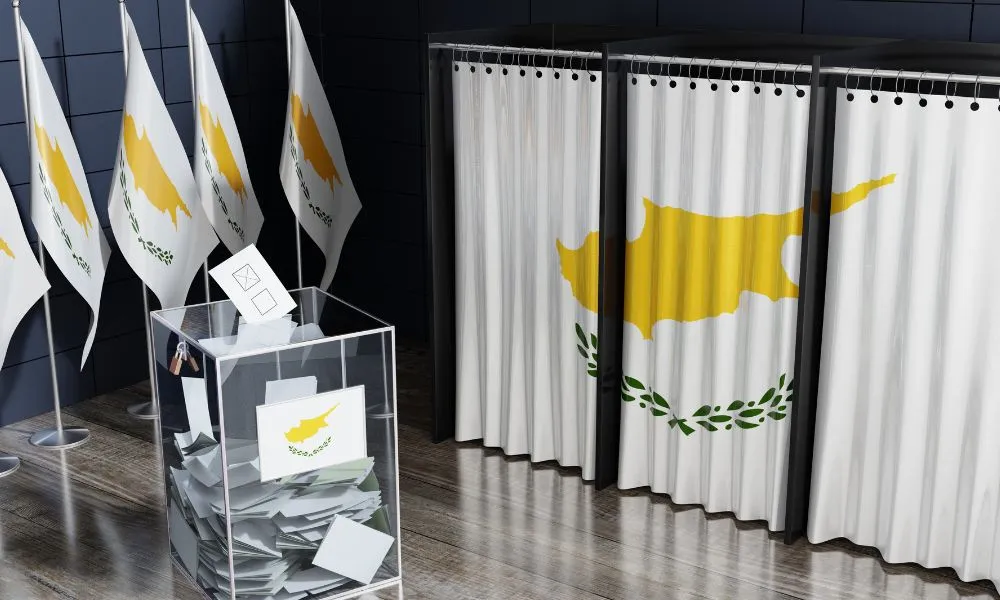
The pre-election climate of recent weeks, reinforced by opinion polls, public noise and a sense of political fatigue, created the impression of an electoral contest that would dismantle traditional balances. There were forecasts for a sweeping rise of ELAM, for a striking entry of new formations, for further weakening of the traditional two-party system and for collapse of the centre ground. None of these were confirmed.
The result shows that Cypriot society is dissatisfied, but remains far more cautious in its final electoral choice than appeared in public debate.
1. Bipartisanship held and strengthened
Bipartisanship not only held, but strengthened. This is perhaps the first and most important conclusion. For years, political discussion in Cyprus has revolved around the weakening of the traditional party model. This time, however, the ballot box said something different.
DISY records 27.1% and AKEL 23.9%. Together, the two major parties gather around 51%, a percentage increased compared to 2021.
This is particularly significant because, while society seems tired of the political personnel, when it came time to vote many returned to familiar choices. DISY not only avoided the image of a sharp decline suggested by some polls, but confirmed that it remains the dominant political force. AKEL, for its part, not only did not suffer losses, but emerged strengthened.
The message is clear: the core of the party system remains resilient. In practice, this has further implications. The two main parties will have the first say in the election of the Speaker of the House and in the selection of a presidential candidate for 2028.
2. ELAM rose but reached its peak
ELAM increased its share, but reached its peak. The 10.9% marks clear reinforcement and establishes the party as a significant parliamentary force. However, compared with recent polls, it is evident that the party did not confirm the more ambitious projections that placed it even close to 15%.
One explanation is that ELAM no longer functions as a purely anti-system formation. When a party remains for years on the political scene, it acquires institutional weight and gradually loses part of its anti-system appeal. There is also a second reading. ELAM functioned largely as a reservoir for dissatisfied right-wing voters. That is, more as a space of right-wing protest than as a vehicle of overall political upheaval. This offers stability, but also sets limits. When a party shifts from pure protest to an “alternative wing” of the right, it struggles to break its ceiling.
3. DIKO survives and remains a player
DIKO survives and remains a player. The party ended at around 10%, avoiding a collapse that many had considered possible. This is politically crucial. DIKO retains parliamentary weight, numerical significance and political usefulness.
In a fragmented landscape, a party of this strength continues to act as a regulator. The fact that it survived the climate of doubt shows that the centre ground has not completely disappeared. It has been rearranged, but not dismantled.
4. It was not a revolution
The entry of ALMA and Direct Democracy was not a revolution. Before the elections, most discussion concerned new formations. ALMA, led by Odysseas Michaelides, entered the race with strong momentum, intense visibility and expectations that in some analyses reached double digits. The final result of 5.8% is undoubtedly a political success for a new party. However, it does not constitute an electoral earthquake. The same applies to Direct Democracy.
Their entry into parliament shows there is space for new voices. However, the fact that neither managed to significantly disrupt the political map says something equally important: voters were not convinced that these are fully developed alternatives of power. Their protest translated into presence, not into overturning. This also raises an additional question. Is this presence stable or temporary?
5. Political graveyard
If there is a real loser in this election, it is the traditional centre. EDEK, DIPA and the Greens remain outside parliament.
This is a historic development. EDEK, a party with deep political and historical roots, fails to secure parliamentary representation. DIPA, established as an attempt at a new centrist synthesis, does not survive electorally. The Greens lose their institutional presence entirely.
This means that the centre ground as it was known is in an existential crisis. It is not simply a defeat. It may amount to a questioning of its very political usefulness.
VOLT and failure
VOLT was perhaps the most characteristic case of a gap between public image and the ballot box. There was a sense that it could function as a liberal, reformist force with appeal mainly among younger audiences. Its failure to enter parliament shows that visibility does not automatically convert into votes. It is one thing to have communication presence and another to have organised electoral reach.
The new House
Based on the results, we are facing a six-party parliament with a clear rightward weight. This in itself changes the functioning of the House.
DISY (17), DIKO (8) and ELAM (8) add up to 33 seats. In theory, this creates a clear right-leaning parliamentary majority. Of course, politics is not simple arithmetic. DIKO is not identical with DISY. ELAM is not a given governing partner. Political distances remain. However, as a parliamentary fact, the right has clearly strengthened institutional weight.
The government
For the government, the result has a double reading. On the one hand, no anti-government wave emerged of such scale as to destabilise the system.
On the other hand, the new House is far more difficult. The presence of more players, pressure from a strengthened right, the parliamentary presence of new formations and broader social distrust make management more complex. The government will need persuasion, cooperation and political flexibility. Easy majorities are not guaranteed.
The final conclusion
Citizens voted with anger, but not with a desire for complete demolition. They punished political formations, reshaped balances and sent warnings. But at the same time, they allowed the core political system to regroup.
The message is more complex than it first appears: Cyprus wants change, but has not yet decided who can truly represent it.