
By Michalis Stavrou and Valia Kaimaki
Former Greek prime minister Alexis Tsipras, long‑time leader of the Left, launched a new political party on Tuesday in a bid to unite the country’s fragmented opposition, amid widespread disillusionment with the political establishment and corruption.
Tsipras, who lost power in 2019, gained international prominence as leader of the radical left‑wing SYRIZA party, which confronted Brussels and Berlin in high‑stakes negotiations at the height of the eurozone debt crisis. Since then, Greece’s political landscape has been dominated by the conservative New Democracy party of Prime Minister Kyriakos Mitsotakis.
With a comfortable lead in the polls, Mitsotakis is expected to call elections before the summer of 2027. Tsipras is now positioning himself as a potential challenger.
His attempt to return to the political frontline comes at a time when opinion polls reveal deep public dissatisfaction with the state of the country. That discontent has been fuelled by a series of major scandals: the government’s failed response to Greece’s deadliest rail disaster in Tempi, spyware found on the phones of dozens of politicians and journalists, and a massive fraud involving EU agricultural funds – the so‑called OPEKEPE scandal.
Yet public anger over mismanagement has not translated into stronger support for the opposition. According to Politico’s ‘Poll of Polls’, New Democracy, on 30 per cent, enjoys double the support of its nearest rival. Much of the remaining political space is occupied by a patchwork of small parties.
“New Democracy has remained in first place for a long time, but its polling numbers are actually at historically low levels. At the same time, there are no obvious forces capable of challenging its dominance,” said Angelos Seriatatos, head of political and social research at polling firm Prorata.
Seriatatos added that the likelihood of New Democracy forming a majority government in either the first or second round of elections is steadily diminishing.
Petros Ioannidis, CEO of research group About People, told Politico: “Tsipras’s first priority will be to rally the left‑wing base, which splintered into various factions after his departure, and then attempt to appeal to a broader audience.”
Several MPs from SYRIZA and from the New Left party that split from it have already resigned, or are expected to do so shortly, in order to join Tsipras.
Alexis Tsipras: The return and wager of a second term
Whatever the newspapers write, whatever the political class comments, the citizens showed up at Thiseio last Wednesday. The rally was large and energetic. And if nothing else, Alexis Tsipras knows how to draw a crowd, how to captivate it and, above all, how to send it to the ballot box.
In an era of abstention, fatigue and distrust in Greece, this ability is not a detail – it is rare political capital. That is the first given of his return.
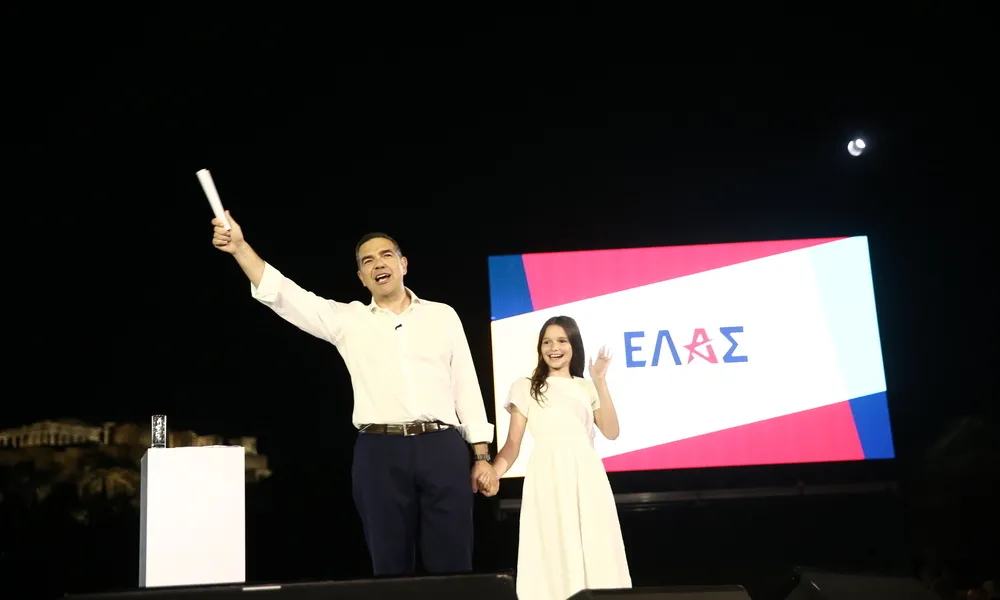
Before the analyses, before the sarcasm, before objections over the party’s name, before the first opinion polls, there was the image. A former prime minister, with the Acropolis as a backdrop, on an evening that – at least on television – looked almost magical, announced the founding of the Hellenic Left Coalition and declared his return to central politics. Not as a commentator on the past, but as a claimant to the future.
The choice of venue, the staging, the music, the behind‑the‑scenes footage, the social‑media video, the embraces, the applause, the chants of “let’s go, president” – all suggested that this was not organised as a routine party announcement. It was a political event, but not an empty one.
It was an attempt to give a fragmented political space something it has lacked for a long time: a centre, a face and a narrative.
Tsipras did not appear only before those gathered. He appeared before a country that has grown accustomed to consuming politics as image, fragment, comment, meme and poll – yet still seeks figures capable of condensing collective expectation.
A viral name
The name of the new party did exactly what it was intended to do: it was discussed. ELAS is a loaded, provocative name, almost dangerous in its symbolism. It evokes the historic ELAS resistance movement, stirs emotion or anger within parts of the Left, echoes ‘Hellas’, opens space for patriotic readings and, at the same time, offers ample material for satire.
It is a party name, a brand, a slogan – and a trap for opponents. Those who mock it reproduce it. Those who denounce it promote it. Those who explain it legitimise it as a political fact.
That does not mean it will be politically successful. Communication shock is one thing; political longevity is another. The name functioned as an entry point into public debate – and in politics, that is not insignificant.
The next step is to demonstrate that behind the symbolism lies a clear political proposal.
Who exactly is Tsipras in 2026? Is he the man seeking to rebuild the Left after the collapse of SYRIZA? Is he the former prime minister who believes he can return to the Maximos Mansion? Is he the leader of a new progressive alliance – or simply the most capable manager of the vacuum left by an ineffective opposition?
It would help to know the destination. Is it the Koumoundourou of the late 2000s, when Tsipras’s rise began – or the Maximos Mansion of 2015? In other words, is the goal the reconstruction of the Left or the seizure of power?
The two are not mutually exclusive, of course. But they are not the same political project. Reconstruction requires ideological clarity, organisational patience and explanations of the past. Power requires majority appeal, alliances, programme, credibility – and, above all, an answer to why this time will be different.
Back in the game
Early opinion polls suggest Tsipras has re‑entered the political game with force. Surveys by Interview and RealPolls place his party in second position, at 12.8 per cent and 14.1 per cent respectively, while PASOK slips to third or even fourth place.
New Democracy remains first, with improved figures around 26–27.5 per cent – but that is not the story. The story is that, within hours, the opposition space ceased to be static.
Tsipras’s immediate objective is not necessarily to defeat Mitsotakis tomorrow. It is to reconstruct the pole that could challenge him the day after tomorrow: to overtake PASOK, absorb SYRIZA’s diffuse disappointment, pressure the New Left and present himself as the only viable vehicle for a progressive alternative.
From that perspective, his return is already successful – not because it has created a majority movement, but because it has shifted the centre of gravity.
New Democracy spoke of a dive into the past. PASOK saw a lack of political substance and an attempt to go viral. The New Left spoke of an ineffective appeal to multiple audiences. The Communist Party accused him of exploiting history. Zoe Konstantopoulou revived the 2015 referendum. SYRIZA tried to remain calm – but internally everyone understands that ELAS is not an external event. It is an existential threat.
Perhaps that is the most interesting point. ELAS had enemies before it had organisations: the enemies of its creator.
For the Right, Tsipras is the ghost of 2015 – the man of uncertainty, capital controls and confrontation with Europe. For PASOK, he is the politician threatening once again to take its space, its voters, its history and its future. For the Left, he is the former comrade who became prime minister and now returns asking for trust. For former allies, he is both opportunity and danger.
The problem
Tsipras does not return to a country without memory. 2015 is not a detail that can be erased behind a new logo. It is his greatest asset, his greatest burden and his most vulnerable point.
Without 2015, he would not have a political myth. With 2015, he also carries a political trauma.
The difference now is that he returns having experienced defeat, withdrawal and ‘Ithaca’. That experience, if politically utilised, could be an advantage rather than just a burden.
Tsipras now seeks to integrate that period of governance into a broader historical chain – from EAM and EDA to PASOK of Change and SYRIZA of ascent. But historical chains are not enough.
‘Ithaca’ may have functioned as a reckoning and an attempt at self‑criticism. But a return to politics demands more than processing the past. It demands a convincing answer about the future.
And here lies the real question. Greece in 2026 is not Greece in 2015. It is not on the brink of bankruptcy. It is not living under the same emergency conditions. It is not waiting for someone to tear up memoranda.
But it is experiencing a different fatigue. Incomes are under pressure, rents have soared, inflation is a daily reality, and the government is burdened by scandals, surveillance, Tempi, OPEKEPE and the wear of power.
The country is not collapsing – but a large part of society does not feel included in the supposed normality.
That is where Tsipras can gain ground: not in bankruptcy, but in discomfort; not in revolt, but in the sense that the political system has once again closed ranks without citizens.
The seven commitments he presented – dignified living, strong democracy, transparency, fair growth, welfare state, resilient Greece, digital democracy and strong international presence – are not rhetorical fireworks. They form a familiar but necessary progressive vocabulary in a society once again seeking security, justice, income, rights and institutional dignity.
The question is not whether they sound right. The question is whether they can be translated into a concrete programme, with conflicts, priorities, costs and credibility.
Because Tsipras 2 cannot simply be better lit than Tsipras 1. He must show what he learned, what he left behind – and what he will not repeat.
Maria Karystianou: A hope that divides
The founding of Tsipras’s party marked the creation of the second new party in less than a week.
Maria Karystianou, mother of one of the victims of the 2023 Tempi rail disaster, presented her new party, ‘Hope for Democracy’, last Thursday. Its programme is based on strong anti‑establishment rhetoric.
Party sources say members and cadres are joining from across the political spectrum, citing encouraging recent polls that present the new party as a force to be reckoned with.
“The Greek society is ready for a new beginning,” Karystianou said yesterday, stressing: “We have nothing to do with protest parties that merely channel public anger.”
However, she has alienated many with statements bordering on right‑wing populism on issues such as abortion rights and relations with Turkey.
“Her positions strongly resemble Italy’s Five Star Movement, but with a much stronger patriotic and nationalist tone and emphasis on corruption,” said Seriatatos. “Although she began with moral capital, she is now on a downward trajectory.”
Critics have also accused her of surrounding herself with figures holding pro‑Russian views or ties to Moscow.
Antonis Samaras: The old Right
Another potential new party may emerge from the right of the political spectrum, led by former prime minister and New Democracy leader Antonis Samaras.
Expelled from the party in 2024 after harsh criticism of government policies – including relations with Turkey and what he considers ‘woke’ approaches such as recognising same‑sex marriage – the 75‑year‑old retains limited electoral appeal. However, his party could create problems for Mitsotakis, who may struggle to secure enough votes to form a government.
If Samaras proceeds, he will clearly aim to siphon conservative voters from New Democracy – an audience he knows how to address. He seeks to present himself as the authentic voice of voters who believe the governing party has drifted from its traditional values.
“The new parties appear to cover the entire political spectrum, from left to right and beyond traditional axes, and will certainly reshape the political landscape,” said Giorgos Arapoglou, director of polling firm Pulse RC.